How mantis shrimp see
Mantis-shrimp compound eyes are mobile mosaics with specialized retinal regions. Numerous receptor channels sample visible, ultraviolet, and polarized light, but receptor count alone does not mean finer color discrimination than humans have.
Last updated
Divide one compound eye into regions
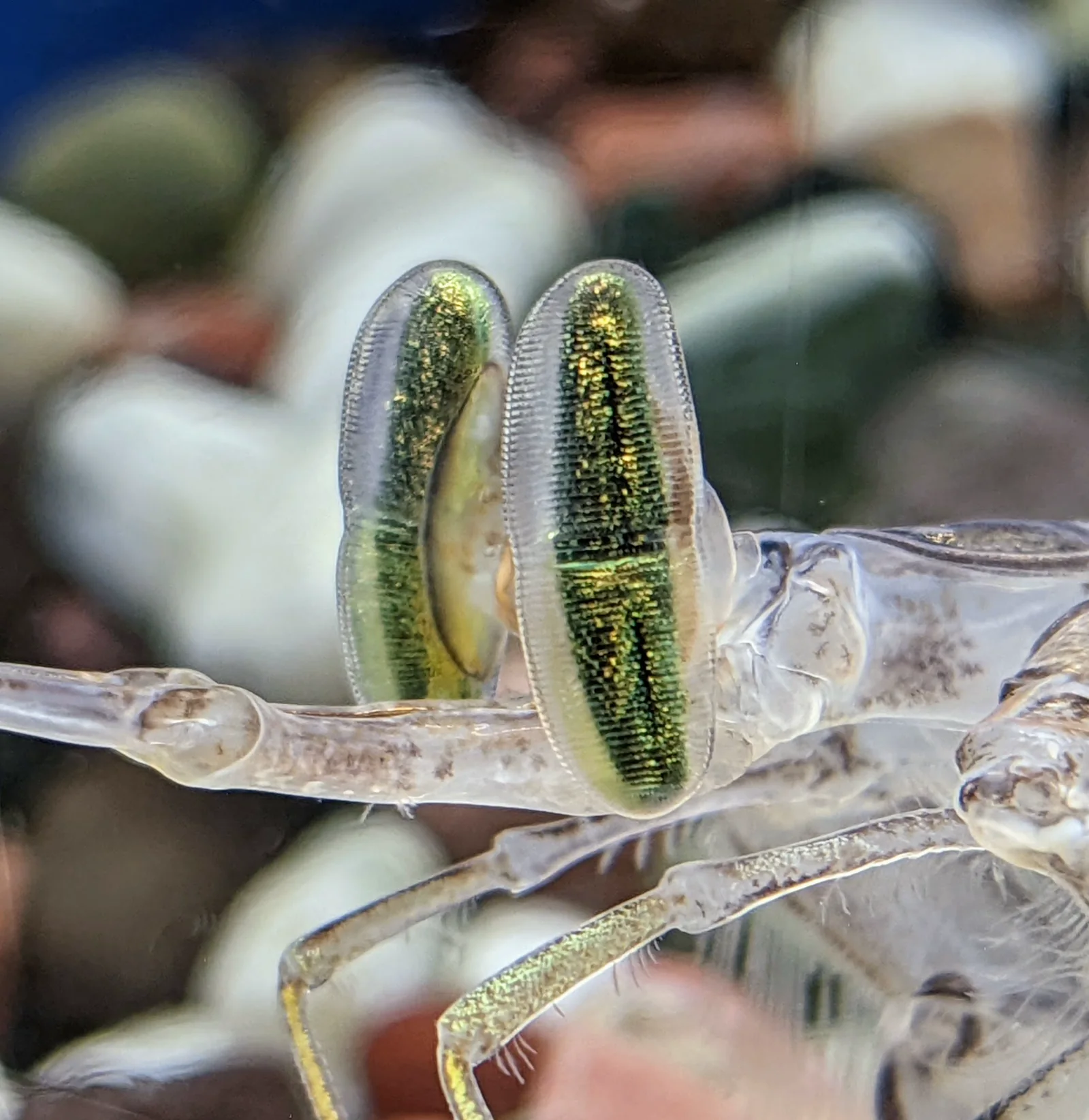
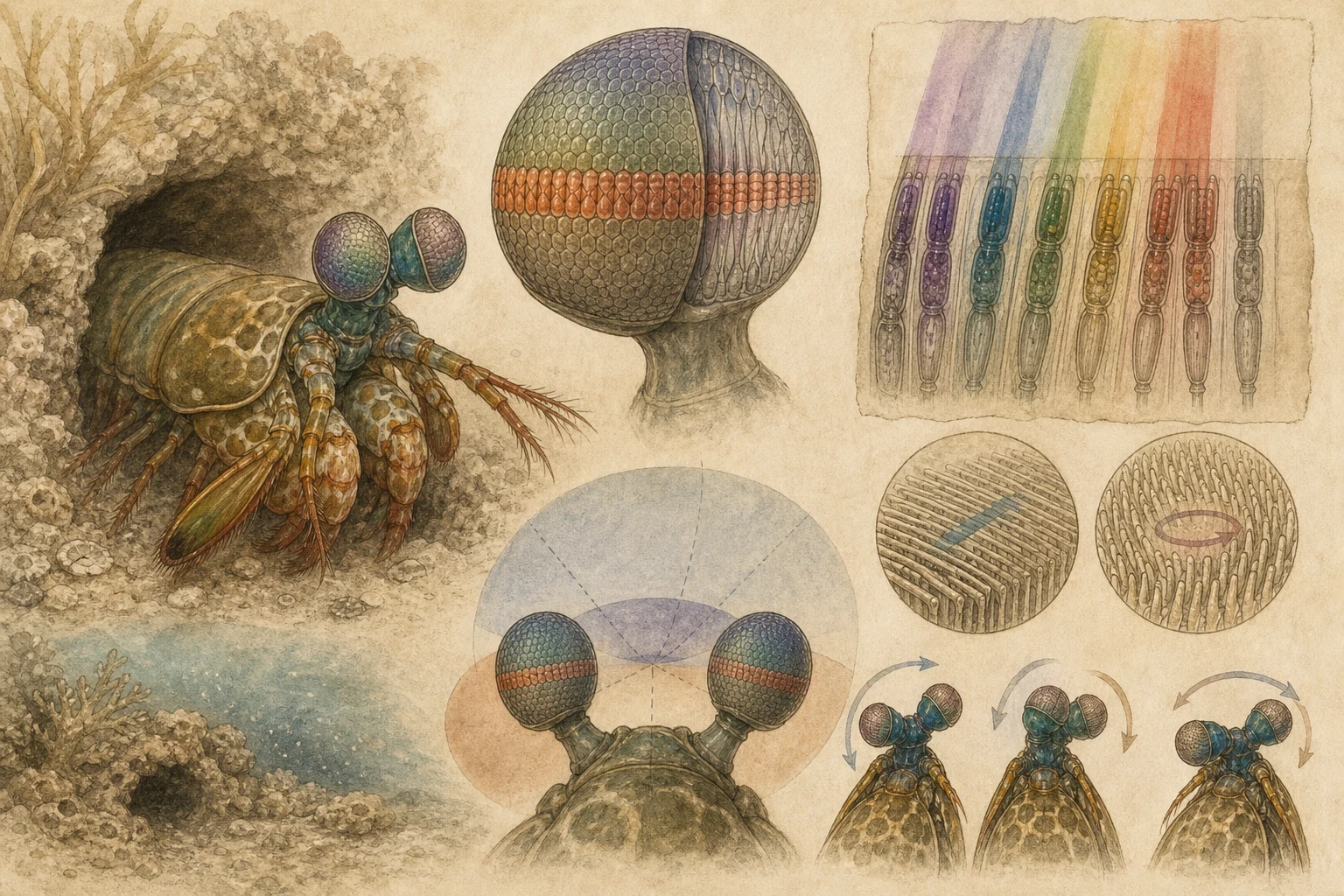
Peer at a peacock mantis shrimp (Odontodactylus scyllarus) at the entrance of its coral-rubble burrow and you will see two stalked compound eyes, each split horizontally by a dark stripe called the midband. Unlike a fly's uniform compound eye, a stomatopod eye aims three zones—the dorsal hemisphere, the ventral hemisphere, and the two-to-six-row equatorial midband—at the same narrow horizontal strip of space in front of the animal. That triply overlapping view gives a single eye trinocular range-finding for a raptorial strike, while the two eye stalks pitch, yaw, and twist independently to scan the reef. [1][4]
- Dorsal and ventral hemispheres plus a central midband view the same narrow equatorial strip simultaneously
- Overlapping fields of view within a single compound eye provide monocular range estimation for fast strikes
- Dark pseudopupil spots visible on the cornea show which ommatidia are currently aimed directly at the observer
Tune channels with pigments and filters
In shallow-water gonodactyloid and odontodactyloid mantis shrimps with six-row midbands, rows one through four are dedicated to spectral analysis from deep ultraviolet (~300 nm) to far red (~700 nm). Each midband row is stacked into two tiers of photoreceptor cells, and in rows two and three the incoming light passes through brightly colored, photostable carotenoid or mycosporine-like optical filters placed between the tiers. Those intrarhabdomal plugs act as long-pass spectral filters that sharpen and shift the transmitted wavelengths, creating roughly twelve narrowband spectral channels across the retina without needing twelve completely unrelated visual opsin pigments. [1][2]
- Rows one through four of a six-row midband house tiered photoreceptors tuned across ultraviolet and visible light
- Colored intrarhabdomal filter plugs in rows two and three sharpen spectral sensitivity into narrow wavelength bands
- Species living in deeper, dimmer water often reduce filters or midband rows to preserve light sensitivity
Do not equate channel count with precision
Having twelve spectral channels led to widespread claims that mantis shrimps experience an unimaginable rainbow of fine hue gradations, yet behavioral training experiments with Haptosquilla trispinosa proved the opposite. While humans easily distinguish wavelengths separated by only one to four nanometers by comparing outputs across three broad cones, tested mantis shrimps struggled to tell wavelengths apart when they were closer than about fifteen to twenty-five nanometers. Instead of computationally intensive opponent comparisons, the midband rows appear to work like a diode array—sweeping across an object in slow scanning eye movements to classify colors rapidly into pre-sorted channels. [1][3]
- Behavioral tests show mantis shrimps discriminate closely spaced wavelengths more coarsely than humans do
- Because the midband sees only a thin strip, the eye must scan slowly across objects to sample their spectrum
- Parallel narrowband channels likely enable rapid pattern recognition without heavy neural opponent processing
Rotate receptors into polarized light
Beyond wavelength, rows five and six of the midband and the surrounding hemispheres contain orthogonal microvilli tuned to linear polarization, and in several species quarter-wave retarder structures convert circularly polarized light into linear form for detection. High-speed video tracking shows that when a mantis shrimp fixates on a linearly polarized stimulus, it actively rolls (torsionally rotates) its eye stalk around the viewing axis until its microvillar receptors align for maximum polarization contrast against the background. Polarization vision helps reveal silvery scales, transparent shrimp prey, and polarized structural markings hidden on the paddles and maxillipeds of rival stomatopods. [2][4]
- Specialized microvilli in the hemispheres and midband rows five and six analyze linear and circular polarization
- Torsional eye-stalk rolling aligns internal polarization receptors to maximize contrast against water scatter
- Many mantis shrimps carry polarized cuticular patches used for private courtship and territorial signals
Related guides
Get Fauna and identify it in the field.
Where this guide comes from
Source-checked editorial guide. Last updated . This guide teaches identification and field skills; it is not a substitute for expert verification when it matters.
- Philosophical transactions of the Royal Society of London. Series B, Biological sciences — Colour vision in stomatopod crustaceans ↗
- Philosophical transactions of the Royal Society of London. Series B, Biological sciences — Filtering and polychromatic vision in mantis shrimps: themes in visible and ultraviolet vision ↗
- Science — A Different Form of Color Vision in Mantis Shrimp ↗
- Nature communications — Dynamic polarization vision in mantis shrimps ↗