How squid use jet propulsion
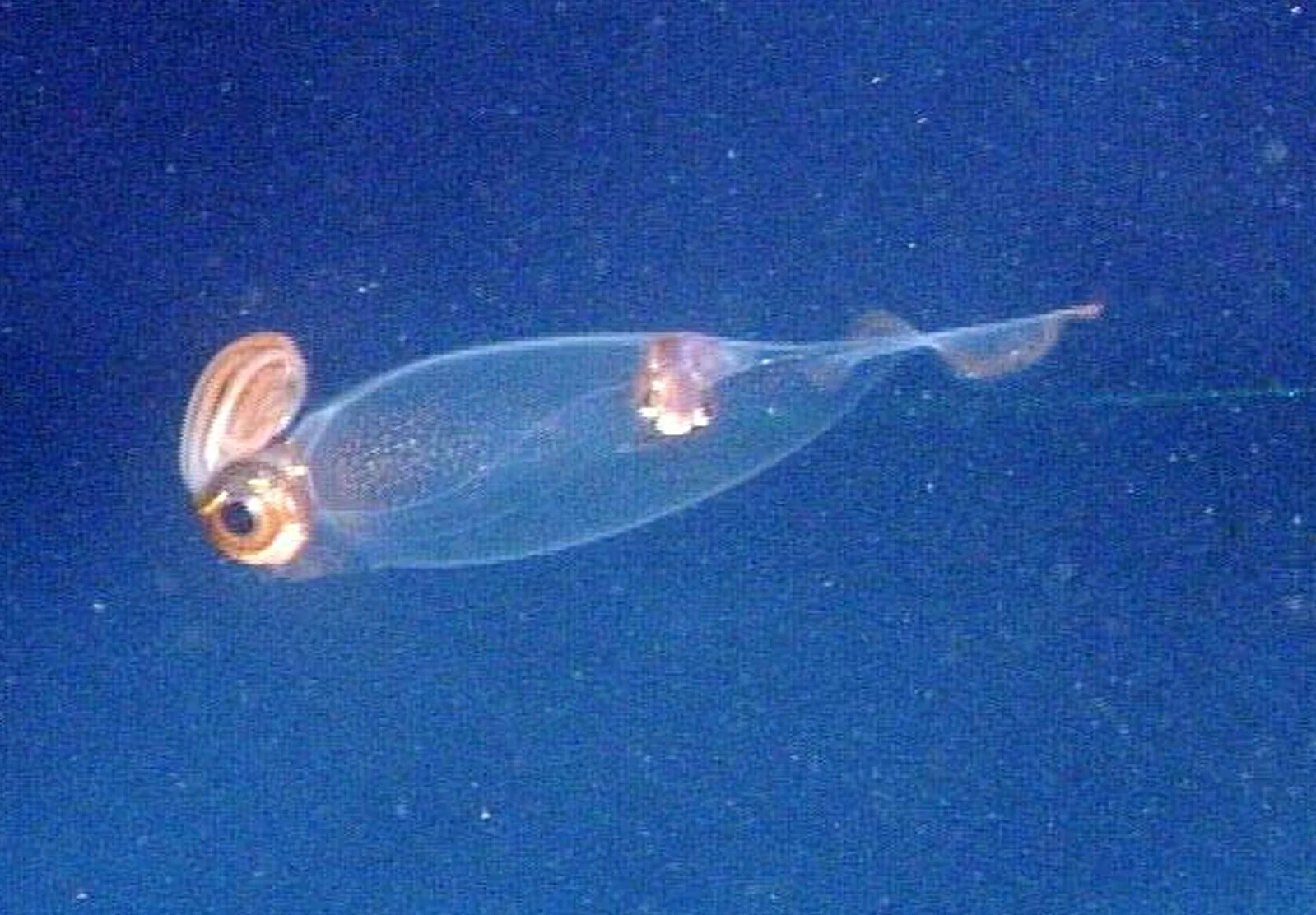
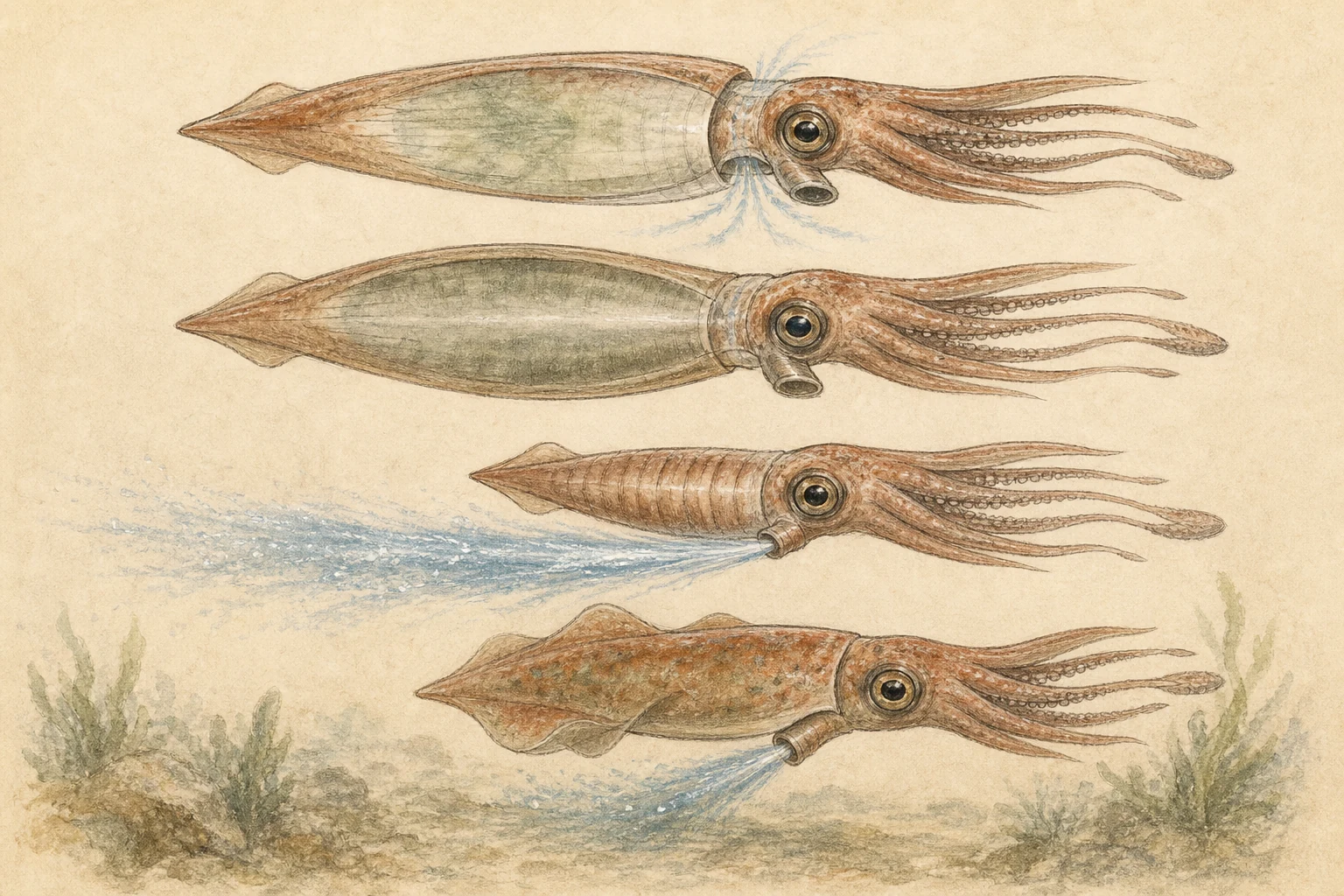
A squid is a pulsed water pump with fins. It draws water around the head into the mantle cavity, closes that route, squeezes the mantle, and ejects a directed jet through the funnel to accelerate in the opposite direction.
Last updated
Fill and seal the mantle cavity
A squid's tubular mantle is a muscular hydrostat enclosing the gills, viscera, and a spacious water-filled mantle cavity. Between jet pulses, radial muscle fibers running perpendicular to the mantle wall contract to thin the wall and expand the cavity's diameter, assisted by elastic recoil of crossed collagenous tunics. Water rushes inward through broad intake slits around the collar behind the head. Just as the circular muscles begin their power stroke, snap-like cartilaginous locking mechanisms on the mantle and funnel (along with one-way collar valves) seal that wide intake gap so pressurized water can escape only through the narrow ventral funnel. [1][4]
- Contracting radial muscle fibers and elastic collagen fibers expand the mantle cavity to draw water in
- Water enters through wide collar slits around the head before one-way valves and locking cartilages seal the rim
- Routing all outflow through the narrow ventral funnel converts a large volume change into a high-velocity jet
Squeeze water into a pulse
Thick rings of circular muscle make up the bulk of the mantle wall and drive the propulsive stroke. Triggered in extreme cases by giant nerve axons that synchronize contraction along the entire length of the body, the circular fibers shorten circumferentially, driving internal cavity pressure up and ejecting a pulse of water from the funnel. Flow measurements behind swimming brief squid (Lolliguncula brevis) and longfin squid (Doryteuthis pealeii) show that routine cruising pulses roll into discrete, efficient vortex rings, whereas maximum-effort escape jets expel long, high-velocity fluid columns that trade hydrodynamic efficiency for explosive acceleration. [1][2]
- Giant motor axons coordinate rapid circular-muscle contraction across the entire mantle during escape jets
- Routine swimming pulses shed discrete vortex rings, whereas escape blasts form elongated high-speed jets
- Water passes over the paired gills inside the mantle cavity, linking respiratory ventilation directly to locomotion
Aim and throttle the funnel
Because the muscular funnel (siphon) protrudes beneath the head like a flexible thruster nozzle, a squid can reverse swimming direction without turning its body around. Bending the funnel backward toward the pointed mantle tip propels the animal head-first toward prey; curving it forward between the arms shoots the squid tail-first away from danger, with the arms held together in a streamlined cone. High-speed video also shows that squid actively vary the circular diameter of the funnel orifice within and between pulses, adjusting nozzle area to control exit velocity, internal cavity pressure, and vortex-ring formation across speeds. [2][3][4]
- Bending the muscular funnel forward drives tail-first escape; pointing it backward drives head-first swimming
- Sphincter-like muscles adjust the funnel aperture during a pulse to tune jet speed and vortex formation
- Lateral funnel vectoring combines with body banking to execute tight, nearly zero-radius turns
Mix jetting with fins and gliding
Accelerating a narrow column of water to high speed wastes kinetic energy in the wake, so squid rely on their lateral fins and body posture to reduce the metabolic cost of transport. At low hovering and foraging speeds, inshore squid undulate or flap their diamond- or ear-shaped fins while using gentle funnel pulses mainly for gill ventilation and fine trim. As swimming speed rises, fin strokes synchronize with stronger mantle jets, and during high-speed tail-first bursts the fins wrap tightly around the mantle to cut drag while the animal alternates powerful contractions with brief coasting glides. [1][2][3]
- Undulating or flapping lateral fins provide economical thrust, lift, and pitch control at slow cruising speeds
- During rapid escape jets, the fins fold flat against the mantle wall while the arms press into a streamlined tip
- Tiny planktonic hatchlings live in a more viscous fluid regime and pulse continuously without long glides
Related guides
Get Fauna and identify it in the field.
Where this guide comes from
Source-checked editorial guide. Last updated . This guide teaches identification and field skills; it is not a substitute for expert verification when it matters.