How bioluminescence works
Different lineages make, obtain, or host different light-producing chemistries, package them in cells or photophores, and control flashes or glows for camouflage, prey capture, defense, communication, or mating.
Last updated
Chemistry reaches an excited state
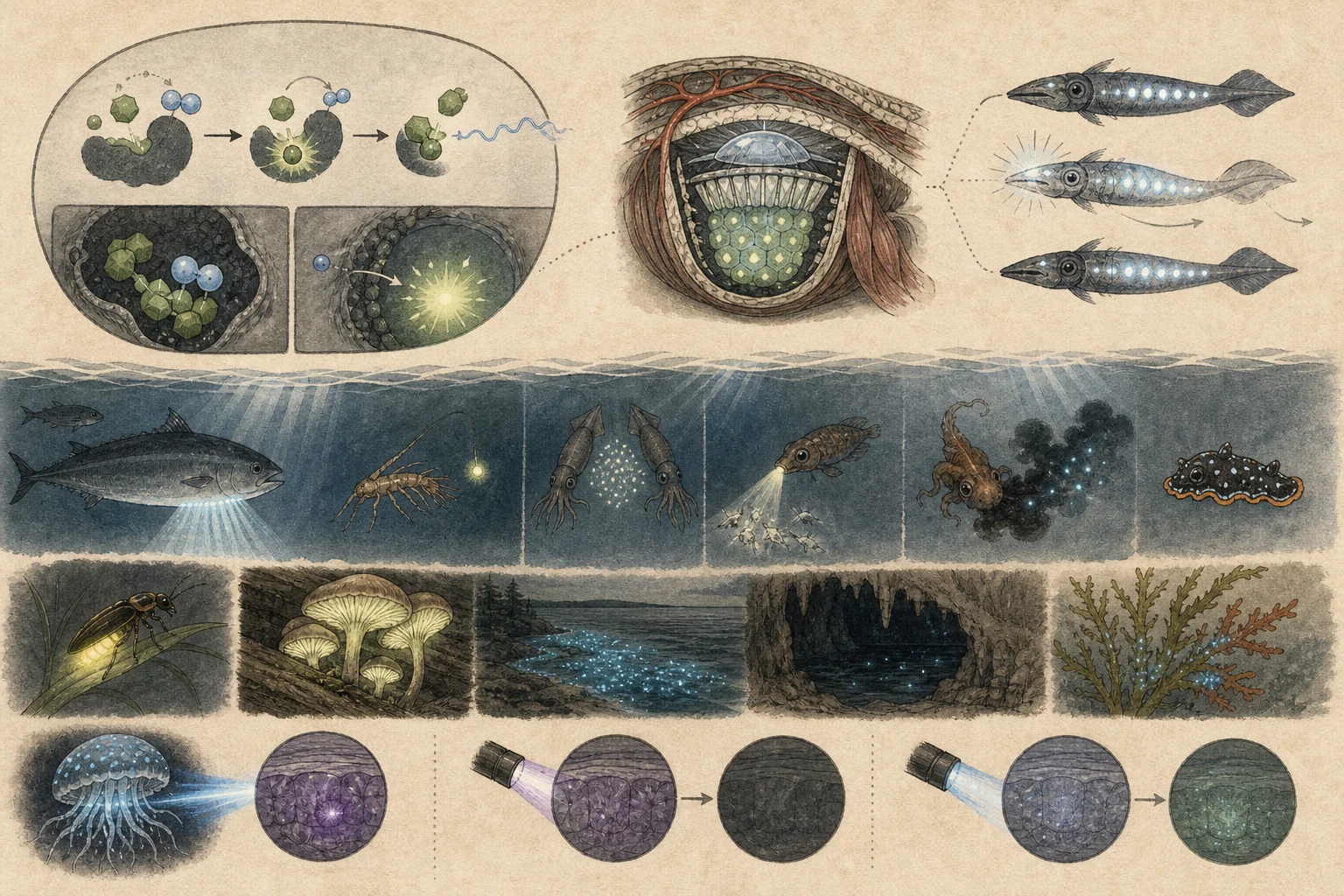
Bioluminescence is cold light generated by living chemistry: when a light-producing substrate (generically termed a luciferin) is oxidized in the presence of an enzyme catalyst (a luciferase), the reaction forms an unstable intermediate in an electronically excited state that decays to its ground state by releasing a visible photon rather than heat. In some marine cnidarians, ctenophores, and squids, the substrate and oxygen are pre-bound inside a charged photoprotein such as aequorin, which fires an instant flash when calcium ions flood the cell. Because bioluminescence evolved independently dozens of times—dating back at least 540 million years in octocorals—fireflies, dinoflagellates, ostracods, and deep-sea shrimps use chemically distinct luciferins. [1][2]
- Treat luciferin and luciferase as functional job titles rather than a single identical molecule shared across all luminous life.
- Distinguish standard enzyme-driven luciferase reactions from pre-charged photoproteins that flash when triggered by calcium ions.
- Notice emission color: marine bioluminescence is predominantly blue-green (which travels farthest in seawater), whereas terrestrial fireflies emit yellow-green.
Animals package and aim the light
Producing photons is only half the biological engineering; luminous animals also control when, where, and in what direction light escapes the body. In fireflies, neural signals gating nitric oxide and oxygen access to abdominal lanterns shape crisp species-specific flash rhythms. In deep-sea decapod shrimps, lanternfishes, and hatchetfishes, complex light organs called photophores combine secretory or intracellular light sources with silvered guanine reflectors, refractive lenses, and muscular pigment shutters or color filters. Other marine animals—such as flashlight fishes, anglerfishes, and bobtail squids—cultivate dense populations of luminous bacteria inside specialized light organs and flip mechanical shutters or ink-sac flaps to switch the beam on and off. [2][3]
- Complex photophores can include biological reflectors, focusing lenses, color filters, and muscular shutters that aim the beam.
- Some marine fishes and squids house symbiotic luminous bacteria in dedicated organs, whereas fireflies and krill synthesize their own light chemistry.
- Several marine predators and midwater fishes cannot synthesize coelenterazine luciferin themselves and must obtain it through their diet.
One glow can hide, lure, warn, or confuse
Living light serves remarkably varied ecological roles across dark habitats, and a single animal may use different light organs for multiple tasks. Across the ocean's mesopelagic twilight zone, downward-pointing ventral photophores match the intensity and blue spectrum of downwelling sunlight—a camouflage strategy called counterillumination that erases the animal's dark silhouette from upward-looking predators below. Elsewhere, anglerfishes dangle luminous esca lures, cookiecutter sharks and midwater shrimps signal or school with patterned photophores, dinoflagellates and brittle stars flash when mechanically jostled, and deep-sea shrimps spew clouds of glowing secretions into the water to blind and distract attacking squid or fish. [1][4]
- Counterillumination uses downward-aimed belly photophores to match overhead twilight and hide a midwater animal's silhouette.
- Defensive bioluminescence includes startle flashes, sacrificial glowing tissue, and luminous clouds spewed by deep-sea shrimps.
- In terrestrial habitats, watch how fireflies and glowworms use timed flashes or steady larval glows for mate attraction and aposematic warning.
Do not confuse emission with fluorescence
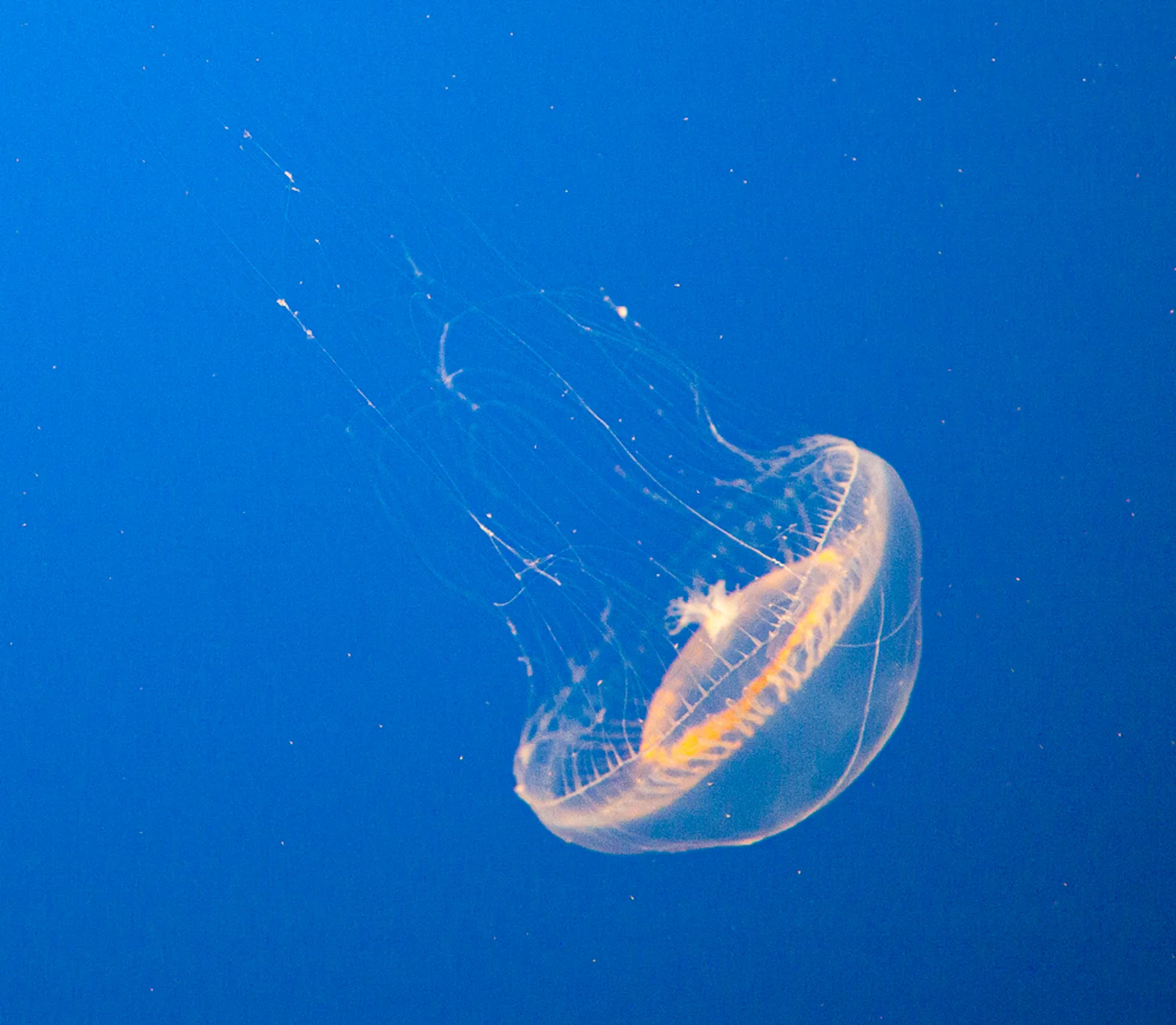
Observers with ultraviolet flashlights often spot scorpions, millipedes, corals, or flying squirrels glowing vivid cyan or pink at night, yet that phenomenon is biofluorescence rather than bioluminescence. A fluorescent molecule absorbs incoming short-wavelength light (such as UV or blue light) and immediately re-emits a longer-wavelength photon, going dark the instant you switch your UV torch off. A bioluminescent organism generates its own light chemically in complete darkness without needing external illumination. Some marine animals—such as the crystal jelly Aequorea victoria—couple both processes inside one organ, using a blue-emitting photoprotein to excite green fluorescent protein (GFP) so the rim glows green. [3][4]
- Test in total darkness with all flashlights off: true bioluminescence continues shining chemically, whereas fluorescence stops immediately.
- Remember that scorpions glowing under a blacklight are exhibiting cuticular fluorescence, not chemical bioluminescence.
- When watching fireflies or glowing surf at night, keep white flashlights and phone screens off so weak natural emissions remain visible.
Related guides
Get Fauna and identify it in the field.
Where this guide comes from
Source-checked editorial guide. Last updated . This guide teaches identification and field skills; it is not a substitute for expert verification when it matters.