Following tidal wildlife rhythms
Plan observations by predicted high or low water and rising or falling phase, record actual conditions and habitat exposure, compare equal windows relative to tide, and add lunar spring-neap stage and weather.
Last updated
Phase changes access to habitat
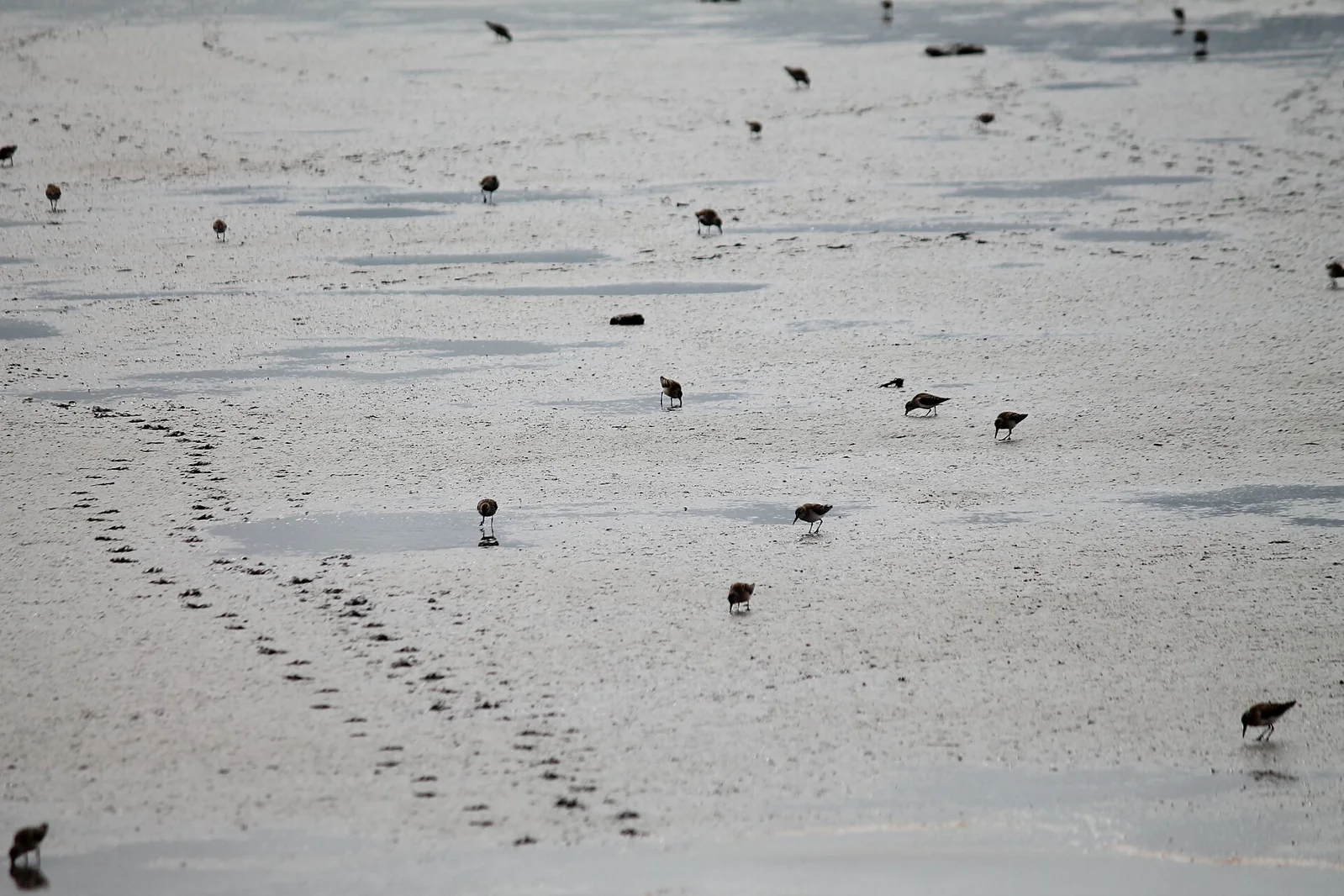
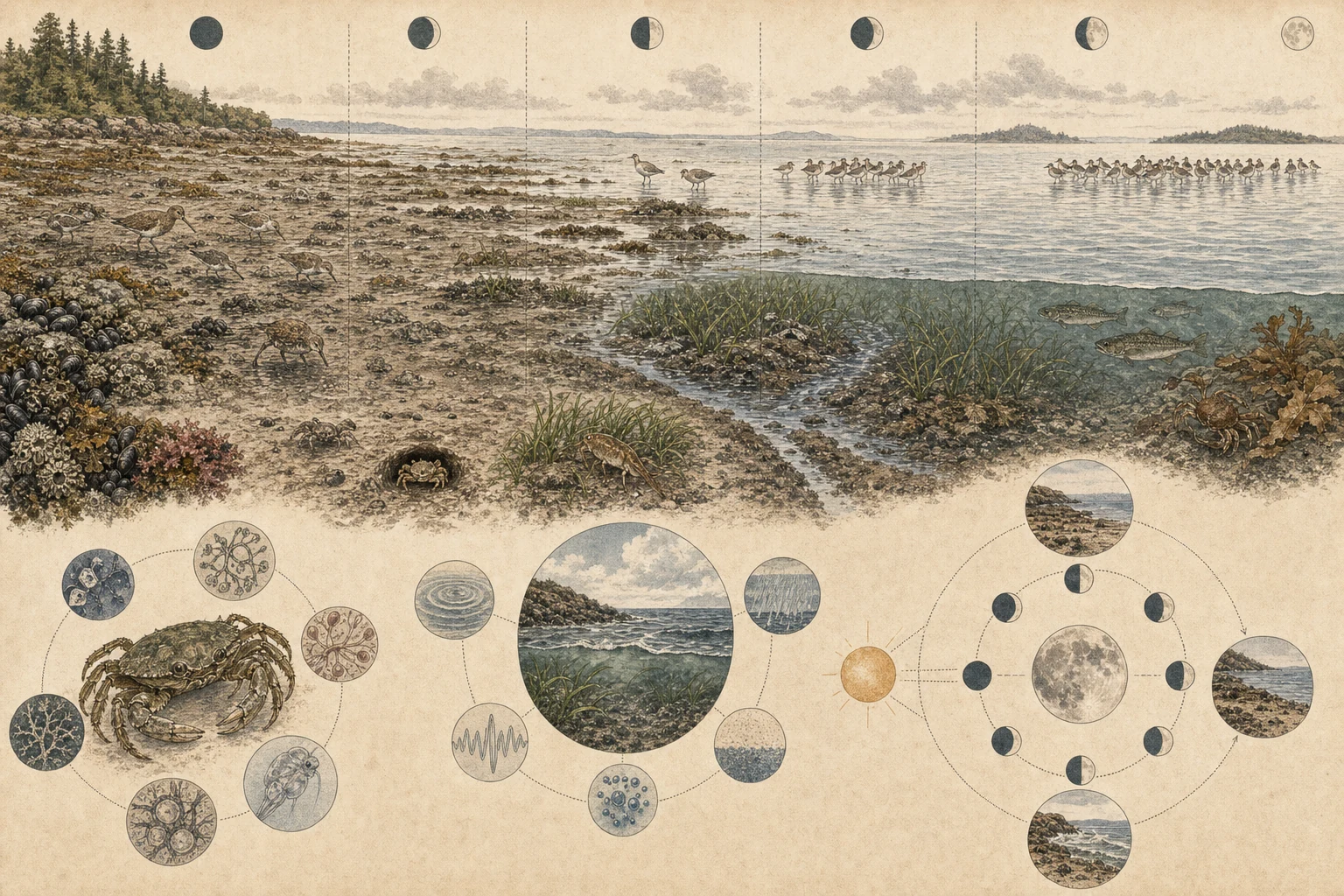
Visit an estuary mudflat or rocky headland at 8:00 a.m. on two different days of the week and you may see completely different wildlife communities, because the tidal cycle shifts roughly fifty minutes later each solar day. As an ebb tide drops, glistening mudflats, mussel beds, and eelgrass benches emerge sequentially, drawing dunlins, godwits, herons, and raccoons along the receding waterline while concentrating small fish in draining tidal creeks. Conversely, a rising flood tide pushes foraging waders upslope into dense high-tide roosts and brings flounder, crabs, and harbor seals over submerged flats. Always record both water height and direction—falling ebb or rising flood—because identical depths on opposite phases carry opposite currents and prey movements. [1][2]
- Log minutes before or after local low or high water alongside whether the tide is ebbing or flooding.
- Watch the moving water's edge on falling and rising tides, where polychaete worms, amphipods, and shorebirds concentrate.
- Locate high-tide shorebird roosts on spits and saltmarsh edges during flood water, then stay well back so packed flocks can rest.
Tidal clocks can continue without a visible tide
Intertidal animals do not simply react passively when waves splash over them; many crustaceans, mollusks, worms, and coastal fishes possess endogenous circatidal clocks with an internal period near 12.4 hours. When researchers bring amphipods such as Parhyale hawaiensis, fiddler crabs, or intertidal snails into constant laboratory conditions without water movement, the animals continue alternating bouts of swimming or foraging and burrow retreat in phase with their home beach's tides for days. In nature, cyclic cues including hydrostatic pressure, wave turbulence, temperature changes, and immersion reset and synchronize these internal pacemakers—and genetic studies show that circatidal timekeeping relies on molecular components partly distinct from standard 24-hour circadian clocks. [1][3]
- Notice how fiddler crabs, sand bubbler crabs, and mudflat snails retreat into burrows shortly before the incoming tide reaches their zone.
- Remember that intertidal organisms anticipate tidal return through entrained internal rhythms combined with local mechanical and thermal cues.
- Avoid assuming one identical clock mechanism across all marine phyla, as crustaceans, mollusks, and fishes use varied pacemakers.
The Moon changes the amplitude pattern
Superimposed on the daily ebb and flood is a fortnightly cycle driven by the alignment of Earth, Moon, and Sun. Around new and full moons, gravitational forces reinforce each other to produce spring tides, which rise higher into the upper saltmarsh and fall lower to expose deep kelp holdfasts, sponge overhangs, and outer sandbars rarely uncovered on ordinary days. Around first- and third-quarter moons, neap tides shrink the vertical range, leaving high roosts dry and lower zones submerged. Many marine invertebrates and coastal fishes time larval release or spawning to spring-tide amplitudes, though local basin shape determines whether a coastline experiences semidiurnal, mixed, or diurnal tides. [2][4]
- Plan low-intertidal rockpool and eelgrass searches around negative spring lows near new and full moons.
- Check neap high tides when studying how shorebirds and marsh mammals use mid-marsh foraging zones that flood during springs.
- Record the lunar phase and predicted tidal range from the local tide table on every coastal observation sheet.
Build comparisons around relative tide
If you want to compare shorebird counts, haul-out numbers for harbor seals, or crab activity across weeks or seasons, anchor your observation window to tidal phase—such as starting exactly two hours before predicted low water and ending one hour after—rather than arriving at a fixed wall-clock hour. At the site, note the nearest reference tide station and any lag inside your specific back-bay or river mouth, and record real-time modifiers that push water away from published predictions: onshore gales and low barometric pressure pile water higher and delay mudflat exposure, whereas offshore winds, high pressure, or drought-lowered river discharge can expose flats early. [3][4]
- Schedule repeat coastal surveys at fixed offsets from local low or high water rather than fixed clock times.
- Note the time lag between the published harbor reference station and your actual estuary reach or sheltered cove.
- Record wind direction, barometric tendency, and river runoff, which frequently override printed tide-table heights.
Related guides
Get Fauna and identify it in the field.
Where this guide comes from
Source-checked editorial guide. Last updated . This guide teaches identification and field skills; it is not a substitute for expert verification when it matters.
- Frontiers in physiology — Towards an Understanding of Circatidal Clocks ↗
- Current biology : CB — Behavioral circatidal rhythms require Bmal1 in Parhyale hawaiensis ↗
- Current biology : CB — Biological clocks: riding the tides ↗
- Philosophical transactions of the Royal Society of London. Series B, Biological sciences — Marine biorhythms: bridging chronobiology and ecology ↗