How dragonfly nymphs hunt
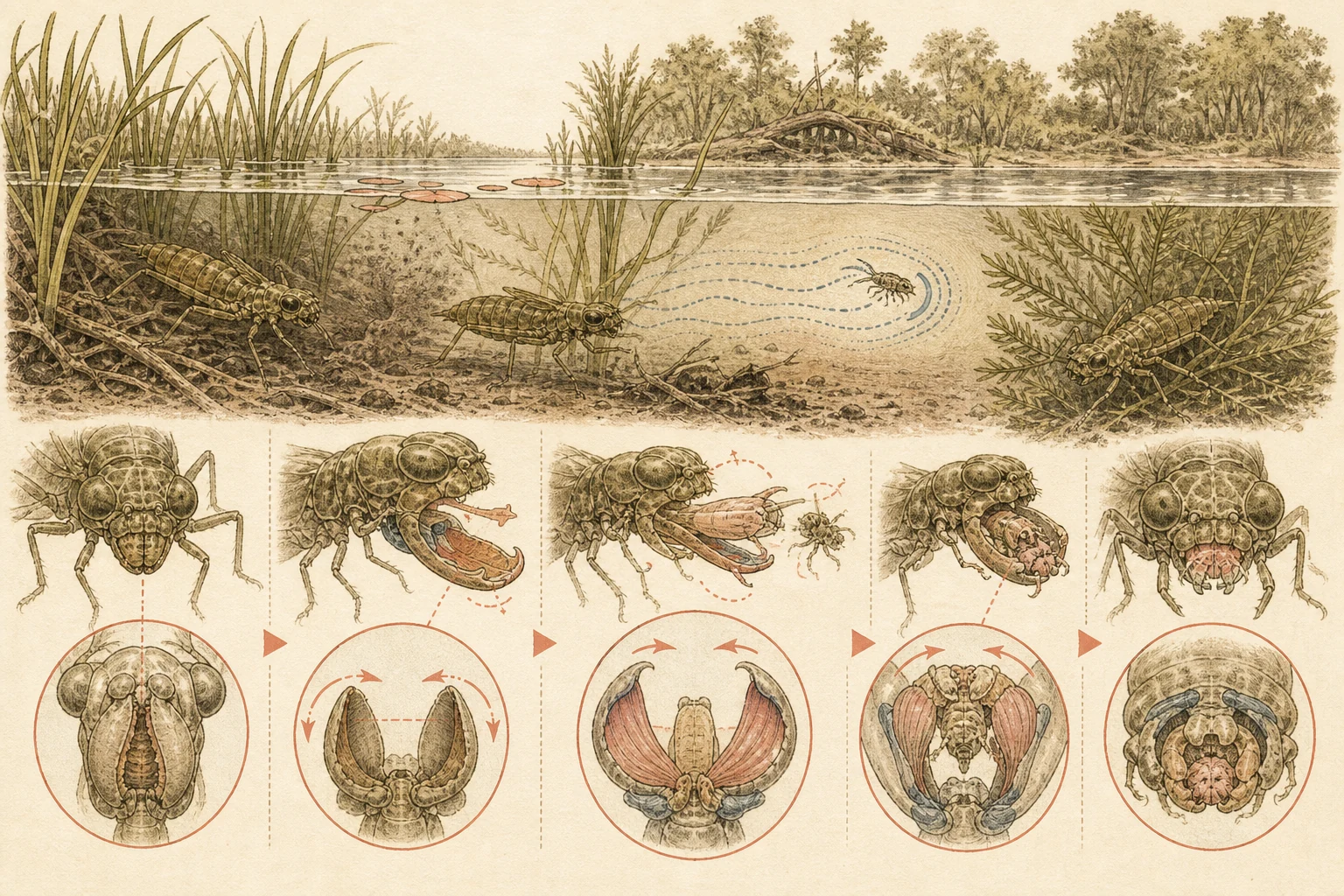
A dragonfly nymph carries a folding capture tool beneath its head. Muscles preload elastic structures at two joints, a synchronized release throws the labial mask forward, and terminal palps close around prey.
Last updated
Wait, orient, and judge range
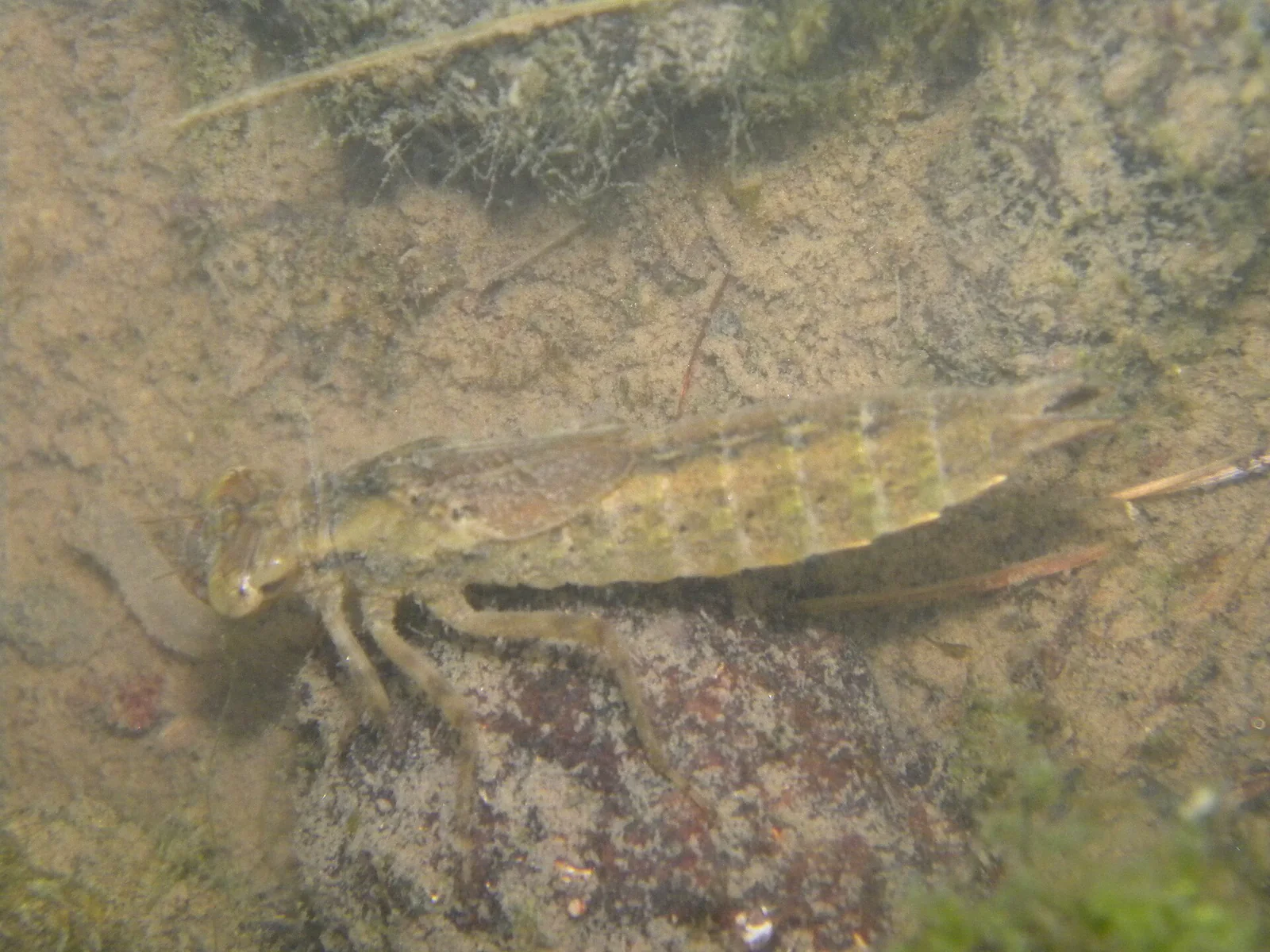
Before an adult dragonfly ever patrols a summer pond on the wing, it spends months or years underwater as a predatory nymph (naiad) stalking tadpoles, mosquito larvae, and mayflies. Depending on family, nymphs hunt as sprawlers half-buried in silt, climbers clinging to submerged reeds (such as darner larvae in Aeshnidae and damselfly nymphs like Pyrrhosoma nymphula), or burrowers waiting beneath sand. Large lateral compound eyes and mechanosensory hairs on the antennae and legs detect the wake or silhouette of passing prey, prompting the nymph to pivot its body or creep forward millimeter by millimeter until the target sits within the exact reach of its folded lower lip. [1][2]
- Pond nymphs divide into weed-climbing stalkers, bottom-sprawling ambushers, and shallow sediment burrowers
- Compound eyes and water-motion mechanoreceptors guide body alignment and range estimation before a strike
- True dragonfly (anisopteran) nymphs can also jet forward by expelling water from the rectal gill chamber
Unfold a prehensile lower lip
Look beneath the head of a resting dragonfly or damselfly nymph and you will see the 'mask'—not a pair of jaws, but the insect's modified lower lip (labium) folded back between its front legs on two primary hinges. The basal postmentum articulates with the underside of the head capsule, while the distal prementum hinges at an elbow-like joint and carries a pair of armed labial palps at its tip. In weed-climbing darners and damselflies, the prementum is flat and the palps end in sharp, pincer-like movable hooks; in bottom-dwelling skimmers (Libellulidae) and clubtails, the prementum and palps form a cupped, spine-lined basket that scoops prey out of mud. [1][2][3]
- The labial mask consists of a basal postmentum, an elbowed prementum, and terminal grasping palps with movable hooks
- Flat masks act like forceps on open stems, whereas spoon-shaped masks scoop prey and sediment together
- At rest, the entire two-segment linkage folds compactly beneath the head and thorax out of the prey's view
Release two loaded springs
Because the labial mask snaps fully open in just a few milliseconds—far too fast to be driven by real-time muscle shortening alone—biologists long assumed it was inflated solely by abdominal hydraulic pressure. High-speed videography, micro-CT anatomy, and surgical nerve-and-cuticle experiments revealed instead a synchronized dual-catapult mechanism: before the strike, slow co-contraction of extensor and flexor muscles cocks two separate elastic springs rich in the rubbery protein resilin, one at the head-postmentum joint and a second at the postmentum-prementum 'elbow.' Releasing two mechanical latches frees both springs to recoil in concert, adjusting trajectory angle and reach to intercept swimming prey. [3][4]
- Two independent resilin-rich cuticular springs—at the base and elbow of the mask—are preloaded by muscle before striking
- Mechanical latches hold both joints cocked until a synchronized release unfolds the mask in milliseconds
- Independently varying the preload on the two joints lets the nymph aim strikes upward or straight ahead
Grip, retract, and chew
As the prementum reaches full extension, the flared labial palps slice through the water edge-on to minimize hydrodynamic bow waves that could push a mosquito larva or tadpole away, then snap shut so their serrated margins and sharp movable hooks impale or cage the target. Powerful adductor and retractor muscles immediately fold the mask back under the head, delivering the struggling prey directly to the true chewing mouthparts: stout, toothed mandibles and spiny maxillae that shear through insect cuticle. Nano-indentation tests on nymph mandibles and palpal hooks show a steep mechanical gradient from hard, wear-resistant tips to tougher, shock-absorbing bases. [1][2][3]
- Labial palps sweep through water with a low-drag profile before locking their movable hooks around the prey
- The mask only seizes and retrieves prey; actual cutting and chewing happen at the mandibles and maxillae
- Heavily sclerotized palpal hooks and mandibular teeth grade from hard cutting edges to elastic, fracture-resistant bases
Related guides
Get Fauna and identify it in the field.
Where this guide comes from
Source-checked editorial guide. Last updated . This guide teaches identification and field skills; it is not a substitute for expert verification when it matters.
- Materials (Basel, Switzerland) — Prey Capturing Dynamics and Nanomechanically Graded Cutting Apparatus of Dragonfly Nymph ↗
- Frontiers in zoology — The head morphology of Pyrrhosoma nymphula larvae (Odonata: Zygoptera) focusing on functional aspects of the mouthparts ↗
- Journal of Zoology — The Toolkit of a Hunter ↗
- Science Robotics — A Controllable Dual-Catapult System Inspired by Dragonfly Larvae ↗