How antlers grow and shed
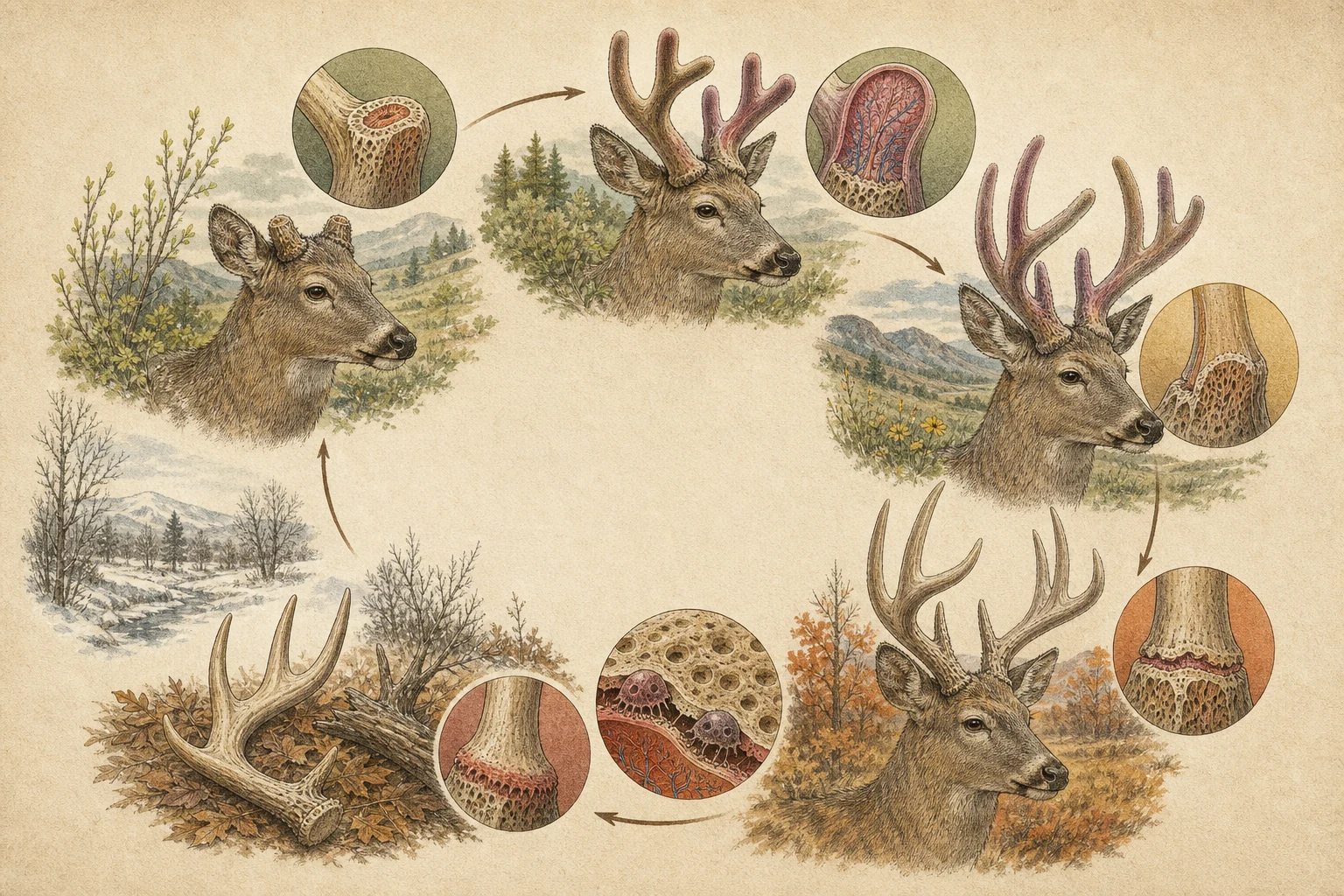
An antler begins as fast-growing tissue supplied by vascular velvet. Cells near its tip build cartilage and bone until seasonal hormonal changes stop growth and the antler mineralizes; after the breeding period, bone-resorbing cells weaken the junction so the hard antler is cast.
Last updated
Antlers are regenerated bone, not horns
True antlers occur only in cervids—members of the deer family such as red deer (Cervus elaphus), elk, moose, roe deer, and white-tailed deer—and grow as annual extensions from permanent bony cylinders on the frontal bones called pedicles. Unlike the horns of bovids (bison, bighorn sheep, goats, and cattle), which consist of a permanent vascularized bone core sheathed in lifelong keratin, a finished antler is solid, naked bone that is cast off and completely regenerated every year. In nearly all deer species only males grow antlers, with reindeer and caribou (Rangifer tarandus) standing out as the exception in which females also grow and shed seasonal racks. [1][4]
- Antlers are deciduous organs of solid bone grown from skull pedicles in the deer family (Cervidae), whereas bovid horns are permanent keratin-sheathed cores.
- Reindeer and caribou (Rangifer tarandus) are the only living deer species in which females routinely grow and cast antlers.
- Pronghorn (Antilocapra americana) carry a third type of headgear: permanent bony cores covered by a branched keratin sheath shed annually.
Velvet sustains an exceptionally fast growth zone
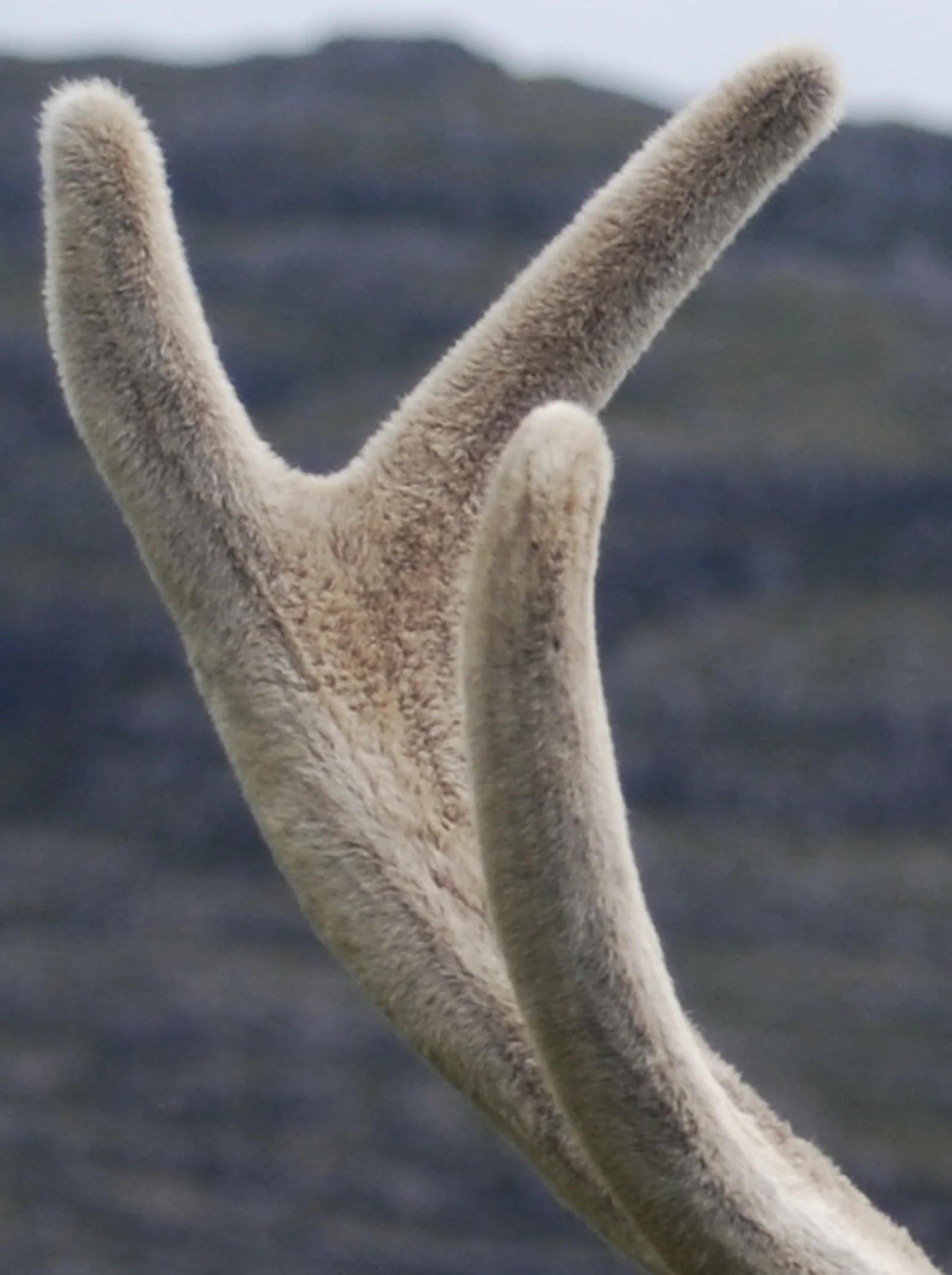
Each spring, stem cells in the periosteum of the pedicle initiate complete organ regeneration, building a new rack from scratch at up to one to two centimeters per day in large elk and moose—the fastest bone growth rate known in adult mammals. At the rounded tip of each main beam and branching tine, proliferating mesenchymal cells differentiate into vascularized cartilage that is progressively replaced by spongy bone through endochondral ossification. Wrapping the entire growing rack is velvet, a warm, hair-covered epidermis rich in arteries and sensory nerves that delivers calcium, phosphorus, and oxygen while making the soft, rounded beams sensitive to bumps in thick brush. [2][3]
- Periosteal stem cells at the pedicle rim drive complete mammalian organ regeneration each year, reaching growth rates over a centimeter per day in large cervids.
- Growing antler tips form a cartilage scaffold that ossifies into spongy and cortical bone from the base upward.
- Arteries and sensory nerves run inside the outer velvet skin, making growing antlers warm to thermal cameras and tender to impact.
Mineralization turns the living organ into hard antler
Photoperiod cues acting through the hypothalamus and pituitary coordinate the switch from soft growth to hard weapon. While low testosterone in spring permits rapid beam elongation, a late-summer surge in circulating testosterone halts cartilage proliferation at the tips, drives heavy calcium and phosphate deposition through the antler shaft, and constricts blood flow into the surrounding velvet. Deprived of oxygen and nutrients, the velvet dies, splits, and hangs in bloody ribbons. Bucks and stags accelerate its removal by thrashing and rubbing their hardened racks against resilient saplings and shrubs, staining the fresh white bone brown with oxidized blood and tree bark tannins just ahead of the autumn rut. [2][3][4]
- Rising late-summer testosterone halts tip elongation, completes bone mineralization, and cuts off blood flow to the velvet.
- Bucks thrash saplings and shrubs to strip dying velvet, leaving bark-peeled rub sign along forest edges and trails.
- Newly stripped bone starts pale and turns rich brown as blood residues react with plant tannins during tree rubbing.
Casting happens by controlled bone resorption
Once the mating season ends and daylength shifts, testosterone levels plummet, triggering a wave of multinucleated bone-resorbing cells (osteoclasts) along a narrow planar boundary where the dead antler base meets the living pedicle. Over days to weeks, osteoclasts dissolve microscopic trabeculae across that abscission line until the heavy beam is held only by fragile bony bridges. A shake of the head, a leap over a log, or brushing past a low branch snaps the weakened seal cleanly, dropping one antler and often the second soon after. Skin quickly migrates across the raw, bleeding pedicle surface to form a smooth scar pad that launches the next cycle. [2][3]
- Falling post-rut testosterone activates osteoclasts that dissolve bone along the narrow abscission zone between pedicle and antler burr.
- Shedding is an active cellular resorption process rather than mechanical breakage, leaving a raw pedicle that rapidly heals over.
- In northern reindeer and caribou, adult bulls cast their large racks in early winter after the rut, whereas pregnant cows keep theirs until spring calving.
Placing an animal in the cycle
Observing what a deer carries on its head—or what lies on the forest floor—lets you place the animal in its seasonal physiological calendar. Bulbous, gray-furred beams indicate active spring-to-summer growth when males avoid sparring and guard their racks carefully; polished, brown-stained bone and freshly shredded cedar or willow saplings mark post-mineralization autumn rutting readiness. When inspecting a detached antler on the ground, turn the base over: a true cast shed shows a rough, convex or slightly hollowed porous burr seal where osteoclasts resorbed the bone, whereas a jagged, splintered shaft indicates an antler broken during a rutting clash or predator kill. [1][2][3][4]
- Rounded tips covered in fuzzy gray or brown velvet mark the spring and summer growth phase when males avoid head-to-head contact.
- A true shed antler displays a granular, resorbed seal beneath the beaded burr rather than jagged, splintered bone.
- Tine count and beam mass reflect nutrition, body condition, and maturity class rather than an exact year-by-year age tally.
Related guides
Get Fauna and identify it in the field.
Where this guide comes from
Source-checked editorial guide. Last updated . This guide teaches identification and field skills; it is not a substitute for expert verification when it matters.
- National Park Service — Horns vs. antlers ↗
- Journal of orthopaedic translation — New physiological insights into the phenomena of deer antler: A unique model for skeletal tissue regeneration ↗
- World journal of stem cells — Deer antler stem cell niche: An interesting perspective ↗
- Biology — Cranial Appendages in Ruminants: Diversity, Evolution, Development, and Molecular Basis of Horns, Pronghorns, Antlers, and Ossicones ↗