Sexual selection vs. natural selection
Natural selection broadly describes consistent differences in reproductive contribution associated with heritable traits. Sexual selection isolates the portion caused by competition for mates or gametes. Biologists sometimes contrast it with viability or fecundity selection for analysis, but the processes combine in total fitness and can reinforce or oppose one another.
Last updated

The apparent opposition is mostly bookkeeping
In modern evolutionary biology, natural selection in the broad sense encompasses all consistent, heritable differences in total genetic contribution to future generations. Sexual selection is not an alien force working outside evolution; it is the specific fitness component arising from competition for mates and fertilizations. When textbooks or field guides contrast sexual selection with natural selection, they are using natural selection in a narrower bookkeeping sense to mean viability selection (survival to adulthood) and fecundity selection (offspring production independent of mating access). Keeping both definitions clear explains why a trait can face opposing pressures between survival and mating while evolving under one unified selective process. [1][3]
- Broad-sense natural selection includes all nonrandom differences in lifetime reproductive success, making sexual selection one of its components.
- Narrow-sense contrasts separate mating and fertilization success from survival (viability) and baseline egg or seed production (fecundity).
- Survival without reproduction leaves zero evolutionary descendants, so mating access and viability jointly determine net fitness.
Competition and choice change mating success
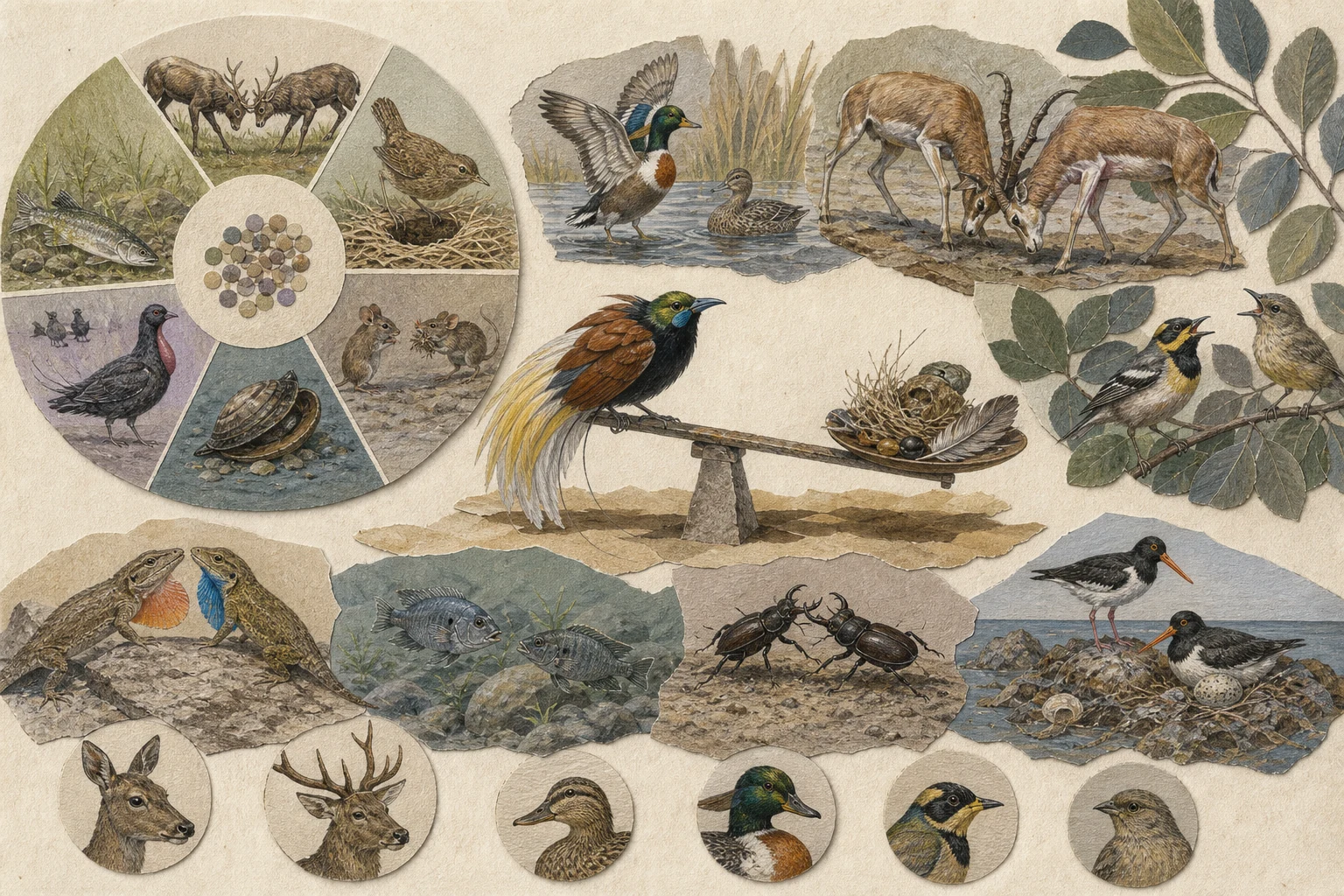
Sexual selection operates through several distinct behavioral and physiological pathways before and after mating. Before copulation or spawning, individuals may fight directly for territories or harems—as when red deer stags roar, parallel-walk, and lock branching antlers during the autumn rut—or court prospective partners through acoustic displays, plumage ornaments, nuptial gifts, or bowers. When females mate with multiple males, sexual selection continues after mating through sperm competition and cryptic female choice inside the reproductive tract. Which pathway dominates in a wild population depends on spatial clumping of mates and resources, operational sex ratios, and how much time and energy each parent invests in offspring. [1][2][4]
- Precopulatory sexual selection includes both direct contests among rivals and mate choice based on displays, territories, or resources.
- Postcopulatory sexual selection continues after mating through sperm competition and differential fertilization success.
- Red deer antlers function in rival assessment and combat during the rut, though nutrition and age strongly influence rack size in the field.
One trait can face opposing components
Elaborate ornaments, loud courtship calls, and heavy weaponry often highlight a tension between mating advantage and survival cost. Bright breeding coloration in guppies or peacocks, prolonged frog choruses that attract acoustically hunting bats and biting midges, or the massive calcium-and-energy investment of regrowing cervid antlers each spring can raise predation risk or drain physiological reserves during lean winters. A conspicuous trait spreads when the gain in fertilizations outweighs the reduction in survival, and stabilizes when marginal survival costs match mating benefits. Conversely, sexual and viability selection can reinforce each other whenever vigor, parasite resistance, and foraging skill boost both longevity and display quality. [2][3]
- Conspicuous courtship songs, bright plumage, and heavy weapons can boost mating success while increasing predation risk or energetic drain.
- Net evolutionary change depends on how survival costs and fertilization gains combine across an individual's entire lifespan.
- Condition-dependent traits can align sexual and viability selection when healthier, well-fed individuals both survive longer and display more strongly.
Avoid fixed stories about sex roles
Although classic nineteenth-century accounts cast males as universally competitive and females as universally choosy, field research across fishes, birds, insects, amphibians, and mammals reveals flexible sex roles shaped by ecology and parental care. In pipefishes, seahorses, jacanas, and phalaropes—where males brood eggs or provide sole parental care—females often bear brighter ornaments and compete vigorously for access to caregiving males. Even in conventional mating systems, females compete for territories, food, breeding slots, and paternal care while males exercise mate choice when sperm or courtship is costly. Biologists therefore test whether a striking horn, crest, or color patch serves social dominance, thermoregulation, or species recognition before assuming male-only sexual selection. [1][4]
- In sex-role-reversed species like pipefishes, seahorses, and phalaropes, heavy male parental investment favors female competition and ornamentation.
- Females in many species compete intensely for nesting sites, social rank, and paternal care, while males also choose mates when mating is costly.
- Not every bright crest, horn, or color patch evolved purely for courtship; social signaling, antipredator defense, and physiology must also be tested.
Related guides
Get Fauna and identify it in the field.
Where this guide comes from
Source-checked editorial guide. Last updated . This guide teaches identification and field skills; it is not a substitute for expert verification when it matters.
- Behavioral ecology : official journal of the International Society for Behavioral Ecology — The definition of sexual selection ↗
- Philosophical transactions of the Royal Society of London. Series B, Biological sciences — Sexual selection is a form of social selection ↗
- Hormones and behavior — Mate choice, sexual selection, and endocrine-disrupting chemicals ↗
- Philosophical transactions of the Royal Society of London. Series B, Biological sciences — Sexual and social competition: broadening perspectives by defining female roles ↗