How animals defend territories
A territory is a prioritized or exclusive area maintained through defense; advertisement can prevent costly encounters, boundaries emerge from repeated neighbor interactions, and defense changes with resources and season.
Last updated
Territory means defended access
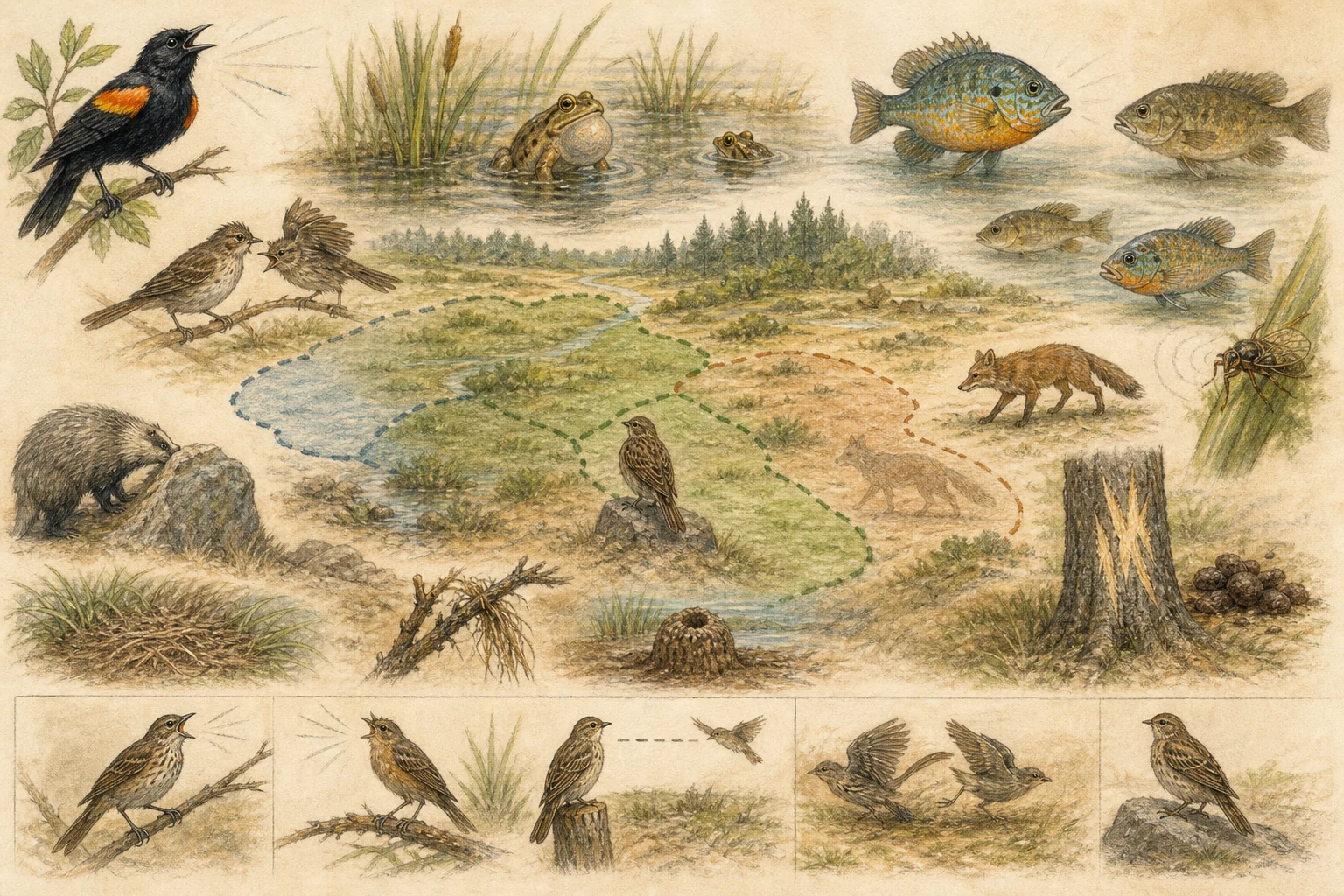
Every mobile animal uses a home range during its routine foraging and resting, but a home range becomes a territory only when an individual, mated pair, or social group actively defends all or part of that space to maintain priority access against competitors. Many mammals and birds have broad, overlapping outer home ranges while defending only a smaller core area, nest ledge, den site, or rich nectar patch. Furthermore, territories are economically defendable only when resources are predictable and moderately clumped: if food is superabundant everywhere or too sparse and fleeting to patrol, the energetic and injury costs of excluding rivals outweigh the payoff. [1][2]
- Keep home range (total area traversed in routine living) distinct from territory (the specific area actively advertised and defended).
- Identify what resource the territory actually encloses—an all-purpose breeding plot, a small cliff nest ledge, a lek court, or a winter berry shrub.
- Note whether defense is carried out by a solitary holder, a mated pair, or a cooperative pack or troop.
Advertisement avoids many fights
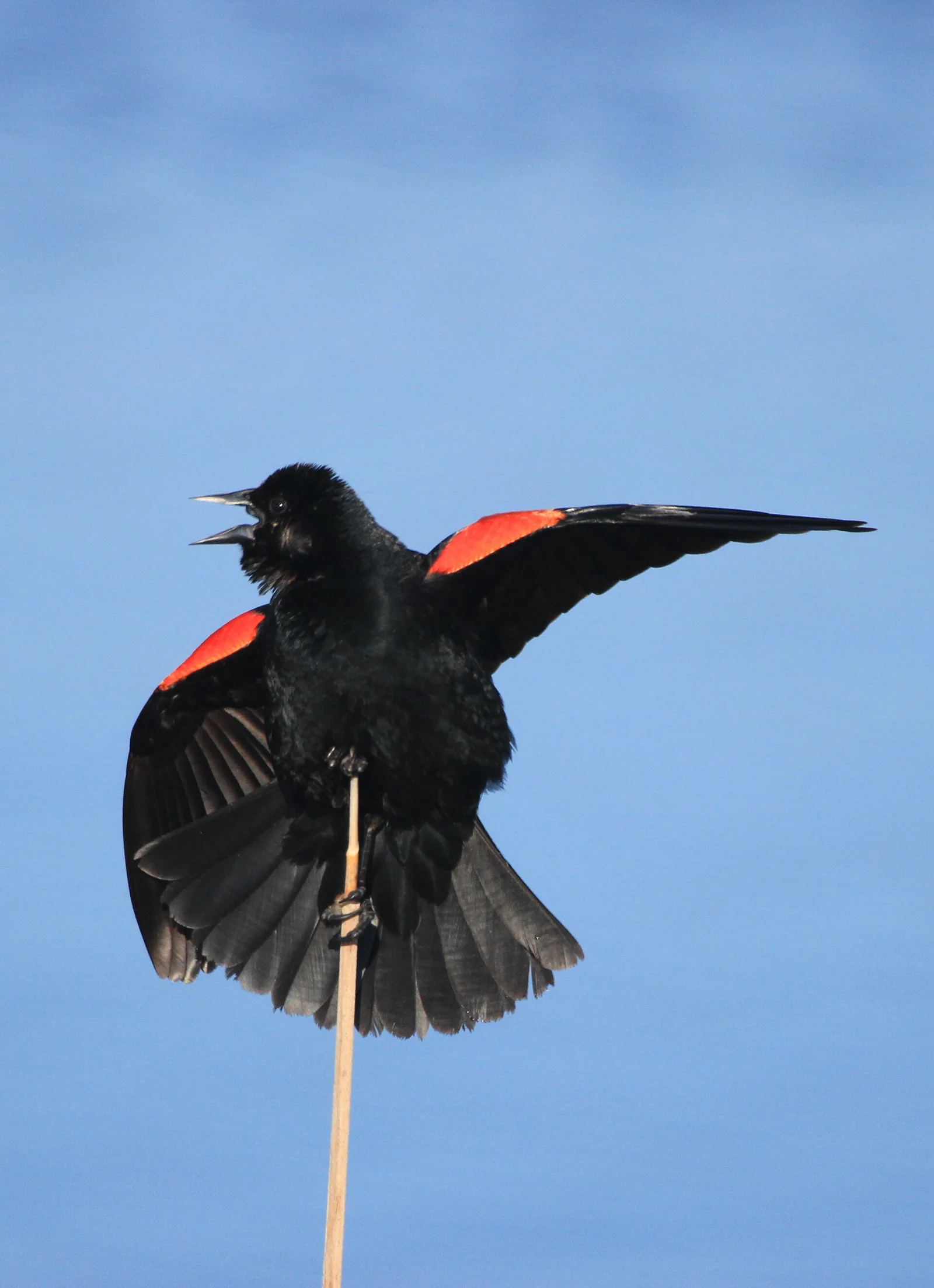
Physical combat risks punctured skin, broken feathers, torn fins, and distraction from predators, so territorial systems rely heavily on long-range and persistent advertisements that settle most disputes before contact occurs. Male red-winged blackbirds flash scarlet epaulets and sing from cattail tips; lizards perform push-up and dewlap displays on sun-warmed boulders; reef damselfishes posture at coral edges; and carnivores, ungulates, and rodents deposit glandular secretions, urine, or dung middens along boundary trails that broadcast chemical identity and freshness long after the signaller has walked on. Once neighbor boundaries stabilize, owners often show reduced aggression toward familiar adjacent holders—the dear-enemy effect—while reacting fiercely to unfamiliar floaters. [2][3]
- Watch how territorial disputes escalate in stages: broadcast song or scent mark first, then countersignaling and parallel posturing, and only rarely physical grappling.
- Look for repeated song posts, visual display boulders, or latrine middens positioned where neighbors can detect them easily.
- Notice the dear-enemy pattern, where established neighbors countersing calmly at a border but chase unfamiliar floaters away.
Boundaries are maintained and movable
A territory map drawn in a field notebook can look like a fixed parcel of real estate, yet mechanistic models and field tracking show that boundaries are dynamic interaction zones maintained by ongoing patrol, scent renewal, and neighbor pressure. If a resident songbird is removed or weakened, or if a rich patch of flowers blooms along one margin, adjacent holders quickly probe inward and renegotiate the border. Territory size also expands and contracts with competitor density and resource richness—shrinking in dense, food-rich marshes and stretching in sparser habitat—and many fiercely defended spring breeding territories dissolve completely into tolerant winter foraging flocks once chicks fledge. [1][4]
- Treat territory borders as negotiated zones of interaction rather than invisible fences fixed for the whole year.
- Watch how boundary lines shift or collapse when seasonal food patches—such as nectar blooms or fruiting shrubs—peak and fade.
- Compare where an owner sings calmly inside its core versus where it engages in parallel boundary walks or chases with a neighbor.
Repeated spatial evidence makes the case
Seeing one jay chase another from a branch or finding a single canine scat on a trail does not by itself prove territoriality: animals also squabble over immediate personal space in a moving flock, enforce dominance rank at a carcass, and leave faeces during ordinary transit. To map a territory convincingly in the field, sketch landmarks in your notebook and plot multiple independent observations across hours or days: recurring song perches of a recognizable individual, simultaneous countersinging between two neighbors, parallel boundary displays, and the exact turn-back points where chases end. Never use audio playback or decoys to provoke territorial attacks, which drains energy needed for nest defense and chick provisioning. [3][4]
- Plot simultaneous countersinging by two neighbors on a sketch map; those simultaneous points confirm that two distinct territories meet nearby.
- Mark the exact endpoints where boundary chases stop and both rivals turn back into their respective zones.
- Never broadcast territorial songs to lure a resident bird out of cover, as simulated intrusions force costly defensive expenditure.
Related guides
Get Fauna and identify it in the field.
Where this guide comes from
Source-checked editorial guide. Last updated . This guide teaches identification and field skills; it is not a substitute for expert verification when it matters.
- Proceedings. Biological sciences — How do animal territories form and change? Lessons from 20 years of mechanistic modelling ↗
- Proceedings. Biological sciences — What do territory owners defend against? ↗
- Sensors (Basel, Switzerland) — Analytical methods for chemical and sensory characterization of scent-markings in large wild mammals: a review ↗
- PLoS computational biology — Animal interactions and the emergence of territoriality ↗