Estimating animal group size
First define what belongs to the group, then choose a direct count or a repeatedly calibrated block size, sweep in one direction, use images when practical, and report an estimate with honest rounding and uncertainty.
Last updated
Define the group before counting it
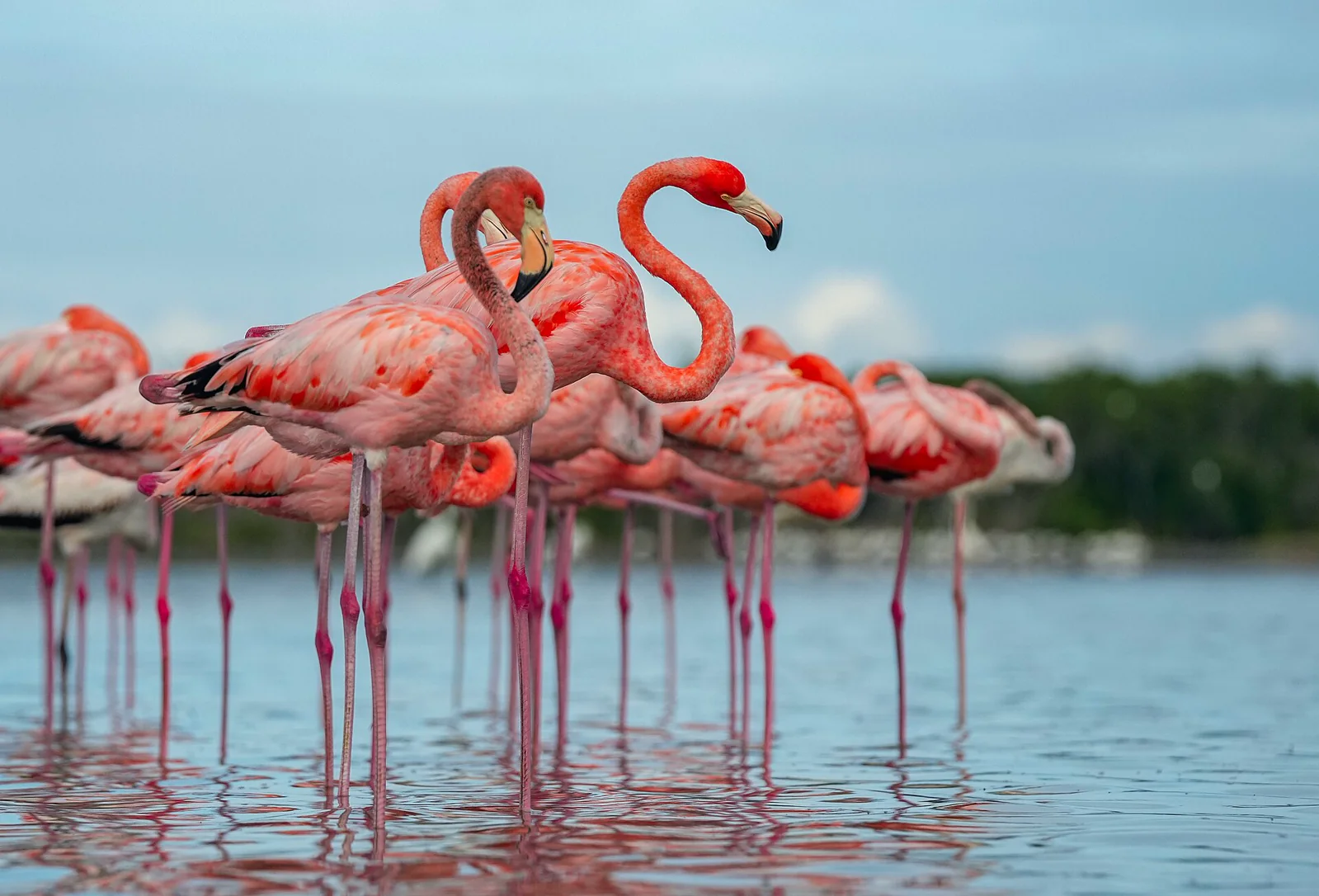
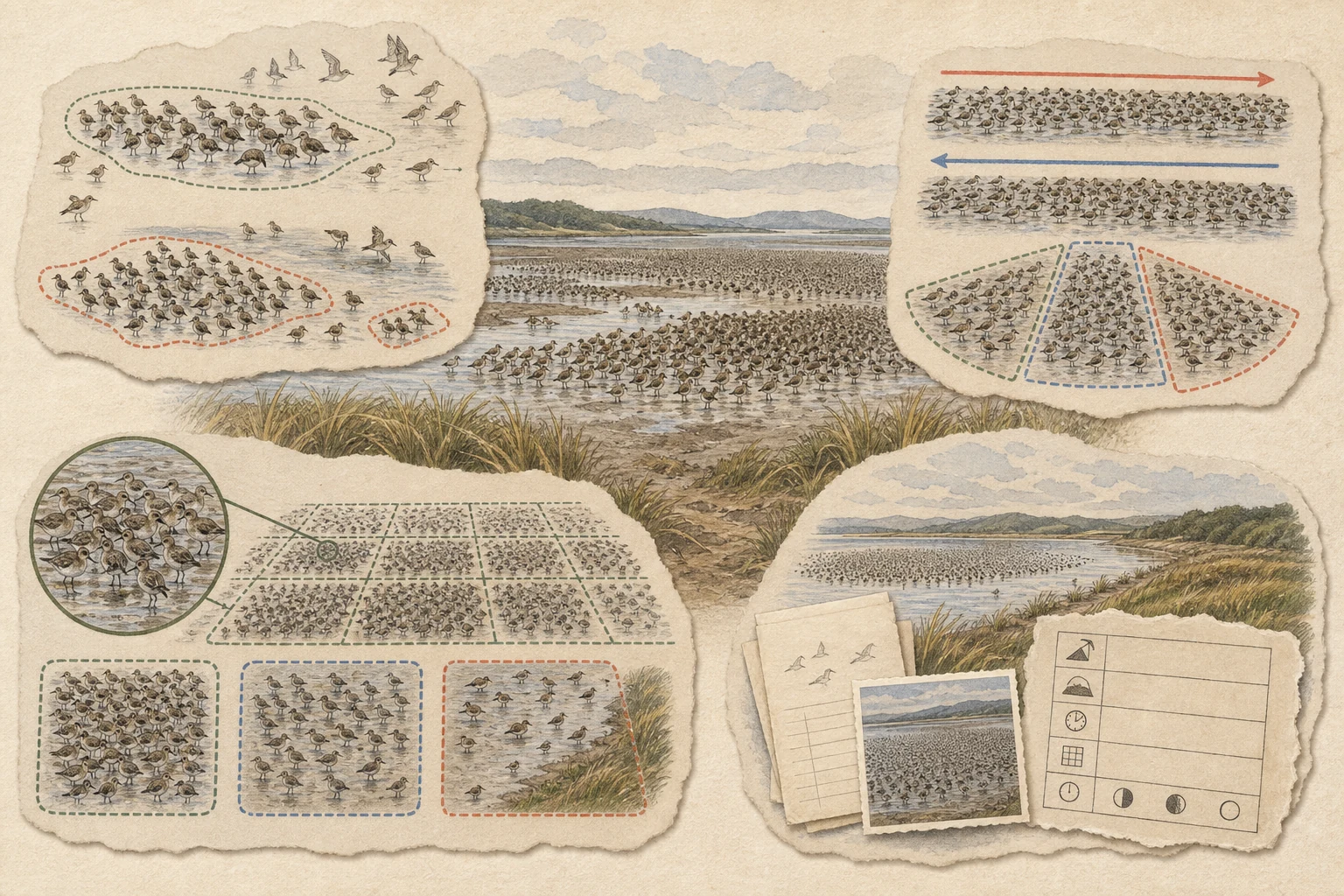
Standing before a lagoon of wading flamingos, a raft of sea ducks, or an elk herd strung across a meadow, your first task is deciding where the group begins and ends. Aggregations frequently fringe out into stragglers, split around sandbars, or mingle with flying arrivals. Before tallying, state a clear spatial or behavioral boundary—such as all individuals within a set body-length spacing or moving cohesively across the flat—and note whether juveniles underfoot, birds wheeling overhead, or peripheral subgroups are included. When distinct clusters occupy separate bays or ridges, log each cluster separately because group size itself influences how easily an aggregation is spotted during a survey. [1][2]
- Write down your boundary rule for stragglers, flying individuals, and nearby subclusters before starting the tally.
- Record distinct clusters as separate entries rather than pooling scattered bands across a whole basin into one number.
- Note whether multiple species are mixed inside the aggregation and estimate total flock size before partitioning proportions.
Count directly while you still can
Whenever a gathering holds fewer than a few dozen animals and remains reasonably still, count one by one rather than guessing by impression. Anchor your scan on fixed habitat landmarks—a driftwood snag, boulder, or channel bend—to divide a crowded view into manageable sectors so your eye does not jump back across already-counted animals. Sweep steadily from left to right with a hand tally clicker, write down the total, and immediately recount from right to left to check for drift. If caribou, shorebirds, or bats are streaming past in a narrow column, fix your binoculars on one post or gap and count individuals as they cross that imaginary gate. [1][3]
- Break wide groups into natural terrain sectors using rocks, posts, or shoreline points before counting one by one.
- Run at least two independent sweeps in opposite directions to reveal whether movement or overlap skewed the first pass.
- For animals filing past in a steady stream, hold your optics stationary on a landmark gate and tally individuals crossing the line.
Build and test a visual block
When hundreds or thousands of snow geese, eiders, or wildebeest pack together or wheel in flight, individual counting breaks down before you finish a single edge. Instead, pick a representative section of the flock, count ten, twenty, or fifty individuals as carefully as possible, and imprint the visual footprint and spacing of that block in your field of view. Tile that mental template systematically across the remaining mass, recalibrating whenever packing density tightens near the core or loosens along the margins. Where a wide-angle or stitched series of photographs captures the entire aggregation without cutting off edges, grid-based subsampling tools can produce verifiable counts with calculated sampling error. [3][4]
- Count one compact block of 10, 20, or 50 individuals carefully to calibrate your eye to the group's current packing density.
- Switch to a smaller block or direct tally along sparse outer edges rather than forcing one dense core unit everywhere.
- When photographing a large flock for later grid counting, overlap frames generously and note any portion hidden behind terrain.
Report precision the view earned
Writing 1,423 birds on a checklist when a wheeling flock was counted in fifties implies a level of certainty the observation never achieved. Express block-estimated gatherings as appropriately rounded figures or bounded intervals—such as 1,300 to 1,600 individuals—and state whether a figure represents a hard minimum of visible heads or a best midpoint estimate. Alongside the number, log your counting method, block unit, viewing angle, optical magnification, distance, and duration. Above all, keep the ecological scale straight: even a meticulous photographic count of one roost or herd measures that local aggregation at that moment, not the wider regional population across unsurveyed habitat. [2][4]
- Round block estimates honestly and record a low-to-high range when diving, vegetation, or body overlap hides part of the group.
- Label counts clearly as exact tallies, block estimates, or minimum visible numbers so future readers know the error margin.
- Distinguish the size of one observed flock or herd from population abundance, which must account for undetected groups.
Related guides
Get Fauna and identify it in the field.
Where this guide comes from
Source-checked editorial guide. Last updated . This guide teaches identification and field skills; it is not a substitute for expert verification when it matters.
- Ecology and evolution — Reliability of animal counts and implications for the interpretation of trends ↗
- USGS — Accounting for imperfect detection of groups and individuals when estimating abundance ↗
- Distance Sampling — CREEM, University of St Andrews (UK) ↗
- Ecosphere — Multi‐image flock size estimation with CountEm: A case study with half a million Common Eiders and Greater Snow Geese ↗