Convergent evolution explained
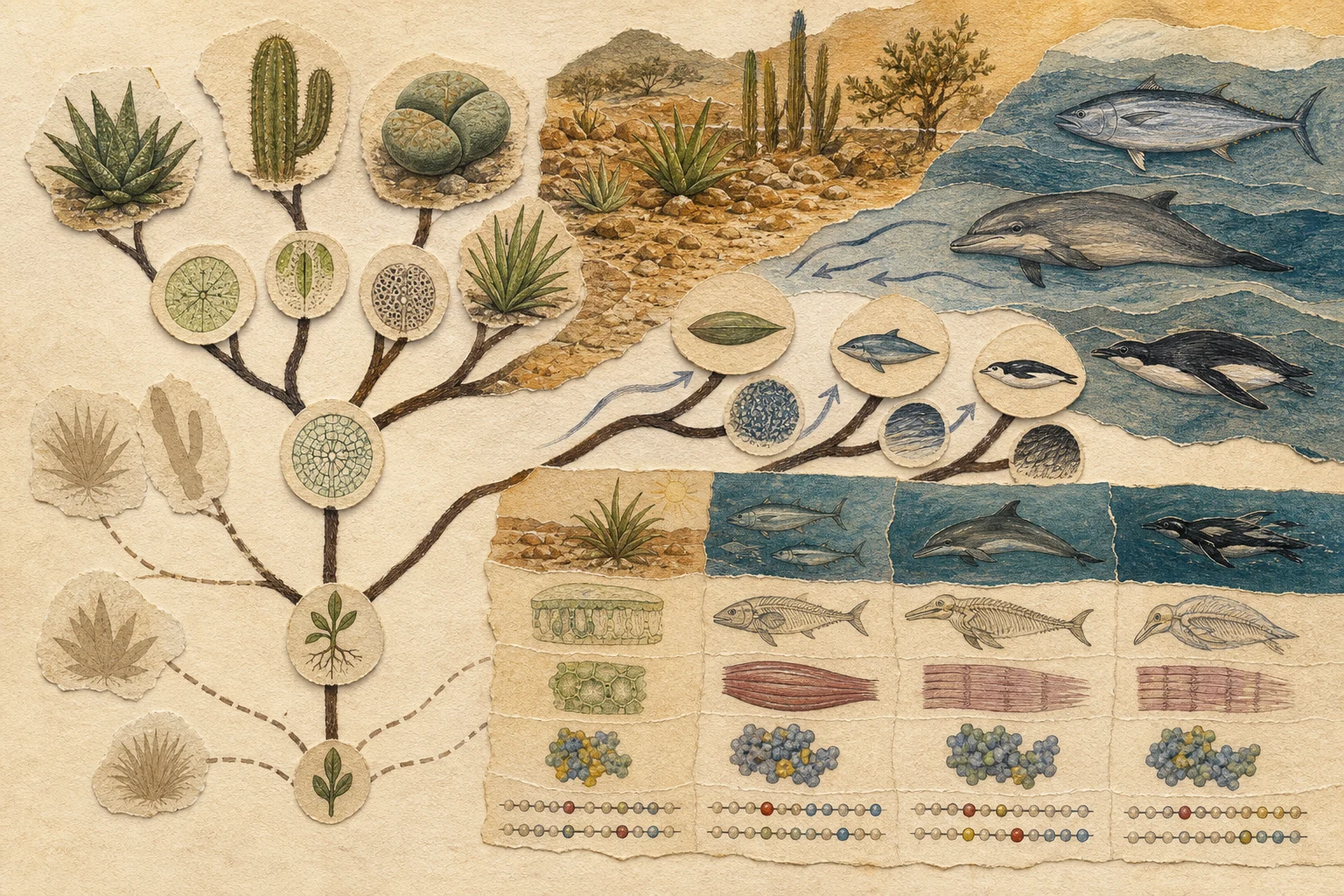
Cacti and some euphorbias independently evolved succulent, spiny forms in dry habitats; wings, streamlined bodies, and camera-like eyes offer other examples at different scales. Establishing convergence requires a phylogeny and evidence that similarity arose separately rather than being inherited unchanged from a common ancestor.
Last updated
Similarity must be placed on a family tree
Spotting two organisms with matching body shapes or behaviors in the field does not by itself prove convergent evolution. Resemblance can arise because two species inherited an intact trait from a shared ancestor (homology), evolved similar forms independently from different starting points, tapped into ancient standing genetic variation, or exchanged alleles through hybridization. To test for true convergence, evolutionary biologists build well-resolved molecular phylogenies and reconstruct the ancestral states of the lineages involved. Only when the shared ancestor lacked the trait—and the similarity arose along separate branches of the family tree—does a field look-alike qualify as convergent. [1][2]
- Proving convergent evolution requires a phylogenetic tree showing that the shared ancestor lacked the matching trait.
- Shared ancestry, introgressive hybridization, and retained ancestral polymorphism must be ruled out before claiming independent origin.
- Field resemblance is an observation about current form and function, whereas convergence is a testable claim about evolutionary history.
Comparable problems can favor comparable solutions
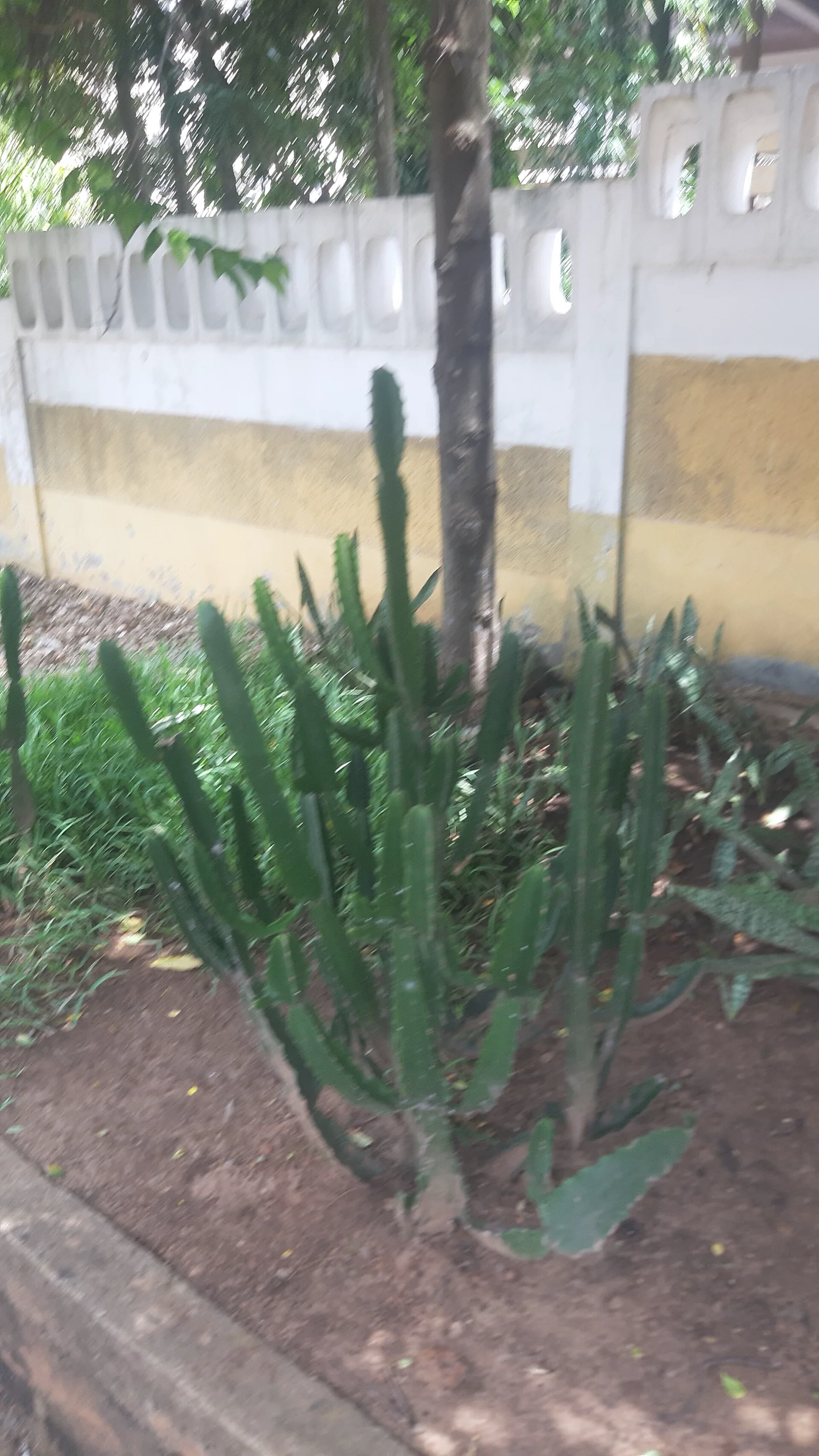
When unrelated lineages confront similar physical or ecological challenges, natural selection and biomechanical constraints often channel them toward remarkably similar functional designs. In sun-drenched deserts, American cacti (family Cactaceae) and African columnar euphorbias (family Euphorbiaceae) independently evolved thick, ribbed, water-storing green stems, leafless photosynthetic surfaces, and protective armatures. In the open ocean, sharks, ichthyosaurs, dolphins, and penguins converged on fusiform bodies that minimize hydrodynamic drag. Close inspection usually reveals the distinct ancestral parts underneath: cactus spines are modified leaves growing from specialized axillary buds called areoles, whereas euphorbia thorns and stipular spines develop from stem or stipule tissues and bleed milky latex when nicked. [1][3]
- American cacti and African succulent euphorbias evolved ribbed, leafless water-storing stems independently in arid climates.
- Anatomical details expose separate ancestry: cacti bear spines in felted areoles, while succulent euphorbias have paired stipular spines or thorns and milky sap.
- Physics and fluid dynamics constrain the number of workable body shapes for fast swimming, gliding, or digging.
Convergence occurs at several biological levels
Independent similarity can appear at one biological level while diverging completely at another. High-altitude birds, echolocating bats and toothed whales, or toxin-resistant snakes and insects sometimes evolve convergent phenotypes through amino-acid substitutions in the very same protein, yet just as often separate lineages reach an identical physiological or anatomical outcome using entirely different genes, developmental pathways, and tissue layers. Calling two whole organisms convergent is imprecise; biologists specify whether convergence occurs in gross morphology, foraging behavior, physiological performance, regulatory networks, or specific nucleotide substitutions, and test how ancestral developmental constraints shaped the route each lineage took. [2][4]
- Similar external traits can be built by completely different genes and developmental pathways in separate lineages.
- Molecular convergence occurs when independent lineages evolve matching amino-acid changes in the same protein, such as echolocation or hemoglobin genes.
- Always specify the exact level of organization—form, physiological function, or DNA sequence—when describing convergence.
Repeated outcomes act like natural comparisons
Because history cannot be replayed on cue, independent origins of a trait across multiple clades serve as natural evolutionary replicates for testing how selection and constraint work. When Anolis lizards on separate Caribbean islands repeatedly sort into crown-giant, trunk-ground, and twig ecomorphs with matching limb proportions and toepads, the pattern provides strong comparative evidence linking microhabitat use to morphology. Still, focusing only on striking look-alikes risks cherry-picking: many lineages sharing the exact same desert, island, or reef evolve completely different ways to survive, reminding observers that contingency and ancestral starting material always share the stage with natural selection. [3][4]
- Repeated evolution of matching forms across separate islands or lakes provides natural replication for testing adaptive hypotheses.
- Lineages living side by side in the same desert or forest often solve the same environmental problem in completely different ways.
- Strong comparative studies include non-convergent relatives and measure actual biomechanical performance in the wild.
Related guides
Get Fauna and identify it in the field.
Where this guide comes from
Source-checked editorial guide. Last updated . This guide teaches identification and field skills; it is not a substitute for expert verification when it matters.
- Interface focus — What does convergent evolution mean? The interpretation of convergence and its implications in the search for limits to evolution ↗
- Philosophical transactions of the Royal Society of London. Series B, Biological sciences — Population genomics perspectives on convergent adaptation ↗
- Current genomics — Genomic Insights into the Adaptive Convergent Evolution ↗
- BMC evolutionary biology — Repeated evolution and the impact of evolutionary history on adaptation ↗