Coevolution and evolutionary arms races
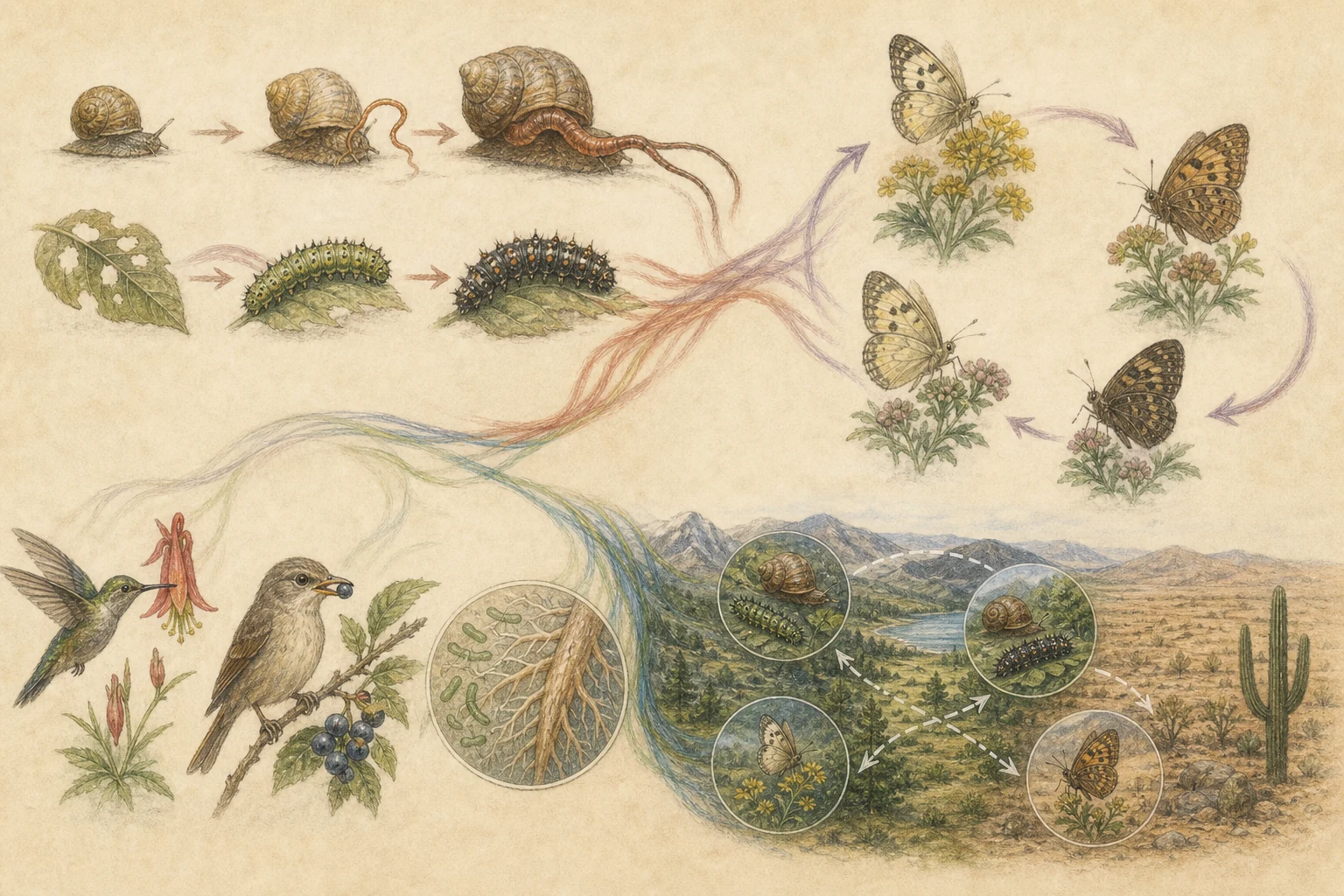
A host defense can favor parasite countermeasures, and those countermeasures can favor new host defenses. Pollinators and flowers can also impose reciprocal selection. The evolutionary response may escalate, cycle, stabilize, vary across landscapes, or involve many species, so a close fit between partners is not by itself proof of a two-species arms race.
Last updated
Reciprocal selection is the essential claim
True coevolution requires two-way evolutionary feedback: heritable trait changes in species A alter natural selection acting on species B, and species B's evolutionary response in turn shifts selection back onto species A. If an insect colonizes a toxic plant after evolving a detoxification enzyme while the plant's chemistry remains unchanged, that is one-sided adaptation or ecological fitting rather than coevolution. Field and laboratory researchers establish reciprocity by measuring fitness consequences for both partners, tracking genetic and phenotypic shifts through time—as in experimental bacteria and phage populations—or comparing cross-infection and trait mismatch across multiple populations. [1][2]
- Coevolution requires reciprocal evolutionary change in both interacting lineages, not just one species adapting to another.
- A close mechanical or chemical fit between two organisms can arise from one-sided adaptation or ecological sorting without reciprocal evolution.
- Time-shift experiments, cross-population trials, and phylogenetic comparisons help test whether selection acted in both directions.
Arms races can escalate or cycle
Antagonistic coevolution between predators and prey or hosts and parasites follows two main dynamical modes. In directional escalation—the classic evolutionary arms race—offense and defense ratchet upward over generations, such as thicker shells paired with stronger crab claws or rising tetrodotoxin levels in rough-skinned newts matched by sodium-channel resistance in garter snakes. In fluctuating or Red Queen dynamics, rare host genotypes escape parasites adapted to last generation's common host type; as that rare host becomes abundant, selection favors a matching parasite variant, driving continuing allele-frequency cycles without either partner becoming permanently invincible. Physiological and energetic costs eventually limit how far escalating traits can go. [1][4]
- Escalating arms races push offensive and defensive traits—like prey toxins and predator resistance—to progressively higher levels.
- Red Queen dynamics cycle allele frequencies as parasites track common host genotypes, giving rare host variants a temporary advantage.
- Physiological costs, trade-offs with growth or reproduction, and gene flow keep antagonistic traits from escalating indefinitely.
Coevolution is not only antagonistic
Reciprocal selection also shapes mutualistic partnerships among flowering plants and pollinators, fruiting trees and frugivorous birds, or legumes and nitrogen-fixing bacteria. Long floral nectar tubes and matching hawkmoth proboscides or hummingbird bills can coevolve as plants gain more efficient pollen transfer and pollinators access deeper nectar rewards. Even in mutualisms, however, partner interests never align completely: plants are selected to minimize nectar production costs while maximizing outcrossing, and visitors are selected to harvest rewards as quickly as possible. Moreover, most species interact within diffuse multi-species networks where guilds of pollinators, dispersers, and herbivores collectively shape trait evolution. [2][3]
- Mutualistic coevolution shapes traits like floral tube depth and pollinator tongue length through reciprocal fitness benefits.
- Even beneficial partnerships involve evolutionary tension over how much reward a host provides versus how much a partner takes.
- Diffuse coevolution across multi-species pollinator or frugivore networks is far more common in nature than strict one-to-one pairings.
The geographic mosaic matters
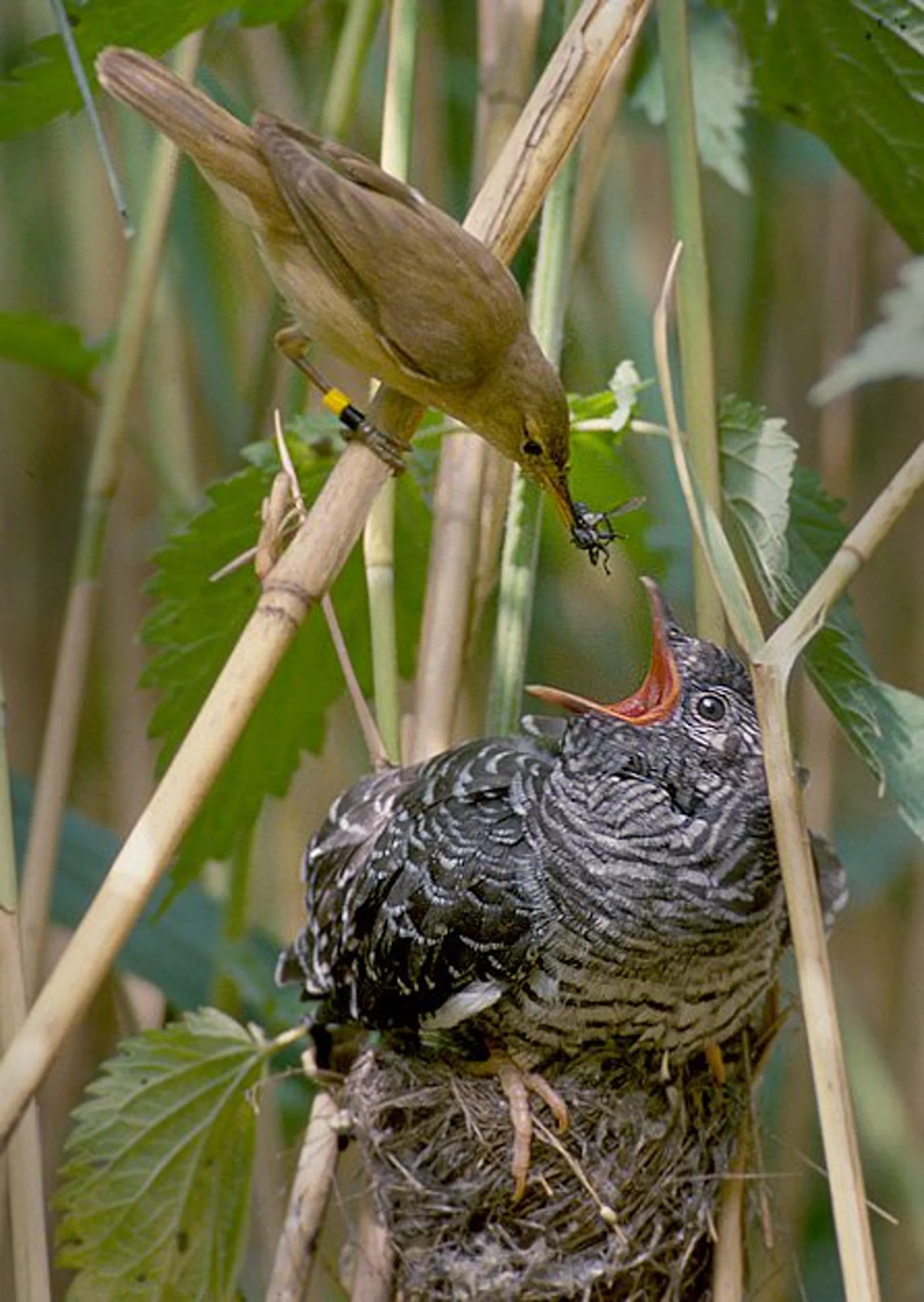
Across a wide geographic range, the strength and direction of reciprocal selection vary from place to place—a pattern known as the geographic mosaic of coevolution. Some valleys or marshes act as coevolutionary hotspots where common cuckoos heavily parasitize reed warbler nests, driving intense selection for host egg recognition and matching cuckoo egg mimicry. Other populations where alternative hosts are absent or parasitism is rare act as coldspots where expensive defenses relax, while gene flow continually mixes alleles among regions. Seeing a reed warbler feed an oversized cuckoo chick in one nest captures a dramatic behavioral outcome, but population-level comparisons are needed to map the underlying evolutionary mosaic. [3][4]
- Interaction landscapes form a mosaic of coevolutionary hotspots with intense reciprocal selection and coldspots where selection is weak or one-sided.
- Gene flow between hotspots and coldspots can prevent local populations from evolving perfect defenses or counterdefenses.
- Common cuckoos and host songbirds like reed warblers vary across Europe in parasitism rates, egg mimicry, and egg rejection behavior.
Related guides
Get Fauna and identify it in the field.
Where this guide comes from
Source-checked editorial guide. Last updated . This guide teaches identification and field skills; it is not a substitute for expert verification when it matters.
- Journal of evolutionary biology — Coevolutionary theory of hosts and parasites ↗
- International journal of evolutionary biology — What Can Phages Tell Us about Host-Pathogen Coevolution? ↗
- Proceedings of the National Academy of Sciences of the United States of America — The geographic mosaic of coevolution in mutualistic networks ↗
- British Ecological Society — Journal of Animal Ecology ↗