Watching dragonflies and damselflies
Dragonflies and damselflies become easier to study when you stop chasing them. Visit in suitable weather, wait near a favored perch or patrol lane, compare structure before color, and record date, place, habitat, behavior, and photographs without capture.
Last updated
Match place, weather, and season
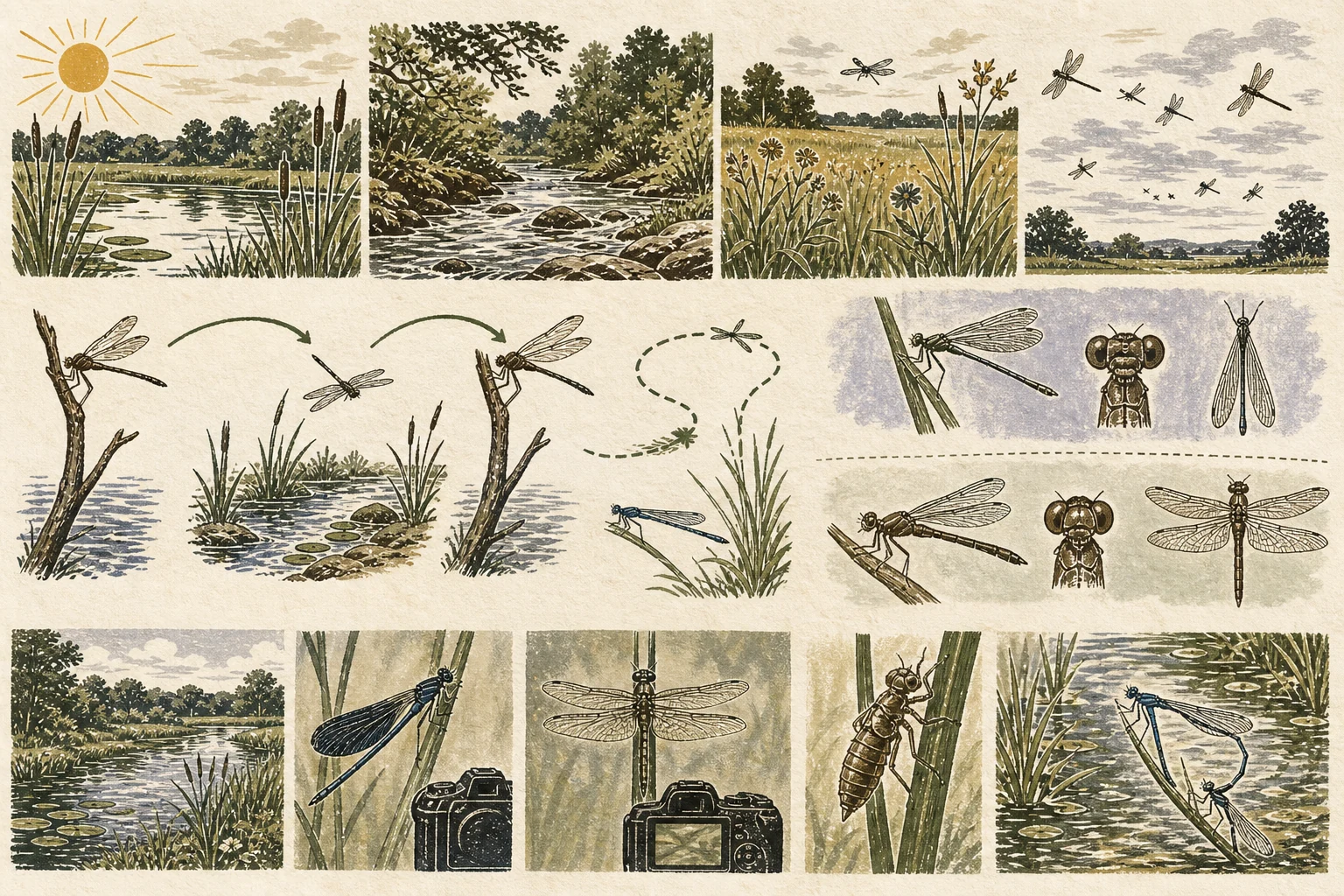
Adult dragonflies and damselflies are solar-powered aerial hunters whose flight muscles work best on warm, calm, sunny days between late morning and mid-afternoon. Still ponds, cattail marshes, and peat bogs host very different communities—such as skimmers, pondhawks, and bluets—than fast, gravelly forest streams patrolled by clubtails, spiketails, and jewelwings. Check a regional flight-season chart before heading out, because spring-emerging basket-tails and corporals give way to completely different midsummer and autumn darner assemblages, and do not overlook sunny meadow edges or woodland rides where newly emerged adults hunt away from water. [1][2][4][5]
- Plan watches for warm, sunny, low-wind hours from late morning through mid-afternoon when odonates are most active.
- Note water flow and bottom substrate, which separate pond-dwelling skimmers and bluets from stream clubtails and jewelwings.
- Check sunny meadow borders and woodland clearings near water where immature and foraging adults congregate.
Wait for a repeated route
Chasing a dragonfly down a muddy shoreline almost always ends with a receding blur and trampled reeds. Instead, watch how the insect divides its time: perchers—including most skimmers, dashers, and meadowhawks—claim an exposed sedge tip, dry twig, or sunlit rock, dart out to snatch a midge or chase a rival, and land back on the exact same stem a few seconds later; fliers—such as darners and emeralds—cruise a regular shoreline beat back and forth for minutes on end. Stand quietly beside a favored perch or patrol lane with close-focusing binoculars and let the insect come to you. [2][4][5]
- Identify whether your subject is a percher that returns to one favored twig or a flier patrolling a fixed beat.
- Position yourself quietly beside an active perch stem and pre-focus your binoculars or camera on the tip.
- Watch for tandem linkage, wheel-shaped mating pairs, and females tapping water or plant stems to lay eggs.
Use group characters with exceptions in mind
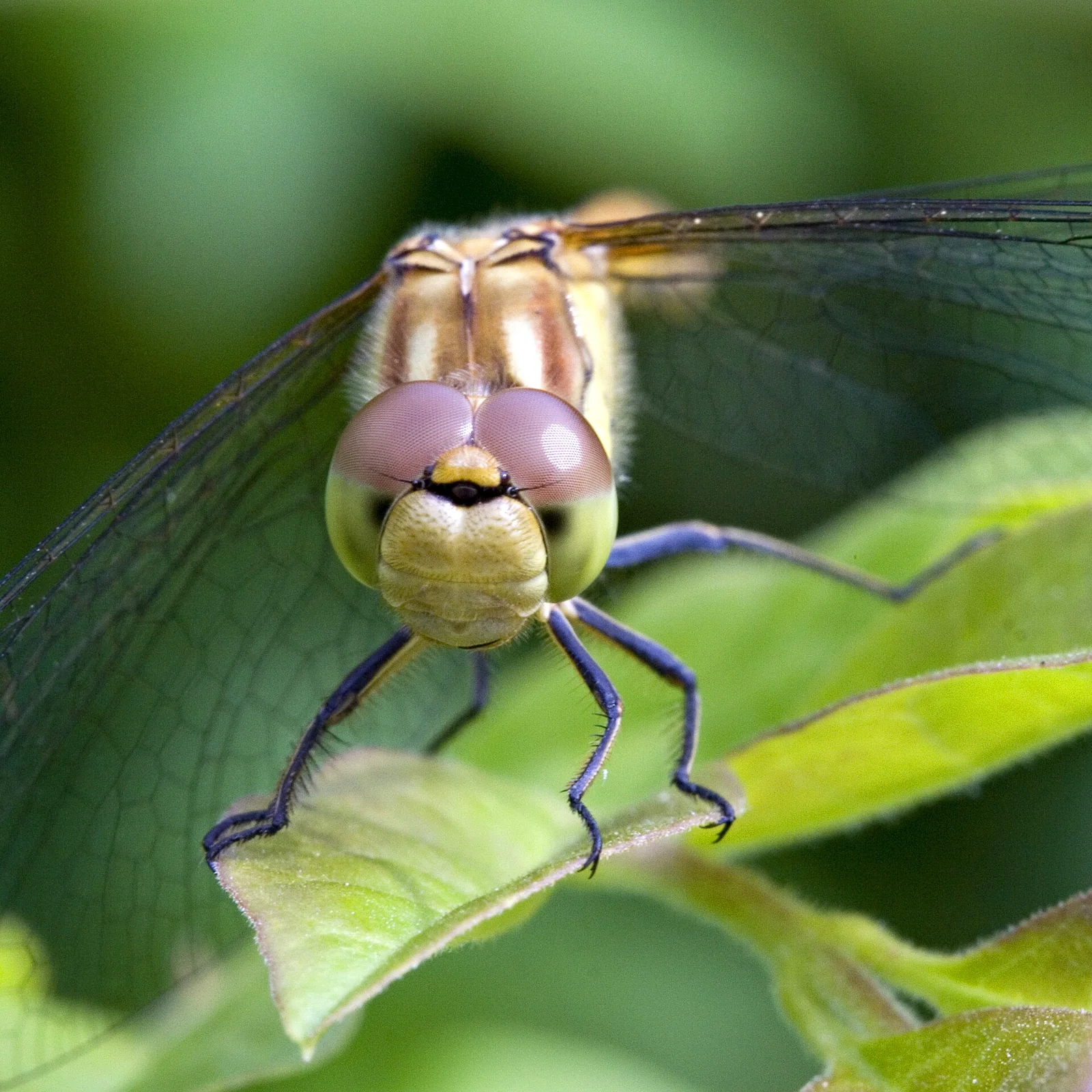
Start by separating the two main suborders: damselflies (Zygoptera) are typically slender-bodied, have widely separated eyes on a hammer-shaped head, and fold their wings together over the back at rest—except for spreadwings (Lestidae), which perch with wings held partly open at an angle. Dragonflies (Anisoptera) have stout bodies, huge eyes that meet across the top of the head (or nearly so in clubtails and petaltails), and hold their wings flat out to the sides when perched. Once you know the family, inspect thoracic side stripes, abdominal rings, face color, wing spots (pterostigmata), and terminal appendages, bearing in mind that body colors shift dramatically with age and temperature. [1][3][4]
- Separate damselflies from dragonflies by eye spacing and body build while remembering that spreadwings rest with wings half-open.
- Focus on thoracic stripes, abdominal ring patterns, wing venation, and colored wing spots (stigmata).
- Keep in mind that newly emerged tenerals, mature males, and females of the same species often wear different colors.
Record adults and exuviae without collecting
A side-profile photograph together with a top-down dorsal shot captures almost every mark needed to identify most perched odonates without ever swinging an insect net. Include a wider habitat photo of the pond or riffle, and log whether you saw territorial clashes, tandem pairs, or oviposition—true breeding evidence that tells conservationists far more than a single wandering vagrant. Check reed stems, dock pilings, and streamside boulders for the empty, split larval skins (exuviae) left behind after metamorphosis; photograph them in place, and stay well back from any pale, soft-winged teneral adult still pumping fluid into its wings. [2][4][5]
- Pair a clean lateral shot of the thorax and abdomen tip with a dorsal view showing wing patterns and eye seams.
- Log breeding behaviors such as tandem flight, copulation wheels, or egg-laying alongside the species tally.
- Photograph shed larval skins (exuviae) on emergent stems and never disturb soft, newly emerged teneral adults.
Related guides
Get Fauna and identify it in the field.
Where this guide comes from
Source-checked editorial guide. Last updated . This guide teaches identification and field skills; it is not a substitute for expert verification when it matters.