Reading burrows, dens, and lodges
An opening or mound is only the first clue. Its construction, position in the landscape, tracks, food remains, and changes over time make a stronger case for who built or uses it.
Last updated
Describe the structure first
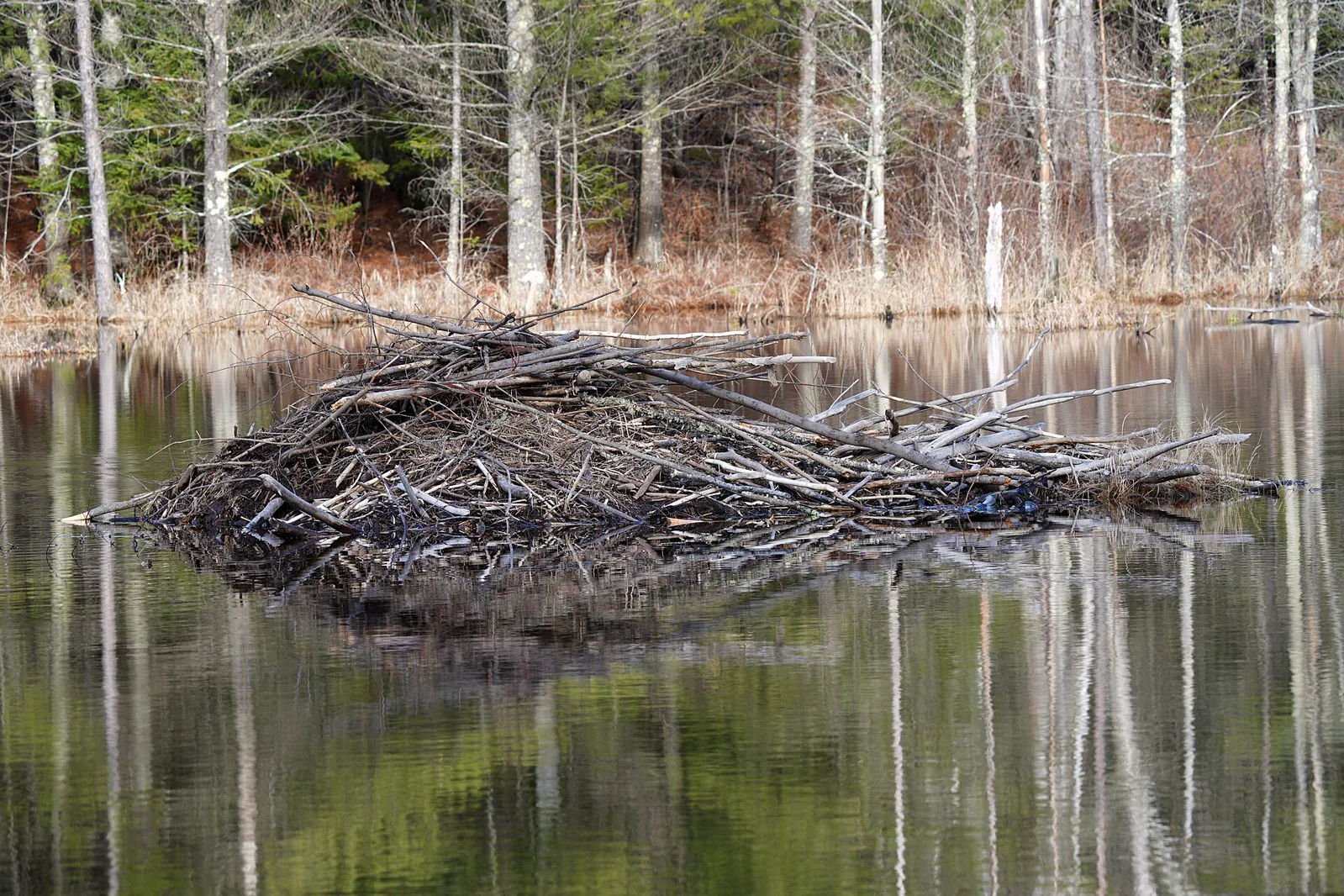
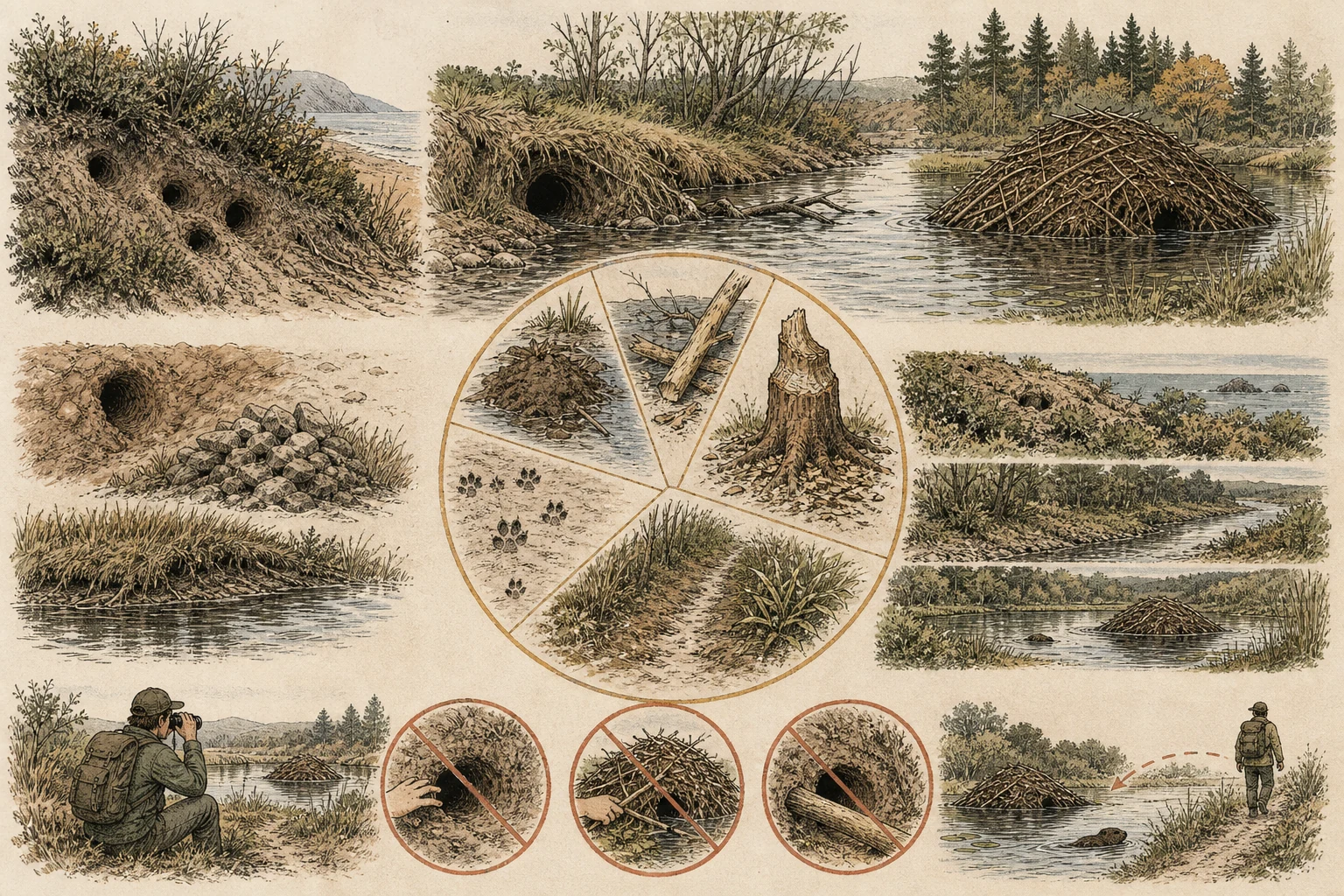
Before guessing which species lives inside, record the physical architecture of the shelter from a respectful distance: the width and cross-sectional shape of the opening, whether excavated soil is fanned out in a fresh apron or missing entirely, how many auxiliary entrances cluster nearby, and whether the site sits in a dry hillside, streambank, boulder talus, or open marsh. Beavers illustrate how strongly local terrain shapes architecture: along slow streams or ponds they heap peeled branches and mud into free-standing domes with underwater entrances, whereas along deep, swift rivers they excavate bank burrows with submerged tunnels and piling roofs of sticks against the shore. [1][2][4]
- Photograph the whole setting before taking a closer view.
- Estimate dimensions from outside; never probe the entrance.
- Note whether water reaches or conceals an entrance.
Look for a constellation of activity
A single hole in the earth rarely identifies its current occupant because burrows change hands constantly across seasons—cottontails, foxes, skunks, opossums, and burrowing owls all Shelter in tunnels originally dug by woodchucks, badgers, or mountain beavers. Look instead for a constellation of fresh neighborhood clues: slick mud plastered onto a lodge before freeze-up, submerged winter food caches of freshly cut alder or aspen branches, worn dirt runways radiating into cover, cobwebs stretched undisturbed across a dormant entrance, or fresh tracks and droppings on the dirt mound outside. [1][2][4][5][6]
- Separate old weathered sign from fresh-looking sign in your notes.
- Follow paths with your eyes rather than walking them to the entrance.
- Recheck from the same distant viewpoint if the site can be visited responsibly.
Use habitat to test the hypothesis
Step back and ask whether the surrounding landscape supplies what your candidate species actually needs to survive. A maze of shallow, six-inch-wide tunnels with clipped fern and salal bundles stacked outside in damp Pacific coast scrub points toward mountain beaver; a wide, flat-bottomed trench dug under a sunlit meadow boulder points toward a marmot or woodchuck; and a mud-and-cattail mound in shallow marsh water alongside floating sedge clippings points toward muskrats rather than beavers. Matching structure, microhabitat, and foraging sign keeps you from forcing a familiar name onto an unfamiliar burrow. [1][2][4]
- Map the feature without publishing a sensitive live location.
- Record vegetation, slope, soil, and distance to water.
- Leave the identification broad when local species overlap in size or behavior.
Observe without testing occupancy
Dens, burrows, and lodges are nurseries and winter survival shelters where disturbance carries real consequences—adult foxes or coyotes may abandon a den and relocate pups in their jaws if humans linger near the entrance, and collapsing a shallow roof tunnel with your boots destroys months of excavation. Never shine flashlights down a hole, poke sticks into an entrance, tap on a beaver lodge, or walk across the roof of a bank den. Watch from an established trail or opposite shoreline with binoculars, and let the animals emerge at dusk or dawn on their own schedule. [3]
- Keep dogs and children away from entrances.
- Never assume an apparently quiet structure is empty.
- Report hazards or conflicts to the relevant land or wildlife manager.
Related guides
Get Fauna and identify it in the field.
Where this guide comes from
Source-checked editorial guide. Last updated . This guide teaches identification and field skills; it is not a substitute for expert verification when it matters.
- National Park Service — beavers at Voyageurs ↗
- National Park Service — Point Reyes mountain beaver burrows ↗
- U.S. Fish & Wildlife Service — responsible wildlife watching at Oxbow NWR ↗
- National Park Service — beaver lodges and bank burrows at Bighorn Canyon ↗
- National Park Service — Track Makers ↗
- Penn State Extension — cottontails and reuse of abandoned burrows ↗