Jaguars of the Pantanal
Brazil's Pantanal, the world's largest tropical wetland, concentrates jaguars along shrinking dry-season rivers where they hunt caiman and capybaras in the open. That makes it the planet's most dependable place to see wild jaguars—and a place where calm, rule-bound boat watching matters for animals that are elusive across the rest of their range.
Last updated
A wetland that concentrates cats
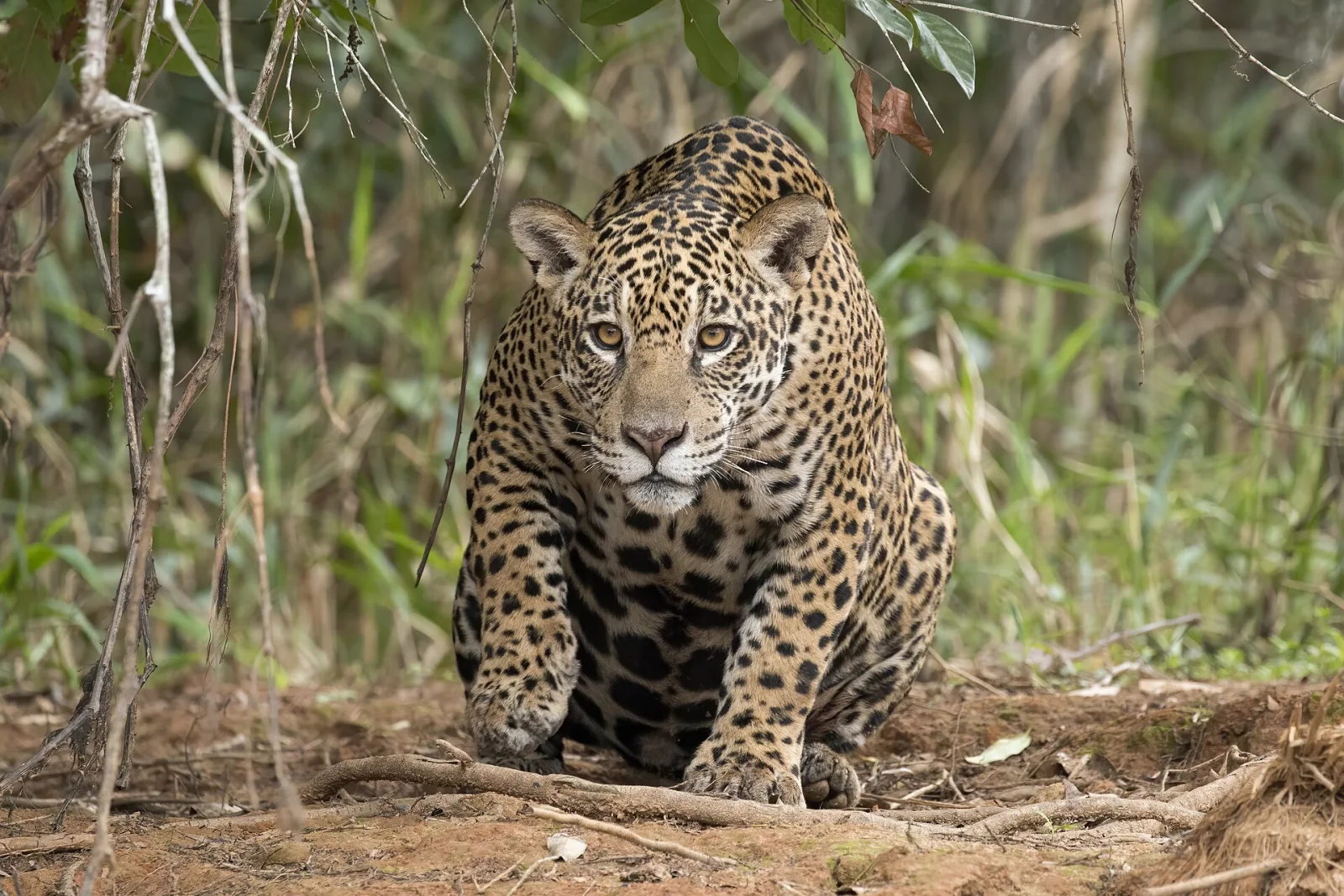
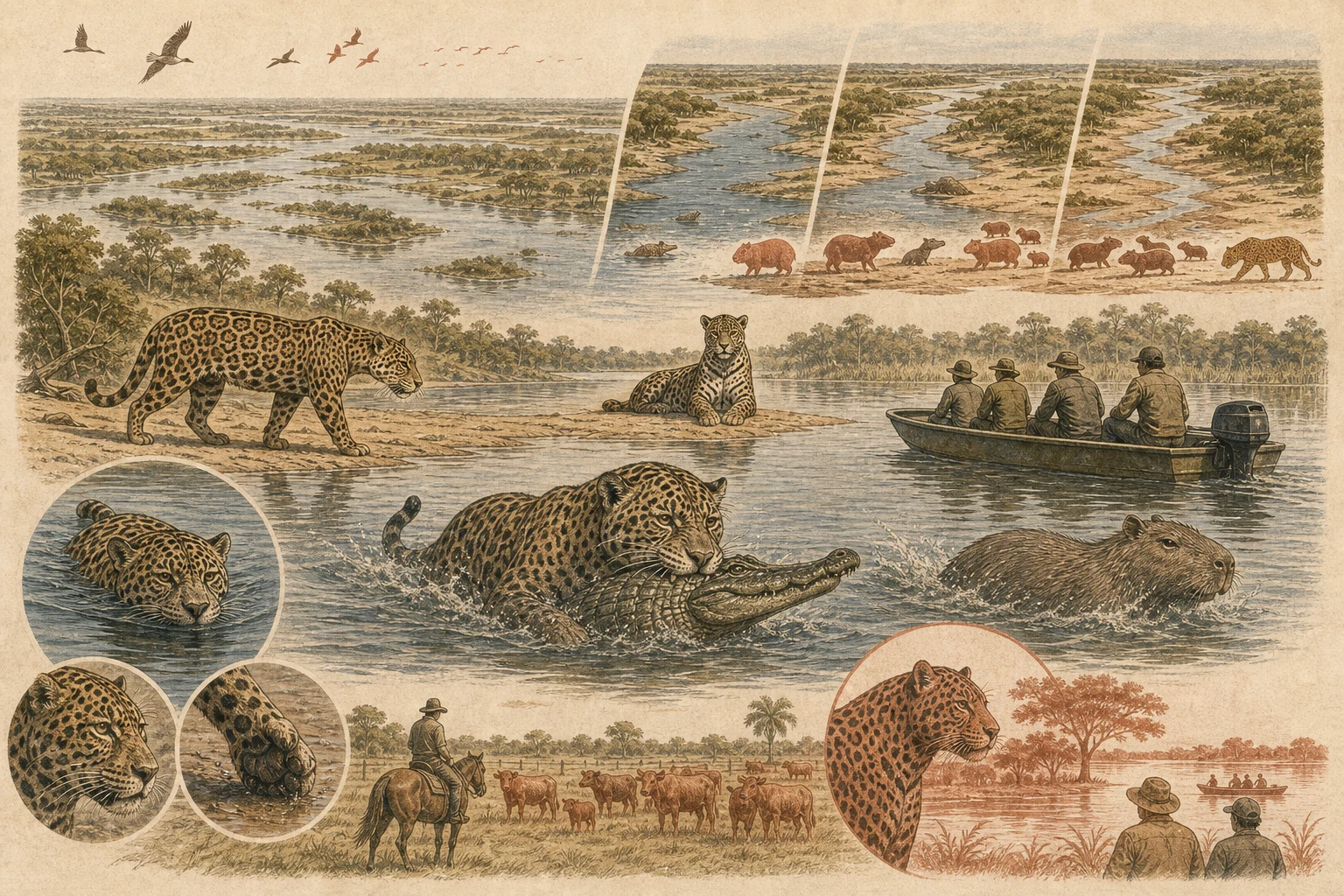
Across most of their Neotropical range, jaguars (Panthera onca) are secretive ambush hunters hidden inside dense rainforest understory. In the Pantanal—a vast seasonal floodplain spanning western Brazil and neighboring Bolivia and Paraguay—hydrology changes the geometry of sightings. As floodwaters recede between June and November, yacare caiman and capybaras crowd onto the exposed sandbars and gallery banks of permanent channels such as the Cuiabá, Piquiri, and Três Irmãos rivers, drawing jaguars out to patrol open shorelines in full daylight. [1][2]
- Dry-season water retreat between June and November concentrates caiman, capybaras, and jaguars along river channels
- Open sandbars and gallery riverbanks allow clear daytime views that closed Amazonian forest rarely offers
- Individual jaguars can be identified across years by the unique rosette patterns on their flanks and faces
Big cats built for water
Weighing over 100 kilograms in the flooded Pantanal—where the species reaches its largest body sizes—the jaguar is a stocky, muscular swimmer with an exceptionally powerful bite relative to body mass. Unlike big cats that dispatch prey primarily with a throat suffocation hold, jaguars frequently drive their canines directly through the armored skull or cervical vertebrae of yacare caiman or the shells of river turtles. Watching a jaguar slip silently off a cutbank, swim across a wide river current, or stalk through floating water hyacinth reveals an apex predator shaped by wetlands. [1][2]
- Pantanal jaguars are the largest-bodied population of the species, regularly hunting in and across deep rivers
- Proportionally massive jaw muscles and stout canines let jaguars pierce caiman skulls and turtle carapaces
- Yacare caiman, capybaras, marsh deer, and peccaries form the core natural prey base along floodplain rivers
Watch from the water, on the animals' terms
Because skiffs and riverboats provide virtually all sightings in the northern Pantanal, boat handling determines whether an encounter remains natural. Responsible river etiquette keeps vessels at a respectful standoff distance—typically 25 meters or more—avoids pinning a cat against a steep bank, leaves an open swimming lane if the jaguar is preparing to cross a channel, and never uses fish or meat bait to stage leaps. When a stalking jaguar locks onto a basking caiman, cutting engines and drifting quietly avoids alerting the prey or spoiling the hunt. [3][4]
- Maintain a generous buffer distance from the bank and never surround a jaguar that is preparing to swim across
- Keep boat engines quiet and still when a cat is stalking so wakes and noise do not alert basking caiman
- Reject any operator that uses bait, calls, or close approaches to force a reaction for cameras
Tourism and coexistence
Over 90 percent of the Pantanal sits on privately owned cattle fazendas, where livestock depredation historically fueled retaliatory shooting of jaguars. Over the past two decades, well-managed jaguar ecotourism along the Transpantaneira and river corridors has generated millions of dollars in local revenue, funding livestock compensation, electric night corrals, veterinary research, and anti-poaching patrols while extreme drought and wildfire threats have grown. Selecting lodges and boat guides that adhere to regional viewing codes directly supports rancher-cat coexistence. [2][4][5]
- Most of the Pantanal is private cattle ranchland, making coexistence programs between ranchers and cats essential
- Ethical ecotourism revenue helps fund predator-proof night corrals, research monitoring, and wildfire response
- Jaguars are listed as Near Threatened globally, with the Pantanal serving as a vital stronghold for the species
Related guides
Get Fauna and identify it in the field.
Where this guide comes from
Source-checked editorial guide. Last updated . This guide teaches identification and field skills; it is not a substitute for expert verification when it matters.