Bird tracks and toe patterns
Bird footprints are easiest to read as a trail, not a single stamp. Start with toe geometry, then use webbing, stride, size, and habitat to build a cautious identification.
Last updated
Start with toe geometry
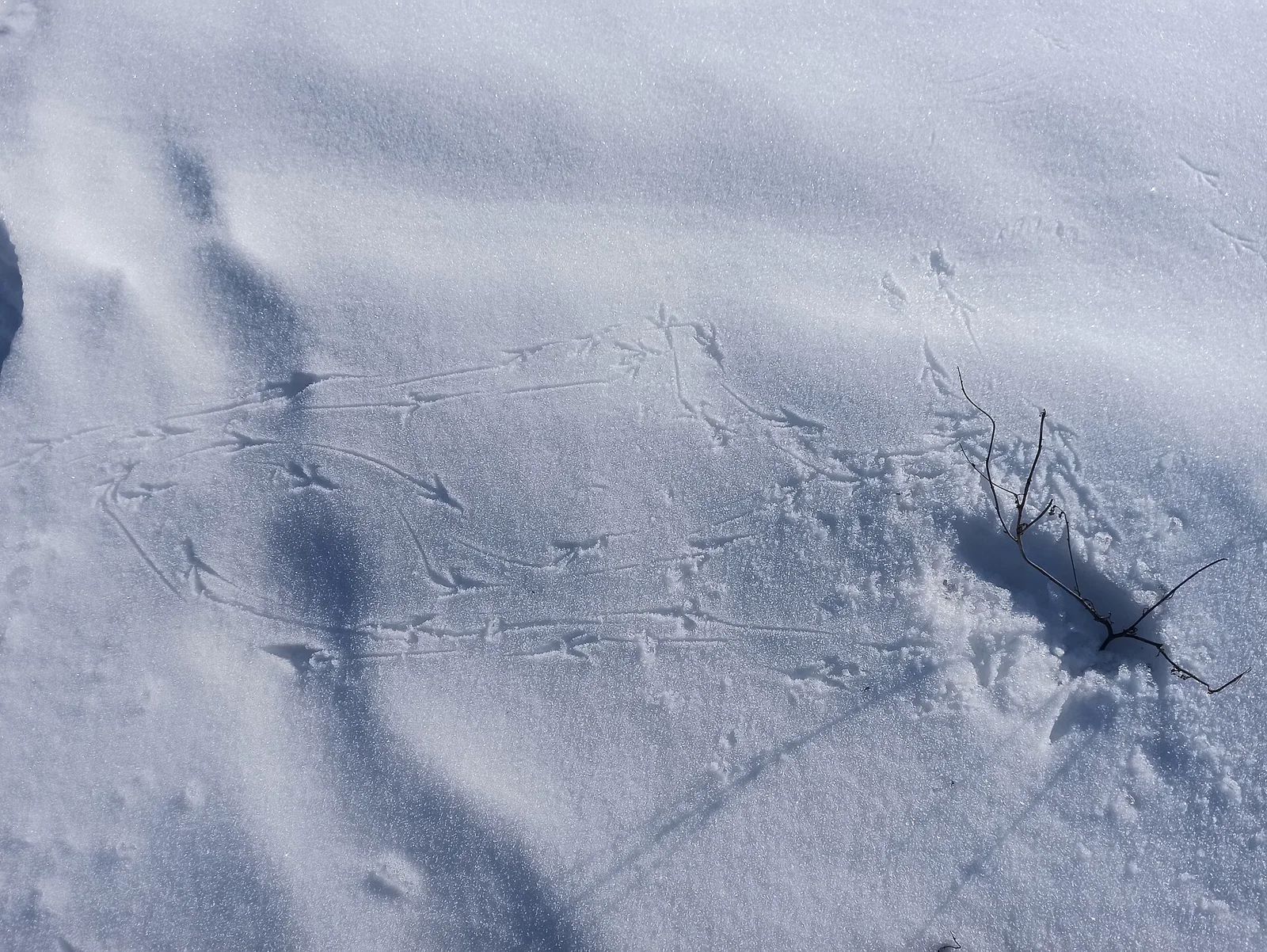
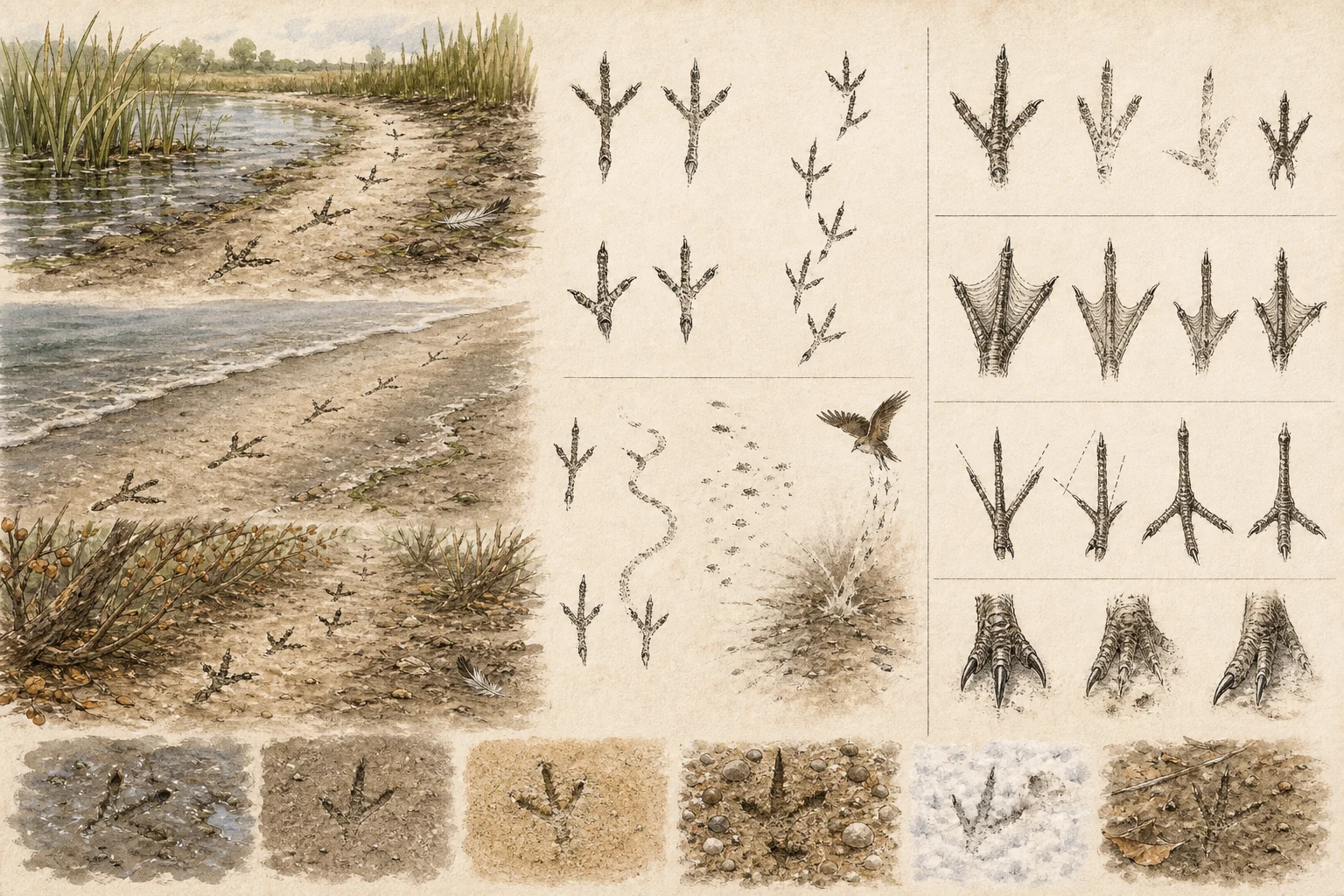
Many perching birds, waterfowl, and wading birds show the classic anisodactyl foot: three toes pointing forward and a single rear hallux pointing back. Woodpeckers, owls, ospreys, and cuckoos commonly leave a zygodactyl impression with two toes forward and two toes back, creating an unmistakable X-like stamp when the substrate is firm. Always record only what actually printed on the ground: in loose snow or dry sand, a short or elevated rear toe often fails to touch down at all, and a partial or double-stepped print can easily mimic a different toe arrangement if you judge a single mark in isolation. [1][2][4]
- Sketch the print before comparing it with a guide.
- Mark the direction of travel so forward and rear toes stay clear.
- Treat a missing toe as unknown unless the substrate preserved the rest sharply.
Read webbing and proportions
Webbing pressed into fine mud or damp sand between the three front toes strongly supports a waterbird hypothesis, but the extent and attachment of that membrane differ sharply across bird families. Ducks, geese, and gulls leave a triangular palmate impression connecting digits two, three, and four, whereas pelicans and cormorants have totipalmate feet that join all four toes in a continuous web, and coots or grebes show scalloped lobes along each individual digit. Compare relative toe lengths, the spread angle between the outer toes, the length of the rear hallux, and whether sharp claw tips registered ahead of the pads. [2][3][4]
- Ducks and geese have palmate feet connecting the front toes.
- Some waterbirds connect all four toes, so 'webbed' is not a species-level answer.
- Photograph a scale beside the track without covering or reshaping it.
Follow the gait
A single footprint shows anatomy, but a run of six or eight prints reveals how the bird moves through its habitat. Tracks that land in tidy side-by-side pairs belong to hoppers—many sparrows, jays, and thrushes that forage on the ground by bounding with both feet together. Alternating left-right footprints belong to walkers and runners such as crows, ravens, pigeons, herons, turkey vultures, and shorebirds. Following the full trail also exposes where a foraging bird paused to probe mud, pivoted toward cover, dragged a middle toe between steps, or brushed the snow with its primary tips on takeoff. [4][5]
- Follow enough steps to see a repeated pattern.
- Measure stride and trail width as well as print length.
- Note wing or tail marks as supporting evidence, not automatic proof of an event.
Let habitat narrow the list
Habitat context eliminates unlikely candidates faster than a ruler alone. A long-toed, wide-splayed walking trail along a cattail marsh edge points toward herons or rails; a pigeon-toed webbed waddle climbing a muddy reservoir bank points toward waterfowl; and paired hopping prints looping between seed heads and low brush piles point toward wintering songbirds. Note the date, location, substrate condition, recent weather, and any accompanying sign—dropped seed hulls, probe holes, chalky whitewash, or plucked feathers—so that your identification rests on converging field clues rather than a single footprint. [2][4][5]
- Compare candidates known from that place and season.
- Use several independent clues before naming a species.
- Save uncertain records at family or group level rather than forcing an exact identification.
Related guides
Get Fauna and identify it in the field.
Where this guide comes from
Source-checked editorial guide. Last updated . This guide teaches identification and field skills; it is not a substitute for expert verification when it matters.
- Cornell Lab Bird Academy — glossary of bird foot arrangements ↗
- U.S. Fish & Wildlife Service — Sacramento NWR wetland track guide ↗
- U.S. Fish & Wildlife Service — Webbed Wonders educator guide ↗
- National Audubon Society — beginner's guide to bird tracks in snow ↗
- National Park Service — Patterns in the Snow ↗