Choosing and using binoculars
Most people buy binoculars, never adjust them, and quietly conclude their eyes are the problem. The setup is the part nobody teaches.
Last updated
What the two numbers mean
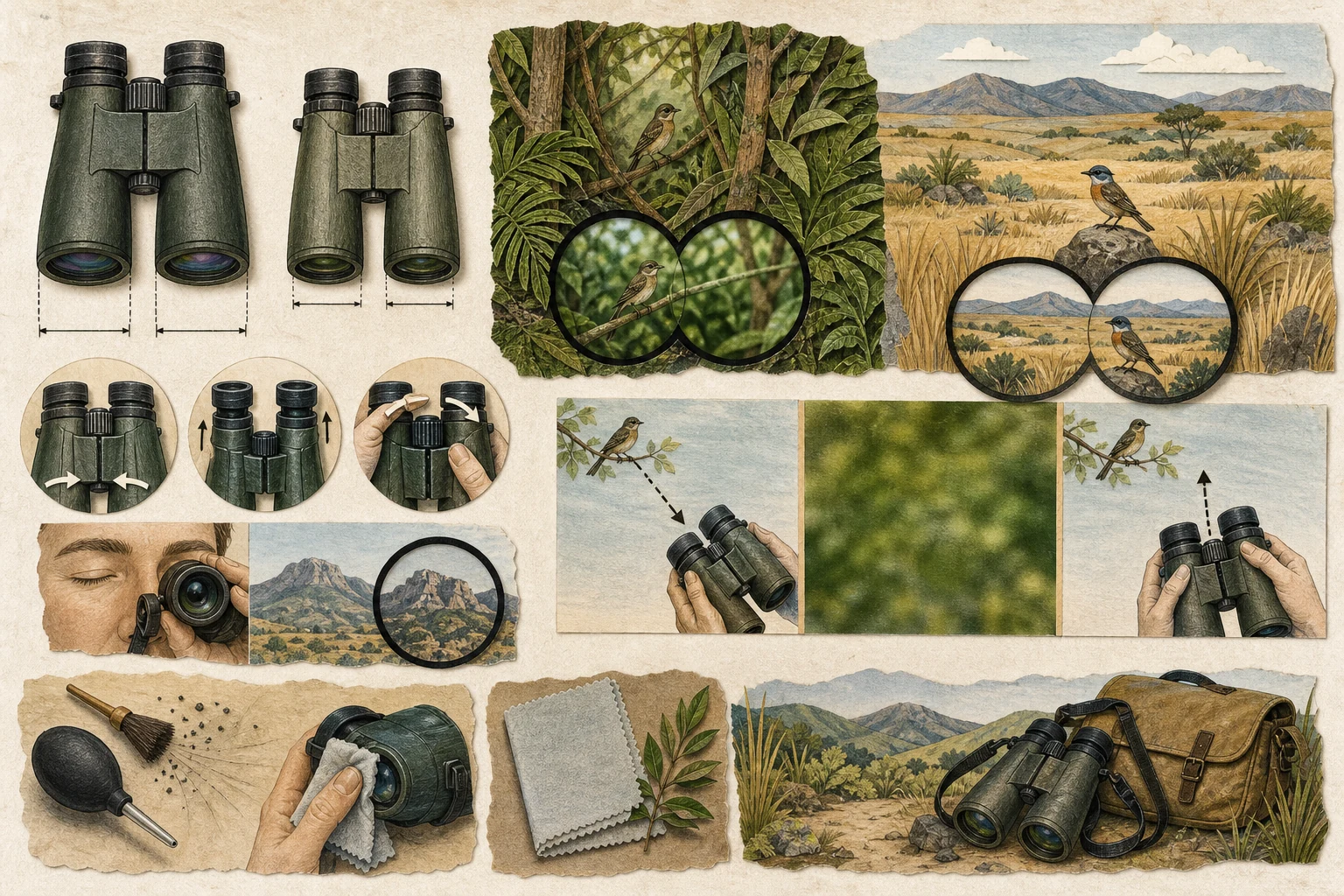
A pair marked 8×32 provides 8× magnification and has 32 mm objective lenses. Objective diameter affects light-gathering and often size and weight; it does not by itself determine field of view. Field of view is a separate specification shaped by magnification and optical design, so compare the published width or angle for the actual models. [5][6]
- First number: magnification. 8× means eight times closer
- Second number: objective lens width in millimeters
- Bigger objectives gather more light, and weigh more around your neck
8x or 10x is a trade-off, not a consensus
Choosing 8× or 10× depends on the observer, optical design, and habitat. BirdLife South Africa suggests 8× in dense forest, where a wider view can help locate a bird, and 10× in open country, where added image scale may help. Compare the actual models: higher magnification often narrows field of view and amplifies hand shake, but optical design matters. [3][5][6]
- Higher magnification often narrows field of view and amplifies hand shake; compare the specifications for the models in hand
- Dense cover rewards a wide view; open country rewards reach
- Anything you cannot hold steady gives back the detail it promised
Set them up for your face
Set the hinge and eyecups first. Then close the right eye and use the center wheel to focus a distant object with the left eye. Close the left eye, open the right, and use only the diopter to focus. Leave the diopter at that setting and use the center wheel normally. [4][5]
- Hinge until you see a single circle, not a figure of eight
- Glasses on: eyecups down. Glasses off: eyecups up
- Center wheel with the left eye, then diopter with the right eye; follow the maker's instructions if controls differ
Getting on the animal
The commonest failure is not optical. You spot a bird, lift the binoculars, and find an empty green blur — because you looked down at the barrels on the way up. Birds Canada and Birds in Backyards teach the same fix: find it with your naked eye, lock your gaze onto it, and bring the binoculars up to meet your eyes without letting go of the spot. Your hands find the line your eyes are already holding. [1][2]
- Keep your naked eyes locked on the bird or branch while raising the barrels to your face
- If the bird is hidden in complex foliage, note a distinctive fork, dead stub, or sunlit leaf beside it as a visual landmark
- Practice lifting and focusing on stationary pinecones or fence posts until the motion is automatic
Look after the glass
Blow or brush away loose grit before using a clean microfiber lens cloth, and follow the maker's cleaning instructions. Wiping sand or salt crystals across dry optical coatings scratches the glass permanently. Beyond basic lens care and a comfortable neck strap or harness, the best pair of binoculars is the one light enough that you actually carry it on every walk. [5]
- Blow or brush off dust and grit before touching the lens with a microfiber cloth
- Use lens-cleaning fluid sparingly on the cloth rather than rubbing dry glass with a shirt hem
- Keep objective and ocular caps on or use a rain guard when walking through brush and sea spray
Related guides
Get Fauna and identify it in the field.
Where this guide comes from
Source-checked editorial guide. Last updated . This guide teaches identification and field skills; it is not a substitute for expert verification when it matters.
- Birds in Backyards (BirdLife Australia) — Bird Watching Equipment ↗
- Birds Canada — New To Birding? ↗
- BirdLife South Africa (GoBirding) — Choosing the Right Binoculars: A Birder's Essential Guide ↗
- Alaska Department of Fish and Game — How to Use Your Binoculars ↗
- Nikon — How to read the numbers on binoculars ↗
- ZEISS — Field of view ↗