Telling venomous snakes from harmless
There is no single worldwide trick that separates venomous snakes from harmless ones. Head shape, patterns, and pupil rules break down across regions and are unsafe to rely on. Reliable identification is regional and cautious, and the safest field response to any snake is simply to give it space.
Last updated
Why the popular shortcuts fail
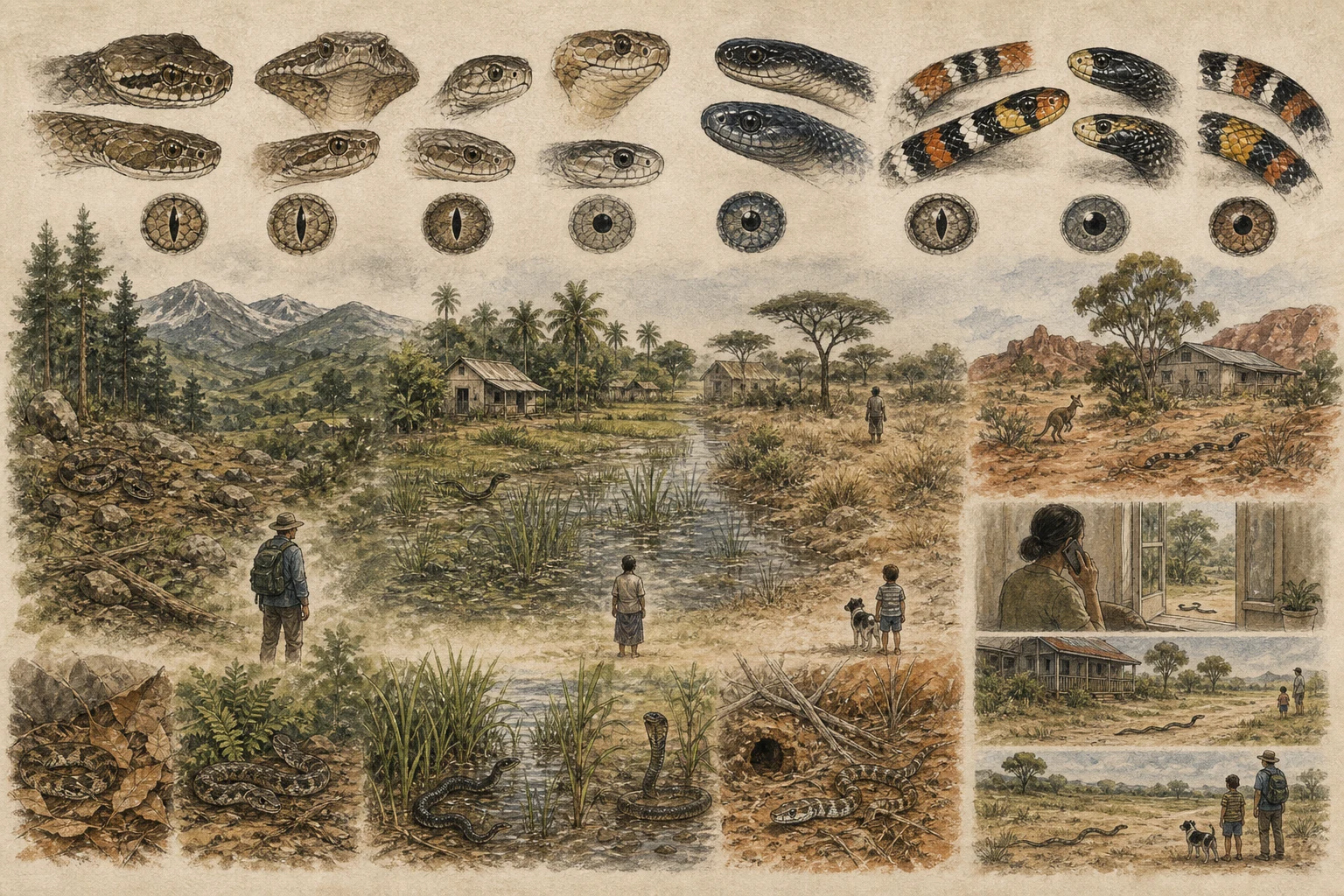
Folk rules promising an instant verdict—triangular heads mean venom, round pupils mean safety, or red-touching-yellow rhymes separate coral snakes from mimics—break down across global snake diversity. Many non-venomous watersnakes, rat snakes, and hognose snakes flare their jaws sideways into a dramatic triangle when startled, while deadly elapids such as cobras, mambas, kraits, coral snakes, and Australian brown snakes have sleek, narrow heads and round pupils. Even slit pupils dilate into circles in dim light, and getting close enough to inspect a snake's eye puts you well within striking reach. [1][2]
- Many harmless snakes flatten their heads into a triangle when threatened, while cobras and coral snakes have narrow heads
- Round pupils occur in numerous dangerously venomous elapids worldwide, and vertical pupils widen in low light
- Color-band rhymes for coral snakes fail outside parts of North America and break down on aberrant individuals
Identification is regional
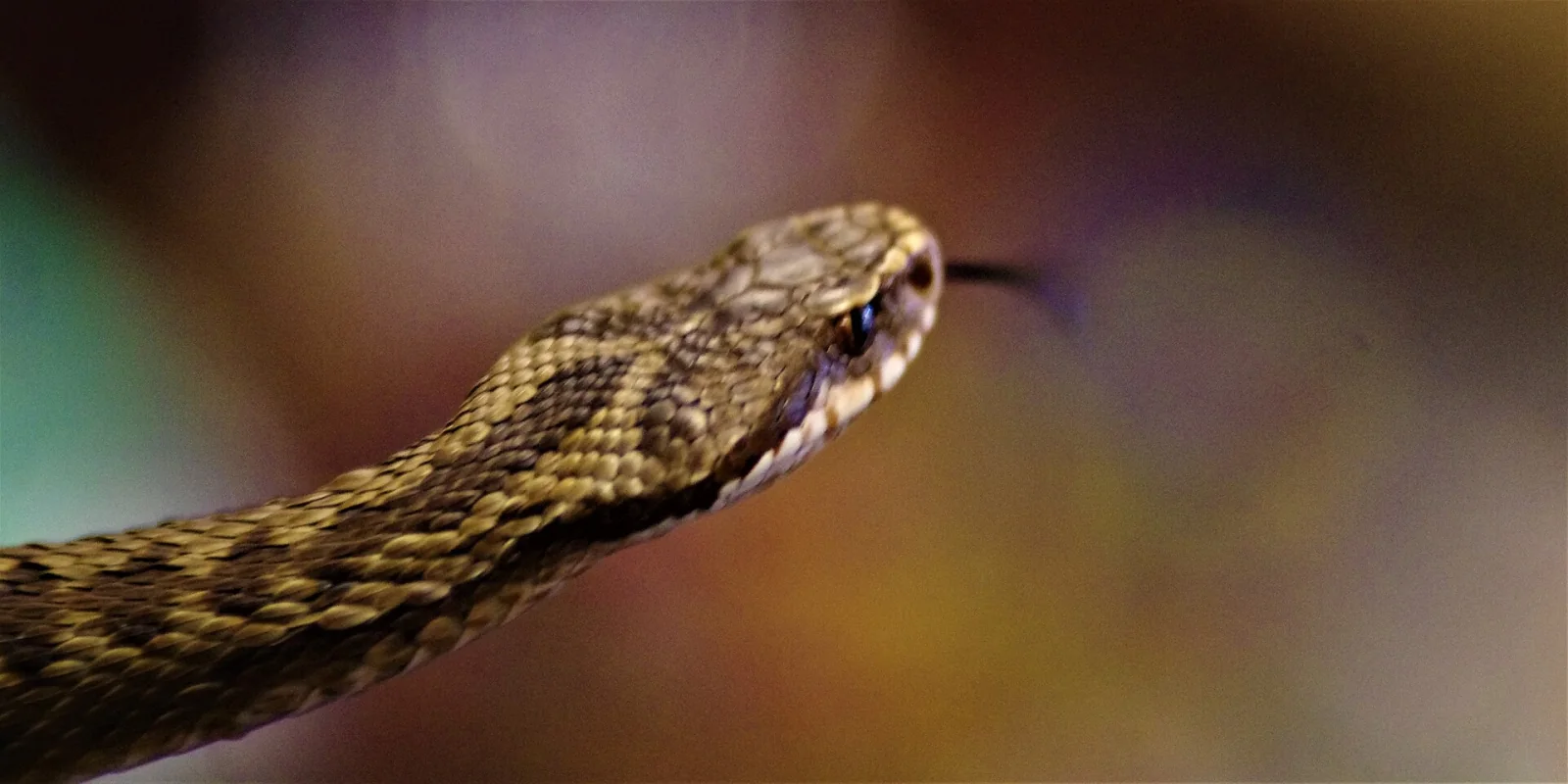
Medically important snakes belong to different families depending on continent and habitat, so reliable field marks are always local. In Britain and much of northern Europe, the common adder—recognized by its stocky build and dark dorsal zigzag—is the sole native venomous species; across much of North America, pit vipers with heat-sensing loreal pits, keeled scales, and rattles or broad cheeks predominate alongside slender coral snakes; in Australia and parts of Asia and Africa, smooth-scaled front-fanged elapids are primary. Learning the three or four venomous species native to your specific district beats any global rule. [2][3]
- Focus on learning the small number of venomous species native to your exact state, province, or region
- Combine body build, scale texture, tail structure, and dorsal pattern rather than relying on any single trait
- Use state wildlife agency guides, museum accounts, or regional herpetological atlases as your reference
Behavior and habitat are better clues
Observing from several paces back gives you safer, more diagnostic information than leaning in to examine head scales. Note whether the snake is basking on open heather or rock ledges, swimming with its body high or low in the water, climbing shrubs, or crossing warm evening pavement, and record approximate length, body girth, and tail tip—such as a rattle, a blunt scale cap, or a long whip taper. Seasonal rainfall and flooding also shift encounter rates by pushing both rodent prey and snakes out of inundated burrows toward dry banks and human structures. [3][4]
- Note habitat, posture, body thickness, scale keeling, and tail shape from a safe distance of several meters
- A telephoto lens or zoomed phone photo captures dorsal blotches and head shields without risking a close approach
- Warm spring mornings and post-rain floods often concentrate both harmless and venomous snakes on dry high ground
Distance is the reliable rule
Across public-health and occupational safety studies, a large proportion of snakebites occur when someone tries to pick up, corner, pin, or kill a snake rather than walking past it. Snakes do not chase people; their venom evolved to immobilize prey, and defensive strikes happen when an animal feels trapped at close range. Step back slowly, give the snake an unobstructed path into cover, keep dogs on a leash and children beside you, and call a licensed local snake catcher if an unidentified snake enters a house or yard. [1][4][5]
- Give any wild snake at least two to three body lengths of clear space and an unblocked route into cover
- Never attempt to pin, bag, or kill a snake—even a recently dead snake can deliver a reflexive envenomation
- Wear sturdy boots, watch where you place hands and feet on rocky ledges, and use a flashlight on warm nights
Related guides
Get Fauna and identify it in the field.
Where this guide comes from
Source-checked editorial guide. Last updated . This guide teaches identification and field skills; it is not a substitute for expert verification when it matters.
- World Health Organization — Snakebite envenoming ↗
- U.S. Centers for Disease Control and Prevention — Venomous snakes at work ↗
- New South Wales Environment and Heritage — Snakes and living with snakes ↗
- Amphibian and Reptile Conservation Trust (UK) — Adder ↗
- Smithsonian's National Zoo and Conservation Biology Institute — Eastern diamondback rattlesnake ↗