Speciation and reproductive isolation
Geography, ecology, mate recognition, timing, chromosome changes, and hybrid performance can restrict gene flow before or after fertilization. Barriers may accumulate gradually and incompletely, and some recognized species still hybridize. Reproductive isolation is central to many studies but is not a single universal species test.
Last updated
Isolation can begin with space or ecology
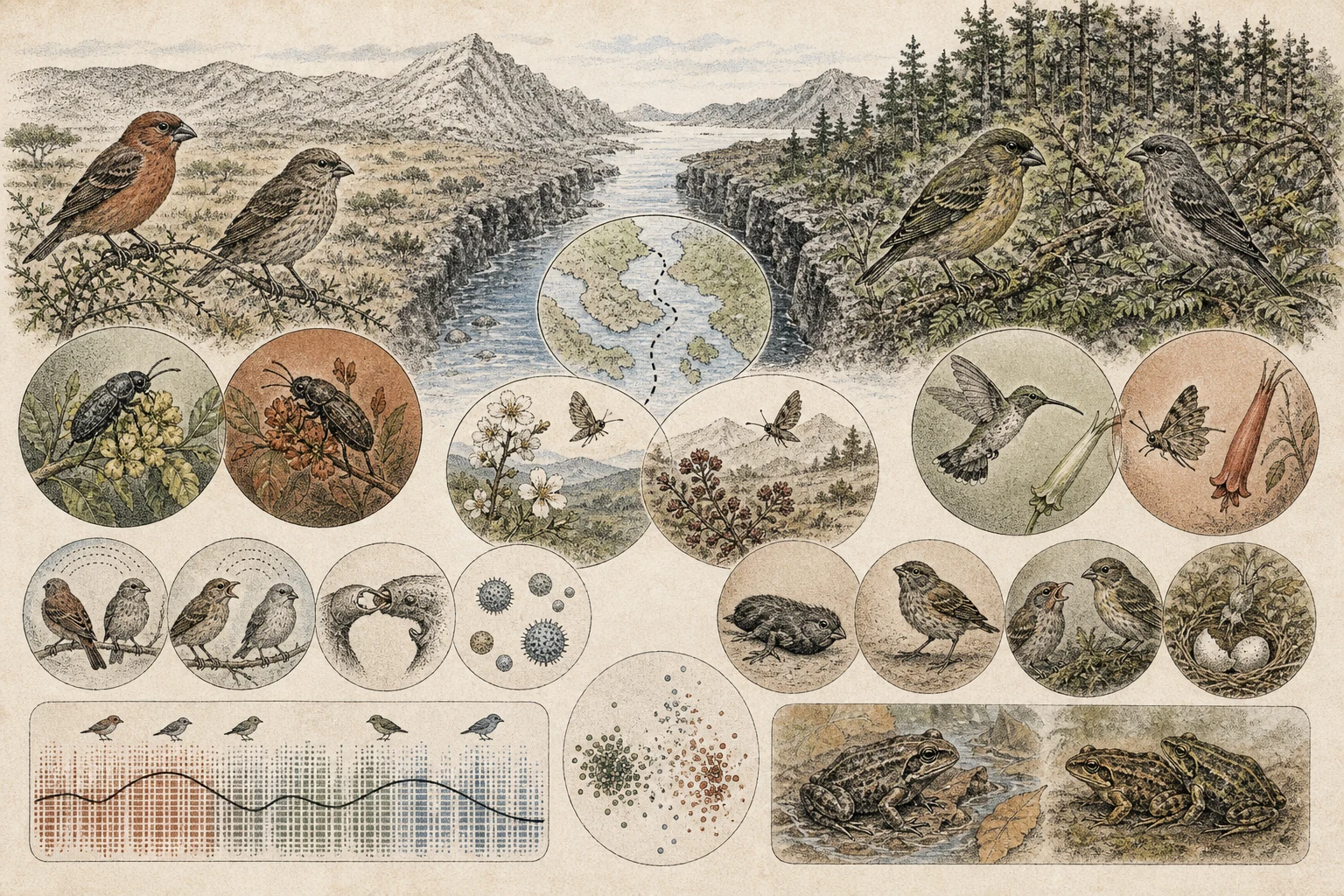
Lineage splitting often starts when a physical barrier—a rising mountain range, a glacial tongue, an arid valley, or an ocean strait—divides a once-continuous population, allowing natural selection and genetic drift to pull the isolated gene pools apart in allopatry. Divergence can also proceed alongside ongoing gene flow when neighboring populations specialize on contrasting host plants, soil types, water depths, pollinators, or breeding seasons and divergent selection is strong enough to counter homogenizing migration. In real landscapes, spatial and ecological divergence routinely interweave: climate cycles repeatedly separate and reconnect populations, testing nascent reproductive barriers in secondary contact zones. [1][3]
- Allopatric divergence begins when geographic barriers physically block dispersal and allow separate populations to evolve independently.
- Ecological divergence can proceed even with some gene flow when strong selection adapts populations to different hosts, soils, or breeding times.
- Many speciation histories combine periods of geographic separation with episodes of secondary contact and ecological sorting.
Barriers act at several stages
Reproductive isolation rarely hinges on a single magic switch; instead, multiple barriers act sequentially across the life cycle to filter out gene exchange. Prezygotic barriers prevent hybrid zygotes from forming in the first place: populations may occupy different microhabitats, flower or spawn in different weeks, use incompatible courtship songs or pheromones, recruit different bee versus hummingbird pollinators, or have mismatched reproductive structures and gametes. Postzygotic barriers act after fertilization, when chromosomal rearrangements, Dobzhansky–Muller genetic incompatibilities, or intermediate ecological traits cause hybrid embryos, seedlings, or adults to survive poorly or fail to produce viable gametes in the wild. [1][4]
- Prezygotic barriers act before fertilization through differences in habitat, breeding season, courtship behavior, pollinators, or gamete recognition.
- Postzygotic barriers act after fertilization when genetic incompatibilities or ecological mismatch lower hybrid survival or fertility.
- Several partial barriers acting one after another across the life cycle can combine to block nearly all effective gene flow.
Reproductive isolation is a quantity
Rather than treating reproductive isolation as an absolute yes-or-no boundary where zero hybrids ever appear, evolutionary biologists measure it quantitatively as the proportional reduction in effective gene flow caused by genetic differences between populations. Genome-wide sequencing shows that isolation is often porous: two distinct oak, butterfly, warbler, or trout lineages can hybridize along a narrow contact zone while natural selection weeds out incompatible genetic combinations and keeps the core genomes separate. Across a single genome, regions linked to barrier loci resist introgression strongly, whereas neutral alleles elsewhere on the chromosomes may cross between species for thousands of generations. [1][3]
- Reproductive isolation is measured as a quantitative reduction in effective gene flow rather than the complete absence of hybrids.
- Stable hybrid zones can persist for millennia when selection against hybrids balances ongoing dispersal across a habitat boundary.
- Different parts of the genome experience different barrier strengths, with loci under divergent selection resisting introgression most strongly.
Do not infer a barrier from appearance alone
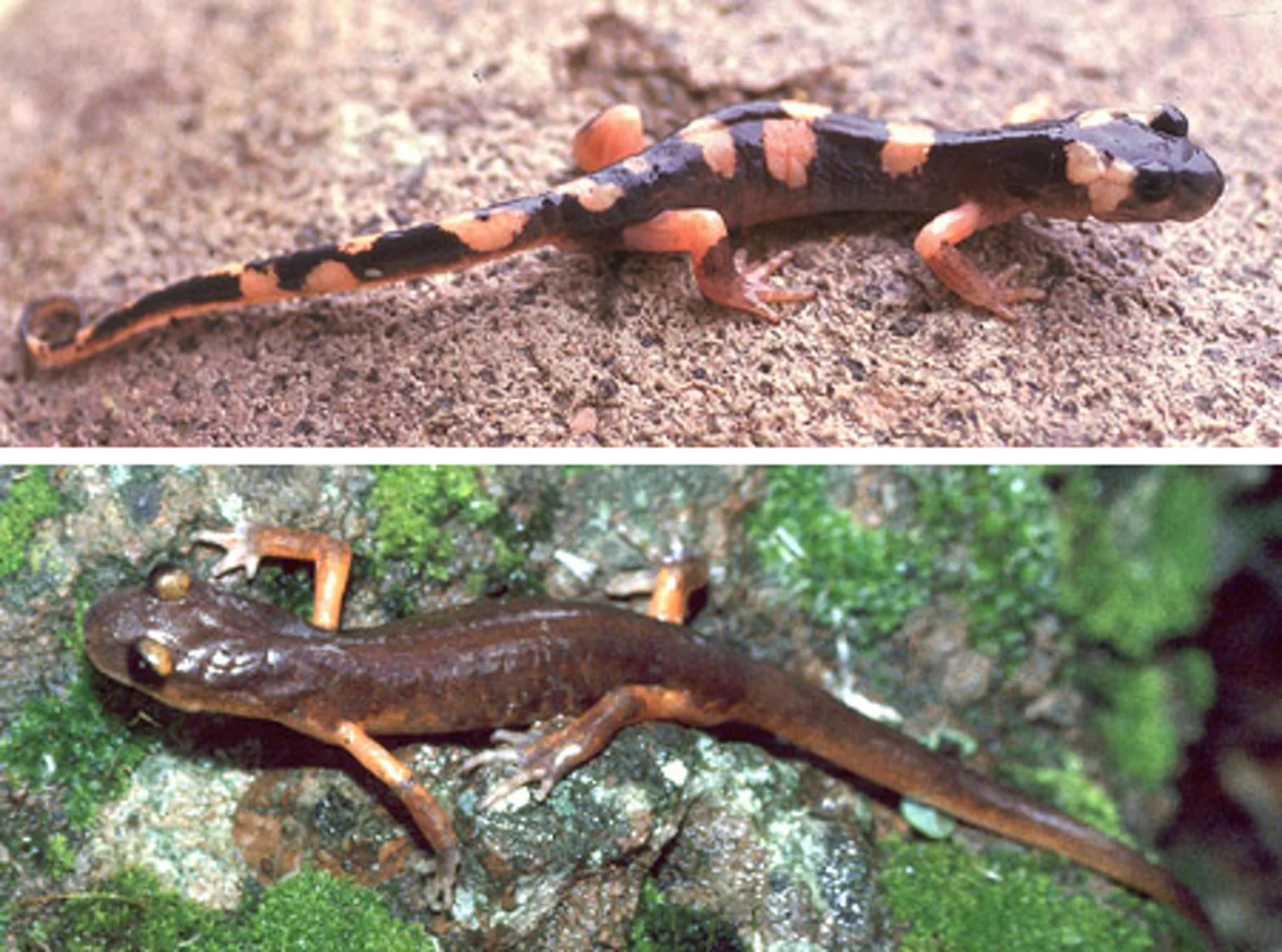
Field observers should resist judging reproductive isolation purely by how similar or different two organisms look in hand or through binoculars. Striking differences in plumage, shell banding, flower color, or body size can reflect phenotypic plasticity or local adaptation within a single interbreeding population, whereas morphologically cryptic frog, bat, or insect species with nearly identical outward appearance can be completely isolated by acoustic calls, pheromones, or chromosomes. Even classic ring-species models such as California's Ensatina salamanders—where blotched and unblotched forms encircle the Central Valley—reveal complex histories of geographic isolation, contact, and partial gene flow when examined with genomic markers. [2][4]
- Dramatic color or size differences can exist within a single interbreeding species, while cryptic species can look identical yet never interbreed.
- Ensatina salamanders around California's Central Valley illustrate how gradual geographic divergence and secondary contact create complex species boundaries.
- Testing species boundaries requires combining behavioral mate-choice trials, hybrid fitness data, and genomic estimates of gene flow.
Related guides
Get Fauna and identify it in the field.
Where this guide comes from
Source-checked editorial guide. Last updated . This guide teaches identification and field skills; it is not a substitute for expert verification when it matters.
- Journal of evolutionary biology — What is reproductive isolation? ↗
- Evolutionary journal of the Linnean Society — Common misconceptions of speciation ↗
- Proceedings of the National Academy of Sciences of the United States of America — Three problems in the genetics of speciation by selection ↗
- Science (New York, N.Y.) — Plant speciation ↗