The IUCN Red List: categories explained
The IUCN Red List is the global standard for extinction risk. It sorts each assessed species into one of nine categories — every one a dated, evidence-based verdict in a stated geographic scope.
Scope: Global and IUCN-published regional species assessments; not a substitute for national legal-protection lists · Last updated
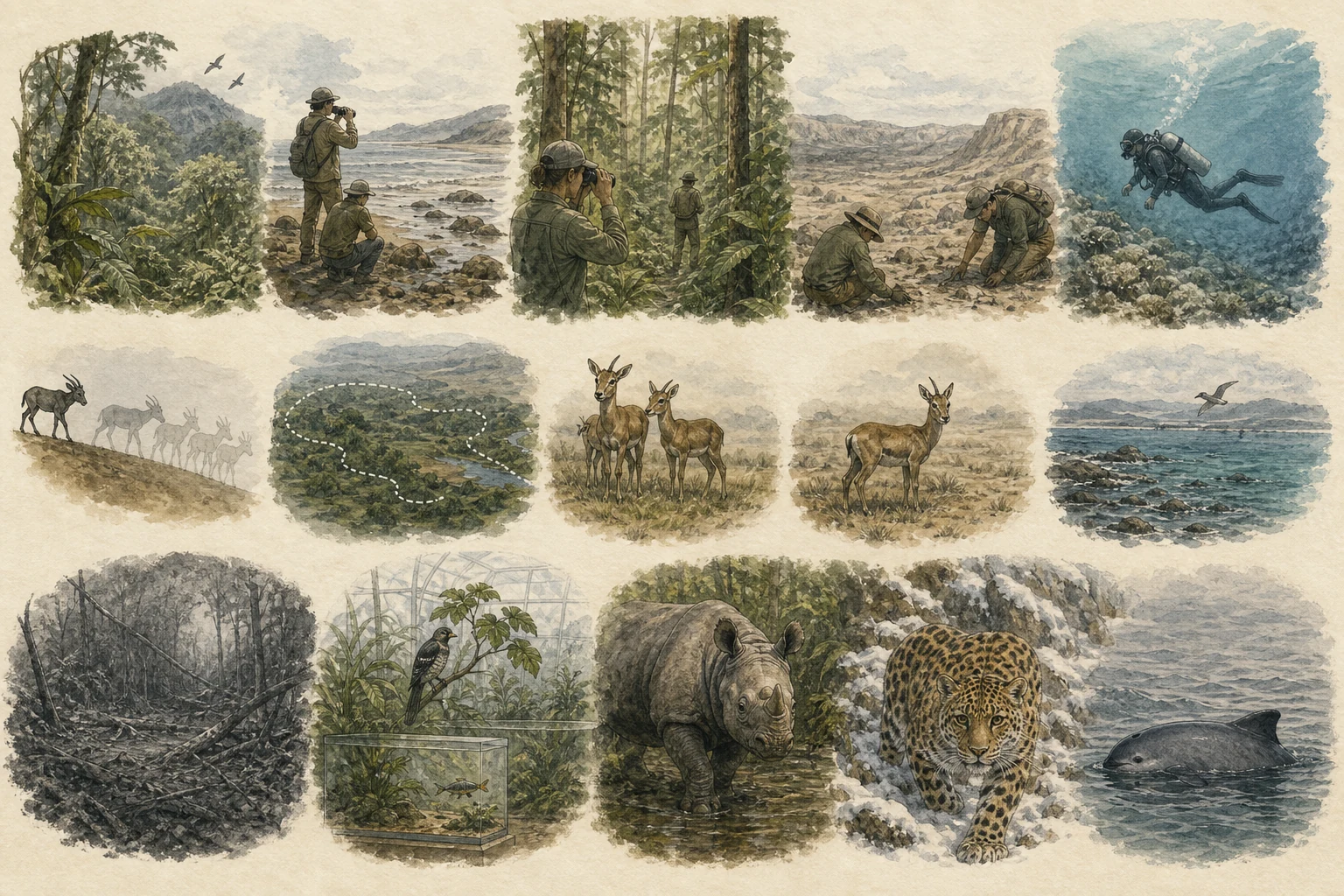
| Category | What it means | Example species |
|---|---|---|
| EXExtinct | No reasonable doubt the last individual has died. | Dodo · Passenger Pigeon · Thylacine |
| EWExtinct in the Wild | Survives only in cultivation, captivity, or as a naturalised population outside its historic range. | Père David's Deer · Hawaiian Crow · Guam Kingfisher |
| CRCritically Endangered | Faces an extremely high risk of extinction in the wild. | Javan Rhino · Amur Leopard · Vaquita |
| ENEndangered | Faces a very high risk of extinction in the wild. | Blue Whale · Asian Elephant · Red Panda |
| VUVulnerable | Faces a high risk of extinction in the wild. | African Lion · Polar Bear · Giant Panda |
| NTNear Threatened | Close to qualifying for a threatened category, or likely to soon. | Jaguar · Maned Wolf · Emperor Penguin |
| LCLeast Concern | Assessed and found widespread and abundant — the lowest risk. | Red Fox · Mallard · Grey Wolf |
| Not on the risk ladder | ||
| DDData Deficient | Not enough information to assess risk directly or indirectly. Not a verdict of low risk. | Orca · many deep-sea sharks |
| NENot Evaluated | Has not yet been assessed against the Red List criteria. | Most newly described and little-studied species |
Categories are assigned in a stated geographic scope and carry an assessment date; a species' category can change with new evidence or revision. Example species are illustrative of recent global assessments, not a current lookup.
What the IUCN Red List is
The IUCN Red List of Threatened Species is the world's most comprehensive inventory of the global extinction risk of animals, fungi, and plants. It is maintained by the International Union for Conservation of Nature with a network of partner organisations and thousands of expert assessors. Importantly, it is a scientific assessment of risk, not a law: appearing on the Red List confers no legal protection by itself. Every entry names the taxon assessed, the geographic scope, the assessment date, a category, the criteria met, and a written rationale. [1][2][6]
How a species gets its category
A category is not a vote or an opinion; it is the outcome of applying five quantitative criteria — population reduction over time, a small or restricted geographic range, a small and declining population, a very small or localised population, and a formal extinction-probability analysis. An assessor documents the evidence, proposes a category, and it is reviewed before publication. The same species can sit in different categories under a global versus a regional assessment, because the populations, dates, and rules differ. [2][3][5][6]
Extinct (EX)
A taxon is Extinct when there is no reasonable doubt that its last individual has died, confirmed by exhaustive surveys across its known range at the times and seasons it should appear. It is a deliberately high bar, which is why some long-unseen species linger in other categories for decades. Familiar examples include the dodo, the passenger pigeon, and the thylacine, or Tasmanian tiger. [1][2]
Extinct in the Wild (EW)
A taxon is Extinct in the Wild when it survives only in cultivation, in captivity, or as a naturalised population well outside its historic range — it no longer exists as a wild, self-sustaining population in its native habitat. It is one of the rarest categories, and often the last stop before either recovery or extinction. Père David's deer, the Hawaiian crow, and the Guam kingfisher have all been listed here. [1][2]
Critically Endangered (CR)
Critically Endangered is the highest level of threat for a species still found in the wild: it faces an extremely high risk of extinction, having met the most severe thresholds under the criteria, such as a tiny or fast-collapsing population. Species including the Javan rhinoceros, the Amur leopard, and the vaquita carry this category. [1][2]
Endangered (EN)
Endangered species face a very high risk of extinction in the wild — one rung below Critically Endangered. They meet serious but less extreme thresholds for population decline, range size, or population size. The blue whale, the Asian elephant, and the red panda are Endangered. [1][2]
Vulnerable (VU)
Vulnerable species face a high risk of extinction in the wild. Together with Endangered and Critically Endangered, Vulnerable makes up the three categories IUCN collectively calls threatened, so a Vulnerable listing still signals real trouble. The African lion, the polar bear, and the giant panda are all Vulnerable. [1][2]
Near Threatened (NT)
Near Threatened species do not currently meet the thresholds for a threatened category, but are close to qualifying, or are likely to qualify in the near future. It is a watch-list signal rather than an all-clear, and a small further decline can tip such a species into Vulnerable. The jaguar and the maned wolf are Near Threatened. [1][2]
Least Concern (LC)
Least Concern is a conclusion, not the absence of one: the species has been assessed and found widespread and abundant, so it does not qualify as threatened or Near Threatened. It does not mean 'no concern forever' — common species can decline, and many Least Concern assessments already note falling trends. The red fox, the mallard, and the grey wolf are Least Concern globally. [1][2]
Data Deficient (DD)
Data Deficient means there is not enough information to assess a species' extinction risk directly or indirectly — it is a statement about knowledge, not about safety. A Data Deficient species may prove common or highly threatened once studied. The orca is Data Deficient, reflecting how much remains unknown across its many distinct populations. [1][2]
Not Evaluated (NE)
Not Evaluated simply means the species has not yet been assessed against the Red List criteria. The majority of described species — especially insects, fungi, and other under-studied groups — are Not Evaluated, so absence from the Red List says nothing on its own about how threatened a species may be. [1]
What 'threatened' groups together
In IUCN usage, threatened is a precise umbrella for exactly three categories: Vulnerable, Endangered, and Critically Endangered. It is not a category of its own, and it does not include Near Threatened or Data Deficient. This is why everyday 'endangered' and Red List 'Endangered' are not the same — the everyday word loosely covers all threatened species, while the capitalised term is one specific rung on the ladder. [1][2]
Common misconceptions
A Red List badge is easy to misread. The category is a dated risk assessment in a stated scope, and several common assumptions simply do not hold: [1][4]
- Data Deficient does not mean safe — it means unknown, and can hide serious threat.
- Least Concern does not mean 'no concern' — assessed common species can still be declining.
- A move to a lower category is not always recovery — it can follow new data, a taxonomic split, or a corrected error.
- The Red List is not a legal protection list — protection comes from national laws and treaties, not the category itself.
How it differs from CITES, national laws, and Green Status
The Red List measures extinction risk; it does not regulate trade or grant protection. CITES is a separate treaty that controls international trade in listed species, while national laws are what actually make harming a species illegal — so a species can be Least Concern yet legally protected, or threatened yet unprotected. IUCN's newer Green Status of Species is a complementary measure that tracks a species' recovery and conservation success rather than only its risk of loss. [8][10]
How the Red List is used, and the bigger picture
Beyond labelling single species, the Red List guides where conservation funding, policy, and protected areas go, and it underpins global biodiversity targets. The Red List Index aggregates category changes over time to show whether biodiversity overall is improving or declining. As of recent updates, more than 150,000 species have been assessed and over a quarter of them are classed as threatened — figures that shift with every assessment cycle, which is why the date on an assessment always matters. [7][9][11]
Related guides
Get Fauna and identify it in the field.
Where this guide comes from
Source-checked editorial guide. Last updated . This guide teaches identification and field skills; it is not a substitute for expert verification when it matters.
- IUCN Red List — Frequently Asked Questions ↗
- IUCN — Red List Categories and Criteria, version 3.1 ↗
- IUCN Red List — Supporting Information ↗
- IUCN Red List — Reasons for Changing Category ↗
- IUCN Red List — Regional Assessments ↗
- IUCN Red List — Assessment Process ↗
- IUCN Red List — Summary Statistics ↗
- IUCN — Green Status of Species ↗
- IUCN Red List Index ↗
- CITES — What is CITES? ↗
- IUCN Red List — Uses of the Red List ↗