How to watch a great migration
The world's great herd migrations, such as East Africa's wildebeest circuit, are driven by rainfall and grazing rather than a calendar. Watching one well means understanding that the animals move on their own timetable, planning around broad seasonal patterns, and keeping enough distance that your presence never changes what the herds do.
Last updated
The herds follow rain, not a calendar
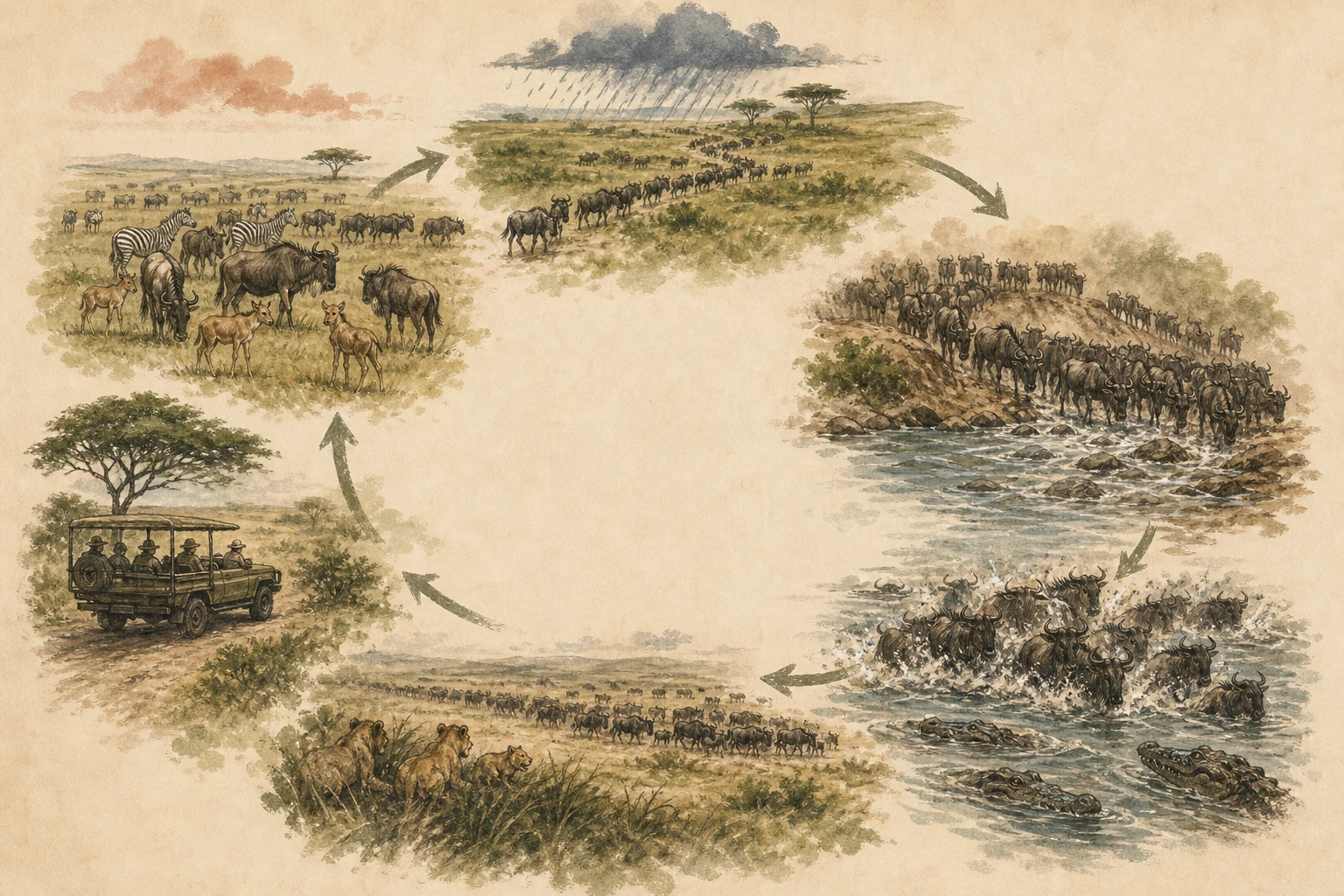
Large overland ungulate migrations track shifting gradients of fresh grass, mineral nutrition, and surface water across seasons. In East Africa's Serengeti–Mara ecosystem, roughly 1.3 million white-bearded wildebeest—accompanied by hundreds of thousands of plains zebras and Thomson's gazelles—move in a clockwise loop spanning Tanzania and Kenya. Because convective rainstorms and the Intertropical Convergence Zone shift weeks earlier or later from year to year, the herds advance, stall, or double back in response to green flushes and thunderheads rather than following fixed human calendar dates. [1][2]
- Roughly 1.3 million wildebeest plus zebras and gazelles cycle between Tanzania's Serengeti and Kenya's Masai Mara
- Herds follow freshly sprouted, mineral-rich grass and local rainstorms rather than fixed calendar dates
- Zebras often graze taller, coarser stems first while wildebeest feed on the shorter, nutritious lawn left behind
Plan around seasonal windows
While no day is guaranteed, the annual circuit follows reliable regional phases. From January through March, herds congregate on the phosphorus-rich short-grass plains of the southern Serengeti and Ngorongoro Conservation Area, where hundreds of thousands of calves are born within a synchronized few weeks. As the plains dry in May and June, columns trek northwest toward the Western Corridor and Grumeti River, reaching the Mara River and northern woodlands between July and October before heading south again with the November short rains. [2][3]
- January to March concentrates synchronized calving on the southern Serengeti short-grass plains
- May and June bring long trekking columns through central woodlands toward the Grumeti River
- July to October centers on the northern Serengeti and Masai Mara, including major Mara River crossings
Read the herd from a distance
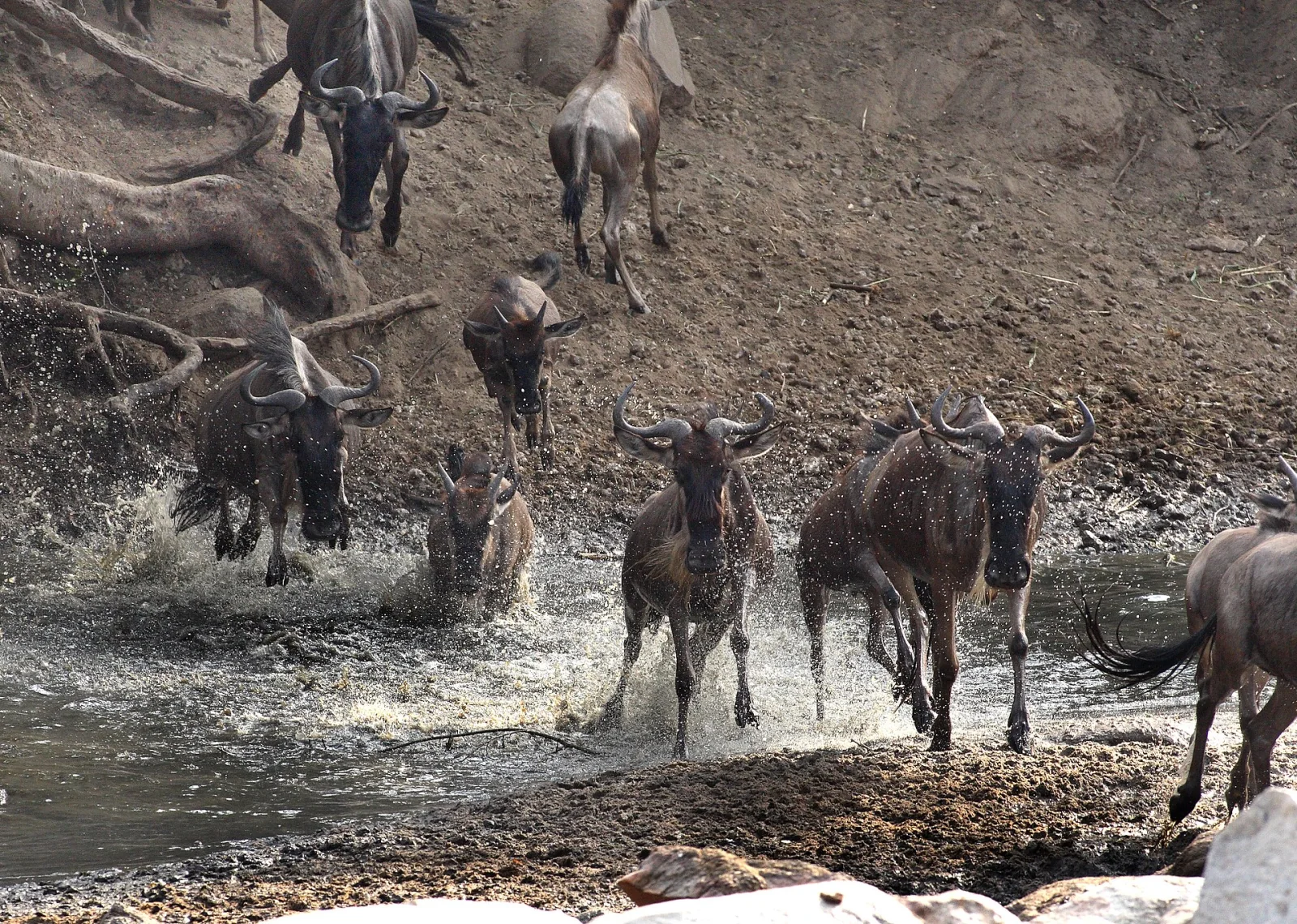
River crossings are famous, yet much of the migration's drama unfolds on the plains and banks long before the first animal leaps. Watch how strung-out trekking columns follow scent trails left by interdigital hoof glands, how herds gather in nervous thousands along steep cutbanks, and how a single alarm snort can send the entire front wheeling back from the water. Inside the river channel, steep mud exits, swift currents, and large Nile crocodiles make every crossing hazardous, so quiet observation of the build-up reveals collective decision-making in real time. [1][3]
- Trekking wildebeest follow both visual lines and interdigital hoof-gland scent trails laid down by leading animals
- Herds may mill and hesitate along a riverbank for hours before a single bold individual triggers a mass crossing
- Lions, leopards, spotted hyenas, and Nile crocodiles shadow herd edges and river bottlenecks
Watch without changing the outcome
At river crossing points and calving grounds, vehicle positioning directly affects animal survival. When safari trucks crowd the top of a riverbank or park in the exit gully on the far side, hesitant wildebeest often abort their crossing or panic into steeper, rockier channels where trampling and drowning spike. Stay strictly on designated park tracks, instruct your driver to hold back behind natural vegetation until the lead animals have committed to the water, and support licensed operators and conservancies that enforce vehicle limits. [3][4][5]
- Keep safari vehicles well back from riverbank entry and exit chutes so massing herds do not abort or stampede
- Never drive off-road onto calving plains, where vehicles can separate newborn calves from their mothers
- Choose licensed guides and conservancies that enforce strict vehicle caps at sightings and river crossings
Related guides
Get Fauna and identify it in the field.
Where this guide comes from
Source-checked editorial guide. Last updated . This guide teaches identification and field skills; it is not a substitute for expert verification when it matters.