Asian hornet, European hornet, or honeybee?
Europe's spreading yellow-legged hornet is smaller and darker than the native European hornet, with yellow leg-tips and an almost-black abdomen. Telling them apart—and telling both from honeybees—matters because official schemes rely on verified public sightings to track and slow an invasive predator of pollinators.
Last updated
Read the abdomen and legs first
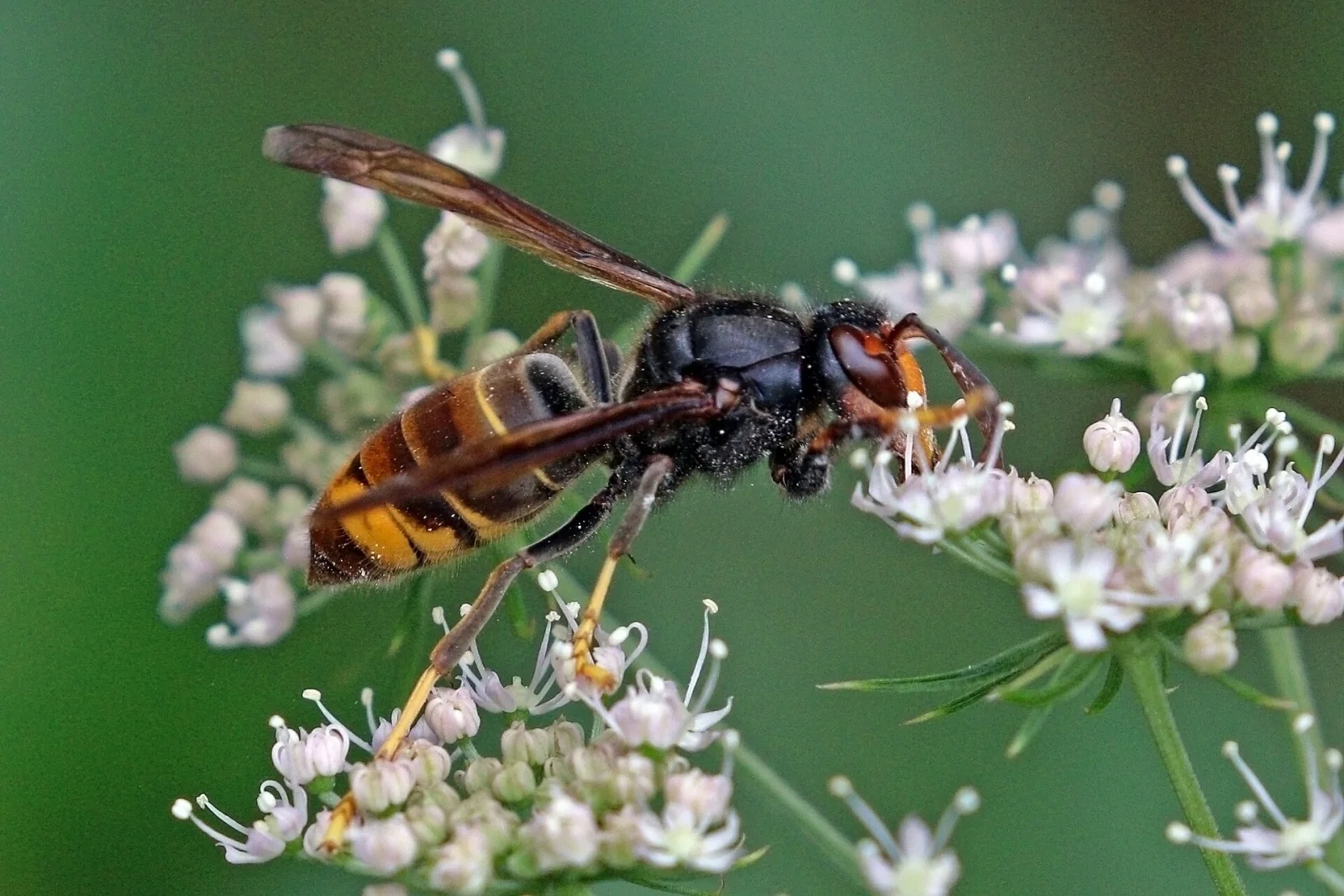
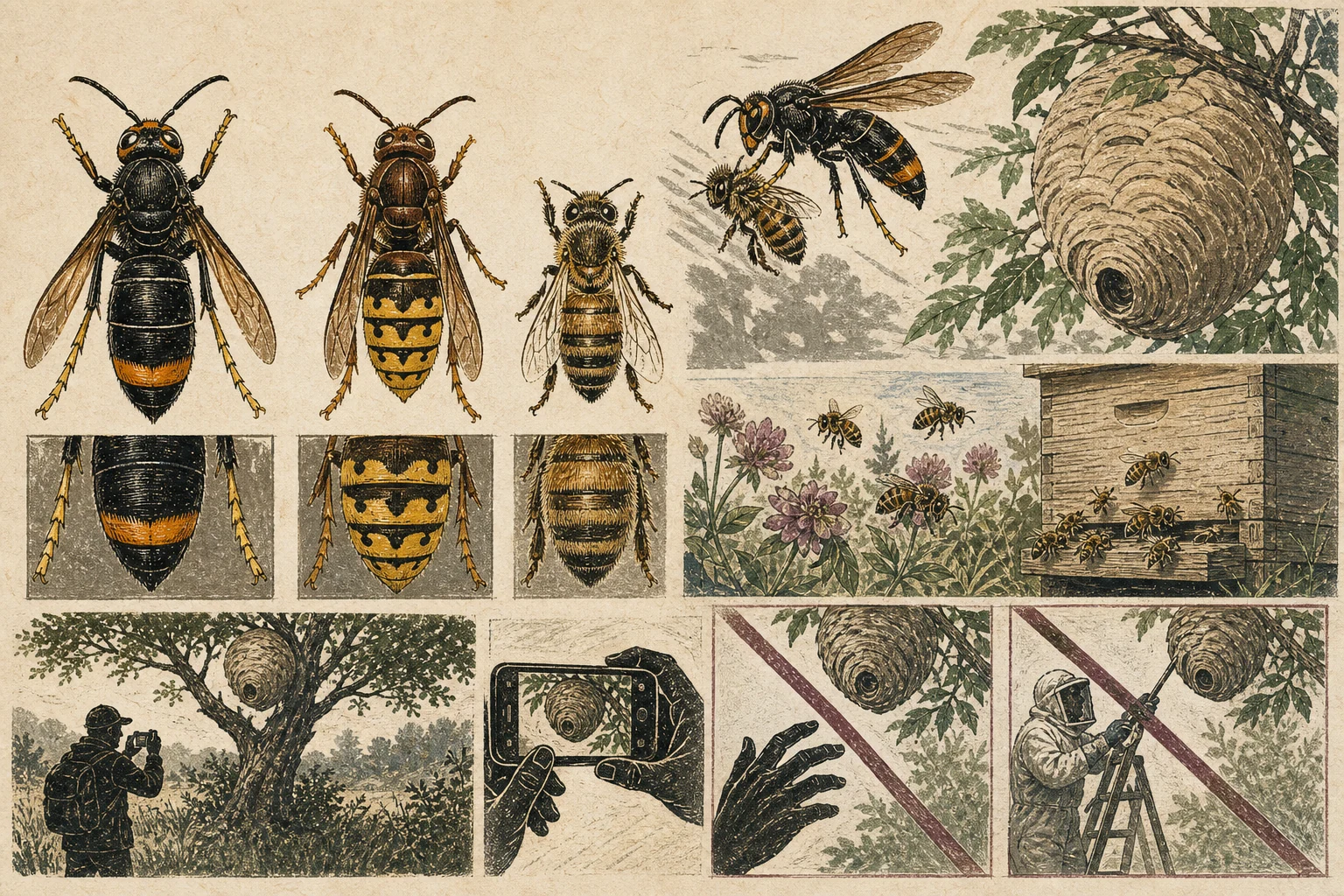
When a large wasp lands on ivy blooms, fallen autumn fruit, or an apiary entrance, check three field marks together: overall darkness, abdominal banding, and leg color. The invasive yellow-legged or Asian hornet (Vespa velutina) has a velvety dark-brown-to-black thorax, a mostly dark abdomen crossed by a single broad orange-yellow fourth segment, an orange face viewed from the front, and bright yellow lower leg segments that give the species its name. The native European hornet (Vespa crabro) is noticeably larger, with a reddish-brown thorax, extensive pale yellow abdominal bands marked with dark teardrops, and wholly brown legs. [1][2]
- Yellow-legged hornet (Vespa velutina): dark velvety thorax, mostly black abdomen with one broad orange band, and bright yellow leg tips
- European hornet (Vespa crabro): larger body, chestnut-brown thorax, brown legs, and pale yellow abdomen across most segments
- Check both the yellow tarsi and the dark single-banded abdomen together so shadows do not trick your eye
Do not confuse hornets with honeybees
Western honeybees (Apis mellifera) and native look-alikes such as giant woodwasps or hoverflies are frequently misreported during public hornet alerts. Honeybees are roughly half a hornet's length, covered in golden-brown branched hairs, and pack pollen into shiny baskets on their dark hind tibiae while foraging quietly on blossoms. Hornets have smooth, sparsely haired bodies, deep waist constrictions, and folding wings, and yellow-legged hornets often hover in a distinctive stationary hawk directly in front of beehive entrances to intercept returning foragers in midair. [2][3]
- Honeybees are much smaller (around 12–15 mm), furry, and amber-brown, carrying pollen loads on dark hind legs
- Native European hornets are valuable woodland predators that often fly at dusk and rarely hawk steadily at hive doors
- Yellow-legged hornets frequently hover facing a beehive entrance to snatch returning honeybees on the wing
Why the sightings are wanted
Accidentally introduced to southwestern France around 2004, Vespa velutina has spread across western Europe and repeatedly reached Britain and Ireland. A single mature secondary nest in late summer can house thousands of hornets that consume large quantities of honeybees, hoverflies, and solitary wasps, stressing both managed apiaries and wild pollination networks. Because fertilized queens establish small primary nests in spring before building high canopy nests in summer, rapid public reporting lets national bee inspectors trace flight lines and remove colonies before new queens disperse in autumn. [3][4][5]
- A single yellow-legged hornet colony can capture thousands of honeybees, hoverflies, and native wasps over a summer
- Queens build small sheltered primary nests in spring before colonies often relocate high into tree crowns in summer
- Finding and destroying nests before autumn prevents dozens of newly mated queens from overwintering
Report, don't approach
If you spot a suspect hornet on late-flowering ivy, fallen orchard fruit, or near hives, step back and take a sharp photograph or brief video showing the legs and abdomen rather than swatting the insect or approaching a nest. Disturbance near a yellow-legged hornet nest provokes coordinated, dangerous mass defense by workers. Submit the image, exact coordinates, and time through your country's official biosecurity channel—such as the Asian Hornet Watch app in the UK—so trained inspectors can verify the record, track foraging direction, and carry out professional nest eradication. [4][5]
- Photograph the insect on ivy blooms, fallen fruit, or bait stations from a safe distance without killing or trapping native species
- Never approach, shake, or attempt to spray a suspected hornet nest, as colonies defend their envelope aggressively
- Submit photos and exact location pins through official national reporting apps so inspectors can trace flight lines
Related guides
Get Fauna and identify it in the field.
Where this guide comes from
Source-checked editorial guide. Last updated . This guide teaches identification and field skills; it is not a substitute for expert verification when it matters.