The IUCN Red List: categories explained
The IUCN Red List is the global standard for extinction risk. It sorts each assessed species into one of nine categories — every one a dated, evidence-based verdict in a stated geographic scope.
Last updated
| Category | What it means | Example species |
|---|---|---|
| EXExtinct | No reasonable doubt the last individual has died. | Dodo · Passenger Pigeon · Thylacine |
| EWExtinct in the Wild | Survives only in cultivation, captivity, or as a naturalised population outside its historic range. | Père David's Deer · Hawaiian Crow · Guam Kingfisher |
| CRCritically Endangered | Faces an extremely high risk of extinction in the wild. | Javan Rhino · Amur Leopard · Vaquita |
| ENEndangered | Faces a very high risk of extinction in the wild. | Blue Whale · Asian Elephant · Red Panda |
| VUVulnerable | Faces a high risk of extinction in the wild. | African Lion · Polar Bear · Giant Panda |
| NTNear Threatened | Close to qualifying for a threatened category, or likely to soon. | Jaguar · Maned Wolf · Emperor Penguin |
| LCLeast Concern | Assessed and found widespread and abundant — the lowest risk. | Red Fox · Mallard · Grey Wolf |
| Not on the risk ladder | ||
| DDData Deficient | Not enough information to assess risk directly or indirectly. Not a verdict of low risk. | Orca · many deep-sea sharks |
| NENot Evaluated | Has not yet been assessed against the Red List criteria. | Most newly described and little-studied species |
Categories are assigned in a stated geographic scope and carry an assessment date; a species' category can change with new evidence or revision. Example species are illustrative of recent global assessments, not a current lookup.
What the IUCN Red List is
The IUCN Red List of Threatened Species is the world's most comprehensive scientific inventory of the extinction risk of animals, fungi, and plants. Maintained by the International Union for Conservation of Nature alongside partner organizations and thousands of specialist assessors, it evaluates how close a taxon is to disappearing within a stated geographic scope. Crucially for naturalists, the Red List is an evidence-based risk assessment rather than a statute: a listing confers no automatic legal protection on the ground. Every published account records the exact taxon concept, the geographic scope, the assessment date, the assigned category, the specific quantitative criteria met, and a detailed supporting rationale. [1][2][6]
- Field check: read the assessment date, geographic scope, and rationale text on a Red List profile rather than quoting the two-letter badge alone.
- Common trap: assuming an IUCN Red List category automatically makes a plant or animal legally protected under national or state law.
- Check the population trend arrow and habitat notes inside the assessment for practical natural-history context.
How a species gets its category
Assigning a Red List category is not an informal vote or a measure of charisma; it is the result of testing available data against five quantitative criteria (A through E). Those criteria measure population reduction over time, restricted geographic range (extent of occurrence or area of occupancy), small and declining population size, very small or restricted populations, and quantitative extinction-probability modeling. Specialist assessors compile survey data, map ranges, propose a category using the strictest threshold met, and submit the account to independent peer review before publication. Because regional assessments evaluate only populations inside a political or biogeographic boundary, the same species can hold different global and regional statuses. [2][3][5][6]
- Five criteria (A–E) test population decline, range size, small and declining numbers, tiny populations, and modeled extinction probability.
- A species only needs to meet one criterion at a given threshold to be placed in that threatened category.
- Field check: verify whether a quoted status comes from the global Red List or a national or regional Red List assessment.
Extinct (EX)
A taxon is classified as Extinct when there is no reasonable doubt that the last individual has died. Reaching that verdict requires exhaustive targeted surveys across all known and likely habitats throughout the species' historic range, conducted at appropriate times of day, seasons, and annual cycles over a timeframe suited to the organism's life history and life form. Because declaring a species Extinct prematurely could halt conservation protection if a remnant population survives, assessors hold this category to a deliberately strict evidentiary bar, leaving some long-unseen taxa as Critically Endangered (Possibly Extinct) for decades. Well-known examples include the dodo, the passenger pigeon, and the thylacine. [1][2]
- Requires exhaustive surveys across historic habitat at appropriate seasons and life-cycle windows before the final verdict is made.
- Long-unseen species where faint hope persists are often flagged as Critically Endangered (Possibly Extinct) rather than moved prematurely to EX.
- Classic examples include the passenger pigeon, the dodo, and the thylacine (Tasmanian tiger).
Extinct in the Wild (EW)
A taxon enters Extinct in the Wild when exhaustive surveys confirm it no longer survives as a free-living, self-sustaining population inside its native range, yet living individuals persist in captivity, botanical cultivation, or as a naturalized population well outside its past distribution. It is one of the smallest categories on the Red List and represents an urgent conservation threshold between total loss and reintroduction to restored native habitat. Species that have occupied this category include Père David's deer, the Hawaiian crow ('alalā), and the Guam kingfisher (sihek), where intensive breeding programs have maintained the lineage while ecological threats in the wild are addressed. [1][2]
- Applies when a species survives only in zoos, aquaria, seed banks, botanical gardens, or naturalized populations outside its historic range.
- Exhaustive field surveys in known and expected native habitat must still verify that no wild native population remains.
- Notable examples that have been listed here include Père David's deer, the Hawaiian crow, and the Guam kingfisher.
Critically Endangered (CR)
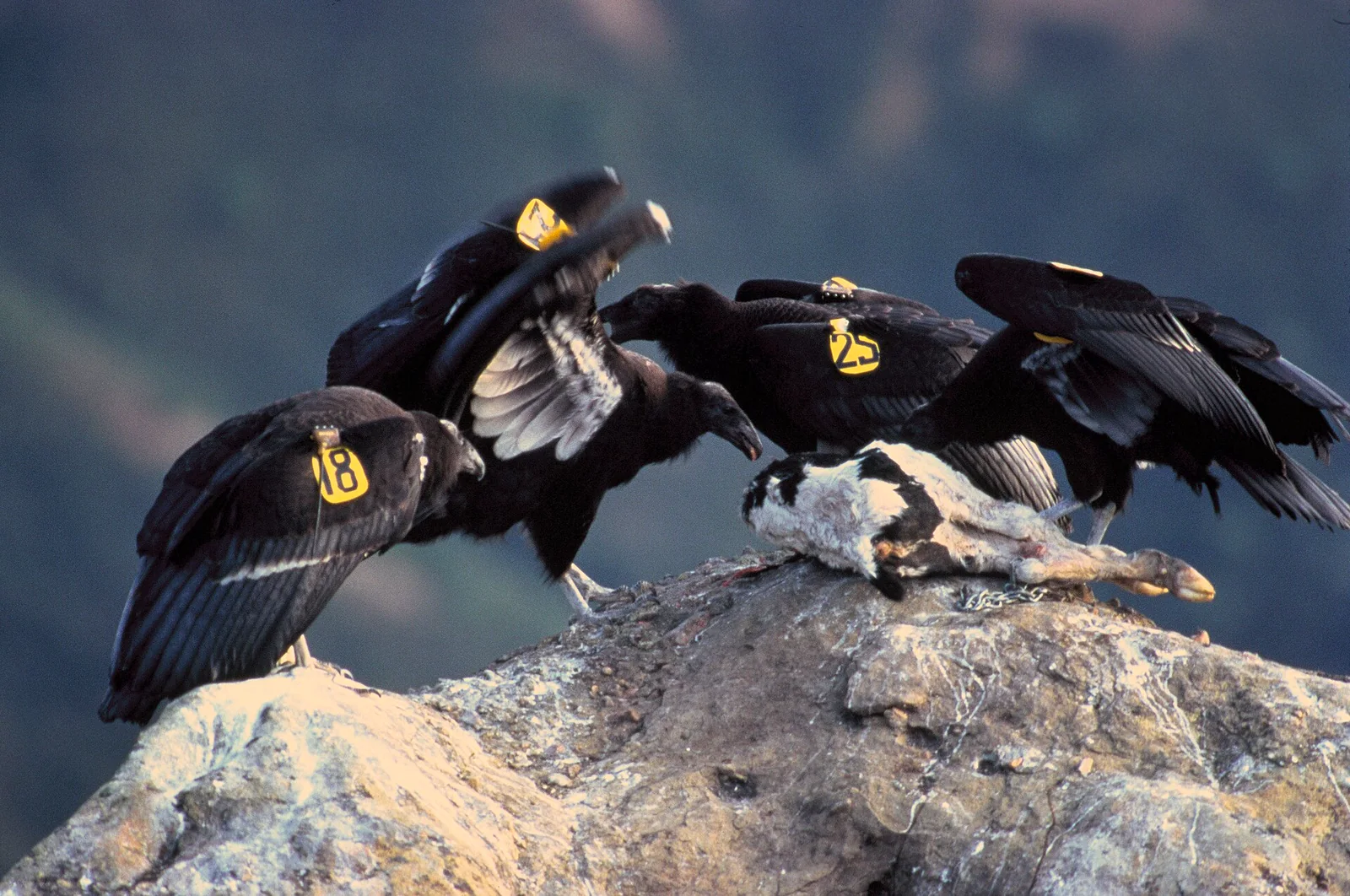
Critically Endangered is the highest risk category assigned to a species that still persists in the wild, indicating an extremely high risk of extinction in the wild. To qualify, a taxon must cross the most severe quantitative thresholds under at least one of the five Red List criteria—such as an extreme, rapid population collapse, an exceedingly small or fragmented area of occupancy coupled with continuing decline, or a total mature wild population numbering fewer than 50 individuals. Iconic species carrying a Critically Endangered global status include the California condor, the Javan rhinoceros, the Amur leopard, and the vaquita porpoise of the northern Gulf of California. [1][2]
- Represents the most severe threat tier for organisms that still have extant wild populations.
- Triggered by extreme thresholds in population loss, tiny and shrinking range size, or very small numbers of mature individuals.
- Global examples include the California condor, Javan rhinoceros, Amur leopard, and vaquita.
Endangered (EN)
Endangered species face a very high risk of extinction in the wild, sitting one step below Critically Endangered on the Red List scale. A species is placed here when empirical or modeled evidence shows that it crosses serious quantitative thresholds for steep population reduction, a restricted and declining geographic range, or a small mature population experiencing ongoing contraction or severe fluctuations. In everyday speech people often call any imperiled animal 'endangered,' but in IUCN terminology Endangered (EN) is a specific mid-tier threatened category. Familiar species assessed as Endangered globally include the blue whale, the Asian elephant, the red panda, and the whale shark. [1][2]
- Indicates a very high risk of extinction in the wild under quantitative thresholds for decline, range restriction, or small population size.
- Keep capital-E Endangered (the specific IUCN category between VU and CR) distinct from the casual everyday word 'endangered.'
- Well-known Endangered species include the blue whale, Asian elephant, and red panda.
Vulnerable (VU)
Vulnerable species face a high risk of extinction in the wild and occupy the first of the three formal threatened categories on the Red List. Even when a Vulnerable plant or animal still looks locally familiar in strongholds, the global assessment shows that it has crossed substantive thresholds for population decline, range contraction, or small population vulnerability that put its long-term survival in jeopardy without effective conservation management. Together with Endangered and Critically Endangered, Vulnerable forms the core group of species counted when scientists report the total number of threatened species worldwide. Prominent Vulnerable species include the African lion, the polar bear, and the giant panda. [1][2]
- Marks the entry threshold for IUCN's three formal threatened categories, indicating a high risk of extinction in the wild.
- A species can still be locally visible in prime habitat while qualifying as Vulnerable due to steep range-wide declines.
- Global examples include the African lion, polar bear, and giant panda.
Near Threatened (NT)
A taxon is classified as Near Threatened when it has been evaluated against the quantitative criteria and does not currently satisfy the thresholds for Critically Endangered, Endangered, or Vulnerable, but is close to qualifying for a threatened category now or is likely to cross into one in the near future. Near Threatened serves as an early-warning watch list rather than a clean bill of health: if habitat loss, overharvest, or climate stress continues unchecked, a modest additional decline can push the species into Vulnerable. Assessors also place species here when their persistence depends on ongoing conservation programs. The jaguar and the maned wolf are both Near Threatened. [1][2]
- Acts as a formal early-warning category for taxa approaching the quantitative thresholds for Vulnerable.
- Not counted inside the official 'threatened' total (which covers only VU, EN, and CR), yet signals real conservation pressure.
- Familiar Near Threatened examples include the jaguar and the maned wolf.
Least Concern (LC)
Least Concern is an active scientific conclusion, not a default label for species that nobody has bothered to study. It means the taxon has been formally evaluated against the Red List criteria and found to be widespread and abundant enough that it does not qualify as Critically Endangered, Endangered, Vulnerable, or Near Threatened. However, Least Concern never means 'safe forever' or 'free of local decline.' Many Least Concern species—including familiar woodland birds, amphibians, and freshwater fishes—carry a declining population trend arrow in their Red List account or face severe regional peril despite a large global range. The red fox, mallard, and grey wolf are Least Concern globally. [1][2]
- Applies only to species that have been formally evaluated and found widespread and abundant enough to fall below Near Threatened.
- Field check: always check the population trend field on a Least Concern profile, as widespread species can still be declining.
- Examples of globally Least Concern species include the mallard, red fox, and grey wolf.
Data Deficient (DD)
A taxon is listed as Data Deficient when there is inadequate information to make a direct or indirect assessment of its risk of extinction based on its distribution or population status. A Data Deficient listing may apply to a newly described amphibian known from a single cloud-forest stream, a cryptic deep-sea fish, or a widespread complex like the killer whale (orca), where taxonomic uncertainty across distinct ecotypes prevents a single unified calculation. Crucially, Data Deficient is not a category of low threat: once field surveys and taxonomic studies fill the gap, many Data Deficient species turn out to be seriously threatened. [1][2]
- Data Deficient is a statement about insufficient scientific data on abundance or distribution, not a low-risk verdict.
- Many poorly known insects, fungi, amphibians, and marine mammals sit in DD until targeted field studies are completed.
- The killer whale (orca) is listed as Data Deficient globally because risk varies across its distinct, still-debated ecotypes.
Not Evaluated (NE)
Not Evaluated is the status of every described species that has not yet been formally put through the IUCN Red List assessment process. While mammals, birds, amphibians, sharks, reef-building corals, conifers, and cycads have been comprehensively assessed, the vast majority of Earth's described invertebrates, fungi, lichens, mosses, and flowering plants remain Not Evaluated simply because expert time and survey funding are finite. When a field guide or database shows no Red List status for a beetle, spider, or mushroom, that silence means Not Evaluated—never assume that an unassessed organism is common, secure, or ecologically resilient. [1]
- Covers all described species that have not yet been formally assessed against the Red List criteria.
- Most insects, arachnids, fungi, and non-vascular plants remain Not Evaluated despite facing the same habitat pressures as vertebrates.
- Common trap: treating the absence of a Red List entry as evidence that a species is abundant or out of danger.
What 'threatened' groups together
In technical conservation writing and IUCN summary statistics, the word 'threatened' is not a loose adjective—it is a strict umbrella term encompassing exactly three Red List categories: Vulnerable (VU), Endangered (EN), and Critically Endangered (CR). It excludes Near Threatened, Least Concern, Data Deficient, and the two extinct categories. Keeping this distinction clear prevents one of the most frequent errors in wildlife reporting: conflating lowercase 'threatened' (the three-category group) with Vulnerable, or conflating everyday 'endangered' with capital-E Endangered (EN). When you cite a species' status in field notes or articles, state the exact IUCN category and its two-letter code. [1][2]
- In IUCN terminology, 'threatened' is the exact combined total of Vulnerable (VU), Endangered (EN), and Critically Endangered (CR).
- Near Threatened (NT) and Data Deficient (DD) are tracked separately and are not included in the threatened species count.
- Write both the capitalized category name and its code (for example, Endangered [EN]) to avoid ambiguity with everyday language.
Common misconceptions
Because Red List badges appear on museum placards, Wikipedia sidebars, and field guides without their accompanying documentation, observers easily misinterpret what a category change or status label actually means. A shift from Endangered to Vulnerable, for instance, does not automatically celebrate a conservation recovery; the Red List tracks 'genuine' changes (driven by real improvements or declines in the wild) separately from 'non-genuine' changes caused by better survey data, taxonomic splits or lumps, or corrected past errors. Reading the 'Reasons for Change' and scope fields prevents you from misreading a taxonomic revision or a Data Deficient label as good news. [1][4]
- Data Deficient does not mean safe—it means risk cannot yet be calculated from existing distribution and population evidence.
- Least Concern does not mean 'no concern'—widespread species can still experience steep local or regional declines.
- A category change often reflects new survey data or a taxonomic split rather than a genuine biological recovery or decline.
How it differs from CITES, national laws, and Green Status
Wildlife observers frequently encounter three other conservation frameworks that serve entirely different roles from the Red List. First, CITES (the Convention on International Trade in Endangered Species of Wild Fauna and Flora) is an international treaty that regulates cross-border trade in listed specimens via Appendices I, II, and III. Second, national and subnational laws—such as the U.S. Endangered Species Act or national wildlife acts—are what confer actual legal protection and penalties on the ground, so a species can be globally Least Concern yet strictly protected by law. Third, IUCN's Green Status of Species complements the Red List by measuring how far a species has recovered toward ecological functionality across its indigenous range. [8][10]
- CITES Appendices regulate international trade in specimens, whereas the Red List evaluates biological extinction risk.
- Legal protection against take, disturbance, or habitat destruction comes from national and local statutes, not from the Red List itself.
- IUCN's Green Status of Species measures recovery and conservation legacy alongside the Red List's measure of extinction risk.
How the Red List is used, and the bigger picture
Beyond informing naturalists about single species, the Red List underpins global biodiversity policy, site-level conservation planning, environmental impact assessments, and funding priorities. By tracking how groups of comprehensively assessed taxa move between categories over time through genuine status changes, scientists compute the Red List Index (RLI), a headline indicator used by international biodiversity conventions to measure whether overall extinction risk is accelerating or slowing. Across recent updates, well over 150,000 species have been evaluated and more than a quarter of assessed species fall into the three threatened categories—numbers that evolve with every update cycle, making the assessment date an essential part of any citation. [7][9][11]
- The Red List Index (RLI) tracks genuine category movements across fully assessed groups to measure global biodiversity trends.
- Conservation planners use Red List spatial data and threat classifications to prioritize protected areas and restoration funding.
- Field check: always record the assessment year when citing Red List statistics or an individual species' category.
Related guides
Get Fauna and identify it in the field.
Where this guide comes from
Source-checked editorial guide. Last updated . This guide teaches identification and field skills; it is not a substitute for expert verification when it matters.
- IUCN Red List — Frequently Asked Questions ↗
- IUCN — Red List Categories and Criteria, version 3.1 ↗
- IUCN Red List — Supporting Information ↗
- IUCN Red List — Reasons for Changing Category ↗
- IUCN Red List — Regional Assessments ↗
- IUCN Red List — Assessment Process ↗
- IUCN Red List — Summary Statistics ↗
- IUCN — Green Status of Species ↗
- IUCN Red List Index ↗
- CITES — What is CITES? ↗
- IUCN Red List — Uses of the Red List ↗