Porcupine warning signs, and the one animal that ignores them
Porcupines cannot throw quills and never start a fight. They run through a predictable ladder of warnings — raise, rattle, then charge backwards — and a person who reads the first rung is never at risk. The animal that cannot read it is the one on the end of your lead, and a quilled dog is a same-day veterinary emergency rather than a job for pliers.
Scope: Escalation sequence and quill anatomy from the Pennsylvania Game Commission and Mass Audubon; veterinary guidance from VCA Animal Hospitals. North American porcupine (Erethizon dorsatum) only — African crested and South American prehensile-tailed porcupines differ in size, quill structure, and behaviour. Two claims commonly repeated about porcupine defence, a pungent warning odour and audible quill rattling, are not made by the authorities cited here and are therefore not stated as fact. Education, not veterinary advice. · Last updated
- They cannot shoot quills. They never could[1][2]
- The ladder, and why it exists[1]
- Level 1: the quills go up and the face goes away[1][2]
- Level 2: the sound you will hear before you see anything[1]
- Level 3: it comes at you backwards[1][2]
- What a quill does once it is in[1][3]
- Why it is nearly always the dog[3]
- If your dog is quilled[3]
They cannot shoot quills. They never could
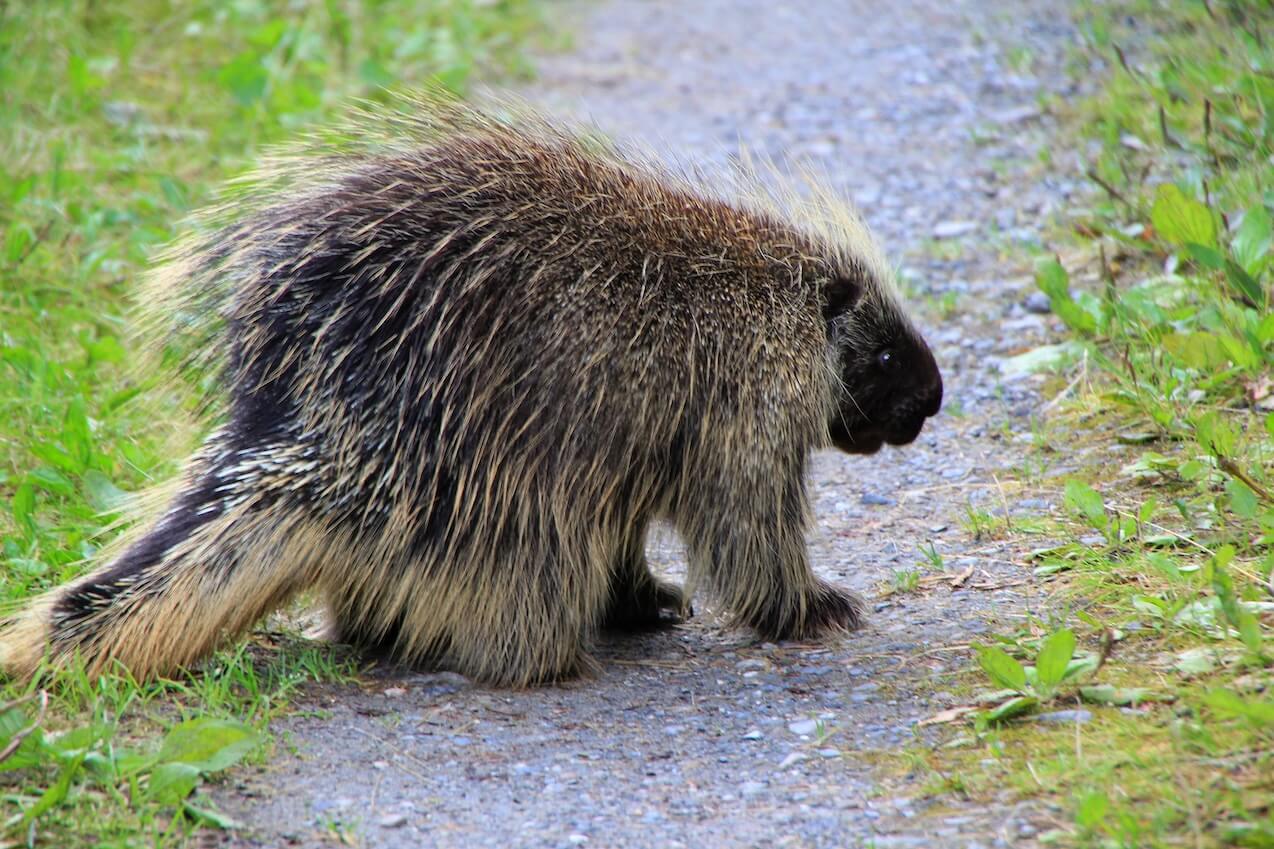
The centuries-old story that a porcupine flings quills like arrows is simply false, and it matters because it distorts how people behave around one. The Pennsylvania Game Commission is direct: porcupines cannot throw their quills, but because the quills are loosely attached they dislodge easily on contact and stick in a victim's flesh. Transfer requires touch. Mass Audubon suggests the myth may have come from people watching a porcupine moult and shake loose quills free, and it is true that a swung tail can shed a few — but nothing is aimed and nothing crosses a gap. If you keep any distance at all, you cannot be quilled. [1][2]
- No quill is ever propelled at a target
- Quills transfer on contact, because they are only loosely anchored
- A swinging tail may shed loose quills; that is moulting, not shooting
- Distance is complete protection — the whole hazard is contact
The ladder, and why it exists
A porcupine is a slow, solitary rodent that would rather leave than fight, and every rung of its defence is an attempt to avoid using the quills at all. The sequence the Game Commission describes runs in order: it tries to escape first; then it tucks its head under something or against its chest, erects its quills, and turns its back on you; then it flails its muscular tail; and it may back toward an adversary while chattering its teeth. Read as a ladder, that is unusually generous signalling. Nothing on it is bluffing for effect — each rung is a request, and the animal only reaches the last one when the first three have failed. [1]
- Level 0 — foraging, climbing, ambling: no threat detected, keep well back
- Level 1 — quills erect, head tucked, back turned: stop moving, do not approach
- Level 2 — teeth chattering, tail flailing: back away slowly and restrain any dog
- Level 3 — reversing toward you, tail lashing: retreat now and put something between you
- The escape attempt comes before all of it — a porcupine leaving is the commonest outcome
Level 1: the quills go up and the face goes away
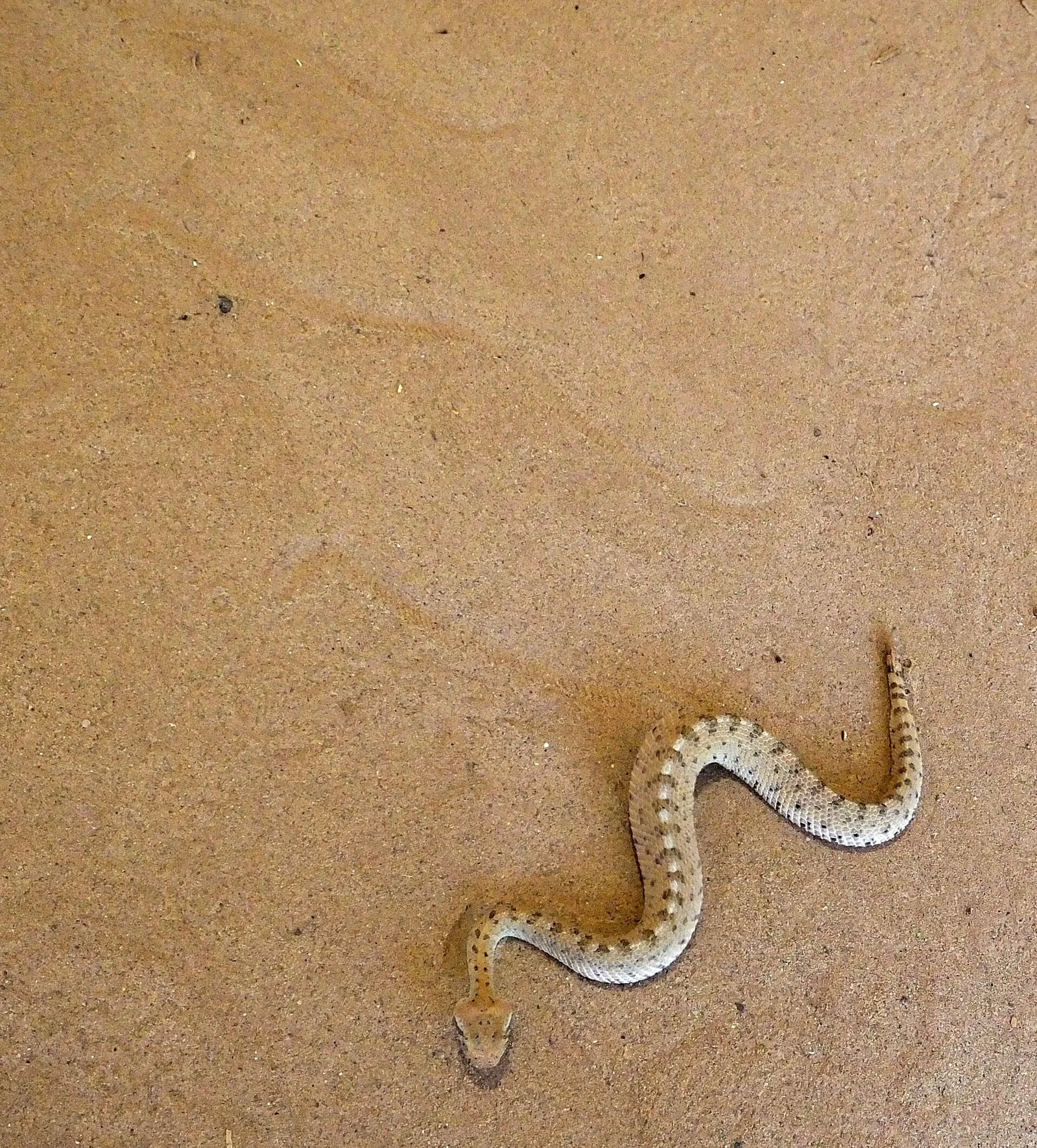
The first visible rung is postural, and it is easy to misread as the animal simply being spiky. Quills that were lying flat are raised, the body appears far bulkier than it did a moment earlier, and — the detail worth learning — the porcupine hides its face. It tucks its head beneath an object or against its own chest and presents its back to you, because the muzzle, legs, and underbelly carry no quills and are the only places it can be hurt. A porcupine showing you its back is not ignoring you. It has already classified you as a threat and arranged its armour accordingly. [1][2]
- Raised quills make the animal look roughly twice its actual size
- The head tucks away because the face and belly are unarmoured
- A turned back is a defensive posture, not indifference
- Correct response: stop where you are, then withdraw the way you came
Level 2: the sound you will hear before you see anything
The second rung is audible, and on a wooded trail it often arrives before you have spotted the animal at all. A porcupine backing toward an adversary chatters its teeth — a rapid, dry clicking that carries, and that has no other obvious source in a quiet wood. Paired with it is the tail: muscular, densely quilled, and flailed hard enough to be heard moving through vegetation. If you hear clicking you cannot place, stop and look low — around tree bases, in shrubs, and up the trunk itself, since these are capable climbers and the animal may be above you rather than in front. [1]
- Teeth chattering is a rapid dry clicking with no natural lookalike in quiet woodland
- The tail is flailed as a warning before it is used as a weapon
- Look low and also up — porcupines climb, and may be over your head
- This is the rung at which a dog must already be under physical control
Level 3: it comes at you backwards
The last rung is the one people find hardest to anticipate, because it runs the wrong way. Having turned its back, the porcupine advances in reverse or sideways toward the threat, driving its tail into whatever is behind it. Every design choice makes sense once you see it: the face stays protected, the quill-dense tail leads, and the animal never has to expose anything soft. It is not fast and it cannot pursue you far, so retreating solves the problem completely — but standing your ground to watch, or reaching in to move the animal off a path, puts you exactly where the tail is going. [1][2]
- The charge is backwards or sideways, never head-on
- The tail leads because it carries the densest quills
- Porcupines are slow — withdrawing on foot always works
- Never try to move a porcupine off a trail or a driveway yourself
What a quill does once it is in
The injury is not a puncture that heals; it is an object that travels. A quill tip carries hundreds of minute, overlapping, diamond-shaped scales that slant backward, and the Game Commission describes what follows plainly: the victim's own muscle-fibre movement engages those scale tips and draws the quill inward, up to an inch a day. Veterinary guidance describes the same mechanism as fishhook barbs that keep the quill moving deeper. That is why time matters so much, and why a quill left in place is a worsening problem rather than a stable one — and why the sensible-looking response of trimming the shaft is the wrong one. [1][3]
- Hundreds of backward-slanting scales per quill tip, acting as barbs
- Muscle movement drives the quill inward at up to an inch a day
- Deep migration can reach joints and internal organs
- Cutting the shaft makes the quill splinter and harder to remove — never trim them
Why it is nearly always the dog
Every rung of the ladder is aimed at an animal that can reason about consequences, and a dog driving into cover at dusk is not that animal. It will not stop for raised quills, it will not interpret teeth chattering, and a tail whack tends to provoke a second lunge rather than a retreat — which is how a dog ends up quilled in the muzzle, tongue, and paws rather than the flank. Prevention is almost entirely mechanical: a lead in wooded country at dawn and dusk, when porcupines are active, and a recall you actually trust. Dogs that have been quilled once are notoriously willing to do it again. [3]
If your dog is quilled
Go to a vet, and go now. Do not pull quills at home: removal without deep sedation or general anaesthesia is extremely painful, a struggling dog drives the quills deeper, and even a calm dog may bite from the pain. Do not cut or trim the shafts. Delay is the thing that turns an unpleasant evening into surgery, because the longer quills stay embedded the deeper they travel and the more brittle they become. Expect the vet to sedate, and expect honesty that they may not find every quill — some are already too deep, which is another argument for the same-day visit rather than a wait-and-see. [3]
- Straight to a veterinary practice, same day, even for a handful of quills
- No home removal — deep sedation or general anaesthesia is required
- Do not cut the shafts; it causes splintering and lodged fragments
- Quills grow more brittle and travel deeper the longer they are left
- Accept that not every quill may be recoverable; that is normal
Get Fauna and identify it in the field.
Where this guide comes from
Source-checked editorial guide. Last updated . This guide teaches identification and field skills; it is not a substitute for expert verification when it matters.