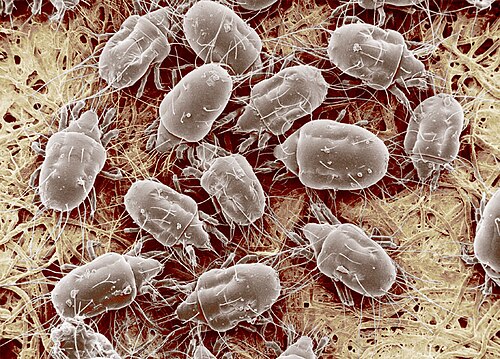
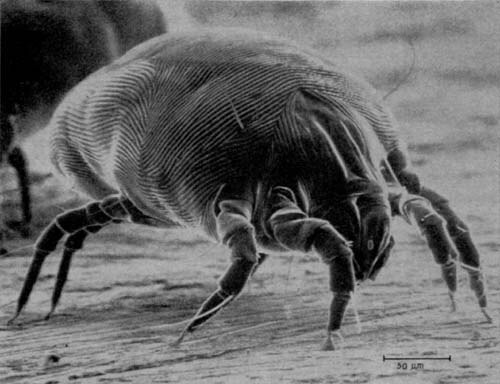
American house dust mites thrive deep inside household fabrics, mattresses, carpets, and upholstered furniture where ambient warmth and moisture concentrate. They rely entirely on atmospheric humidity to stay hydrated, absorbing ambient moisture through specialized supracoxal glands above their legs. Microscopic fecal pellets and decomposed body fragments drift into household air currents, serving as primary triggers for human indoor allergies worldwide.
MicroscopicSynanthropicIndoor
—observations
—countries
—peak records
Not EvaluatedConservation statusIUCN Red List categoriesLCNTVUENCREWEXNot Evaluated — not placed on the risk ladderRed List categories, explained →
Key facts
Diet & preyDesquamated human skin flakes, Indoor fungal spores, Pet dander
HabitatsIndoor human dwellings, mattresses, pillows, and carpet fibers
Life span60–100 days
Classification
FamilyPyroglyphidae
SpeciesDermatophagoides farinae
Range & activity
Range data is not available yet.
Safe observation
Interaction riskLow
Low
Moderate
High
Very high
Why interaction risk is low
Produces potent respiratory and contact allergens in fecal pellets; reduce exposure via frequent laundering and dehumidification.
Why it is dangerous
Excretes digestive enzymes such as Der f 1 and Der f 2 that trigger allergic rhinitis, asthma flare-ups, and atopic dermatitis in sensitized individuals.
How to recognize a risky encounter
Invisible to the naked eye; suspected when respiratory allergy symptoms worsen around undisturbed mattresses or dusty carpets.
What to do
Do not attempt physical handling; vacuum carpets with HEPA filtration and wash bedding in hot water.
Responsible observation
Humidity control: Maintain indoor relative humidity below 50 percent to disrupt their survival and breeding cycle.
Barrier covers: Encase mattresses and pillows with tightly woven, allergen-impermeable fabric covers.
Hot laundering: Wash bedding weekly in hot water above 55 degrees Celsius to eliminate live mites and denature allergens.